Decoding the Symbolic Architecture of The Unconscious Mind
Author: Andrew T. Austin
Andrew T. Austin is the developer of "Integral Eye Movement Therapy (IEMT)" and "Metaphors of Movement". He is an author, therapist and trainer who speaks on a variety of topics related to emotional and mental health. Andrew T. Austin is a well-known critic of the mental health and personal development "industries" and openly criticizes the cult of personality and the high-status games that are so prevalent amongst these so-called "experts". Needless to say, they don't much like him. #NLP #metaphor #archetypes
Working with Aphantasia in Metaphors of Movement by Masha Bennett
One of the common assumptions in therapeutic metaphor work is that people can, in some way, access internal imagery: to visualise, to see things “in their mind’s eye”. Even when this imagery is vague, blurry or fleeting (as my own typically is), it is often treated as the primary medium through which metaphor unfolds and can be explored.
However, this assumption does not always hold. Occasionally, we may encounter people affected by severe forms of aphantasia: not simply someone who reports some level of difficulty with visualising, but someone who cannot access internal imagery at all.
Whilst the prevalence of aphantasia in the general population is estimated to be around 4%, this includes cases of the so-called “visual imagery weakness” (e.g. affected individuals may still be able to see some dim or vague images); however, the extreme form of aphantasia is thought to only affect 0.8% of the population, in whom imagery is altogether absent (Dance et al., 2022).
This raises an interesting and important question for Metaphors of Movement: what happens when the visual inner landscape is not available, e.g. as in cases of severe aphantasia?
R., one of the participants of my recent Metaphors of Movement training, had reservations about joining the course, as she could not access any inner imagery whatsoever.
However, we found that she was still able to engage meaningfully in the training and successfully work with her own metaphors and those of others through a series of practical adaptations. R. has kindly given me permission to share these findings with the wider Metaphors of Movement community.
What emerged was not a limitation of the model, but rather a demonstration of its flexibility when grounded in embodiment.
When working on her own metaphor, in the absence of visual elements R. was able to rely on her felt sense; she physically adopted the body position that corresponded to her posture within the metaphor, allowing the experience to emerge through the body rather than through imagery.
R. also found that she needed to draw her own metaphor. Drawings produced by other participants when they played the role of a therapist during practical exercises often did not resonate, and it was difficult for her to make suggestions on how these should be corrected.
When movement was involved in working with the metaphor, R. enacted it physically, for example by taking steps, sitting down, standing up. I often give my students a choice whether to do this, instead of simply visualising movement, and some find it helpful, but on this occasion, it appeared necessary, not optional.
“In effect, the metaphor was not “seen” internally but instead felt and constructed through action, orientation, and interaction with the physical environment.”
When in the role of a therapist, eliciting metaphors and guiding others through this work, a different set of adaptations became necessary for R. She found that she needed to write down the client’s description of the metaphor landscape before attempting to draw it; that is, details such as what was to the left, right, in front, or behind had to be explicitly recorded and organised first. She was then able to produce a drawing based on the written description.
This suggests that, in the absence of internal imagery, spatial cognition may be supported through language and structured external representation.
R.’s experience highlights something fundamental about metaphor work: imagery is not the mechanism; it is just one possible interface. The underlying processes appear to be grounded in embodiment, spatial orientation, relational positioning, and movement.
If someone reports difficulty visualising, it may not be a barrier to effective work. Instead, it invites flexibility in approach. This might include encouraging physical enactment of metaphor, working explicitly with spatial language, and inviting the individual to feel rather than see the metaphor.
Where imagery is absent, the metaphor may still exist and can be effectively explored and utilised in the context of the Metaphors of Movement model. For R., most of the components of this work, including idiomisation, testing out the real-world coping strategy (“Strange Road”), taking steps, and so on, turned out to be just as relevant and significant as they were to those participants who could see clear images in their mind’s eye.
I would love to hear from any Metaphors of Movement practitioners or trainees who are aphantasic themselves or work with clients who cannot access imagery, and to learn about any adjustments to the model that you have found useful in such cases.
Meteor: Etymology, Semantic Drift, and the Metaphors of Sudden Motion
Abstract
“What goes up, must come down.”
The word meteor occupies a distinctive position at the intersection of cosmology, philosophy, and metaphor. While commonly understood today as a fiery object streaking across the night sky, meteor originally referred to anything suspended in the air, a meaning far broader and more abstract than its modern usage. This page traces the etymology of meteor from Ancient Greek through medieval natural philosophy to contemporary English, mapping its derivative forms (meteoric, meteorology, meteoroid) and the idiomatic expressions that encode its metaphorical force. Particular attention is paid to how meteor functions within a Metaphors of Movement framework: signifying sudden appearance, rapid ascent, transience, and uncontrolled descent.
In idiomatic expressions, meteors initially rise.
Greek Origins: meteōros (“Lifted Up, Suspended”)
The English word meteor derives from the Ancient Greek adjective μετέωρος (meteōros), meaning:
raised up
lofty
suspended in mid-air
aloft, unsettled
Crucially, meteōros does not originally imply fire, rock, or space. It denotes a state of suspension between realms, neither grounded nor celestial. The term is composed of:
μετά (meta): between, among, beyond
ἀείρω (aeírō): to lift, raise up
Etymologically, meteōros signifies “that which is raised up between,” a formulation that later proves highly fertile for metaphorical interpretation involving instability, impermanence, and dramatic transition.
Classical Philosophy: The Meteor as a Middle-Realm Phenomenon
In classical Greek philosophy, particularly in Aristotelian natural science, meteōra referred to all phenomena occurring between the earth and the fixed heavens. In his treatise Meteorologica, Aristotle examined clouds, rain, wind, lightning, comets, atmospheric fires, and falling stones.
These phenomena belonged to the sub-lunary realm: the mutable, unstable region beneath the Moon, in contrast to the perfect and eternal heavens beyond it. A “meteor” was therefore not a discrete object but a process in motion, often transient, unpredictable, and difficult to categorise.
This framing is central to later metaphorical uses: meteors are things that appear suddenly, move dramatically, and disappear without permanence.
Latin and Medieval Transmission
The Greek term entered Latin as meteorum and meteora, retaining its broad meaning of aerial or atmospheric phenomena. Medieval scholastic texts, still grounded in Aristotelian cosmology, used the term “meteor” to denote lightning, halos, comets, falling stars, and unusual celestial phenomena.
Only with the decline of Aristotelian physics during the early modern period did the term begin to narrow in meaning.
Scientific Narrowing: From Atmosphere to Space Object
By the eighteenth and nineteenth centuries, meteor acquired its modern technical sense:
meteor: the visible streak of light caused by an object burning in the atmosphere
meteoroid: the object while still in space
meteorite: the fragment that reaches the ground
From a metaphorical perspective, this narrowing is historically late and conceptually reductive. Linguistically, it obscures the word’s original emphasis on suspension, instability, and transition.
Derivative Forms and Semantic Fields
Meteoric
The adjective meteoric preserves much of the metaphorical power lost by the noun meteor. Its dominant connotations include:
suddenness
rapidity
spectacle
brevity
instability
Common examples include “a meteoric rise to fame” or “a meteoric career.” Within a Metaphors of Movement framework, meteoric implies high upward velocity without structural support, often carrying an implicit expectation of collapse or disappearance.
Meteorology
Despite popular misunderstanding, meteorology does not originally mean the study of space objects. It literally refers to the study of things suspended in the air, preserving the older Greek sense of meteōra.
Meteorite
The meteorite represents semantic closure: that which was once suspended but has fallen and become grounded. Conceptually, it is the failure of suspension.
The word meteorite comes from Greek roots: meteoron (“thing high up”) and the suffix -ite, meaning it’s a rock from the sky, specifically the stony remnant of a meteor (shooting star) that falls to Earth. While meteor originally denoted any atmospheric phenomenon, meteorite emerged in the 19th century to refer to space rocks that hit Earth, derived from the meteor process (meteor + -ite).
The suffix “-ite” has several meanings, most commonly denoting a person from a place or follower of a belief (like Israelite, Thatcherite), a mineral or fossil (like granite, ammonite), or a chemical compound/product (like sulfite, dynamite), often originating from Greek or Latin roots related to “stone” or “belonging to”. It can also signify a segment of a body part (like somite) or a type of salt from an “-ous” acid (like phosphite).
Idioms and Fixed Expressions
English idioms involving meteors are remarkably consistent in their movement logic:
a meteoric rise: rapid ascent with minimal preparation
to rise like a meteor: sudden visibility and dramatic entry
burn bright and fade: brilliance without duration
Principally, the unspoken suggestion is that it’s an earth rock falling back down.
Metaphors of Movement Analysis
Within a Metaphors of Movement model, meteor belongs to a distinctive cluster characterised by:
upward then downward motion
extreme speed
lack of control
high visibility
short duration
This makes the meteor metaphor particularly useful for describing careers, social influence, fame, emotional surges, ideologies, and trends. A meteoric trajectory is movement without containment.
Psychological and Cultural Resonance
Meteor metaphors persist because they encode a cultural ambivalence: awe at rapid ascent paired with anxiety about impermanence. In psychological and narrative contexts, meteoric movement often signals externally driven validation, fragile self-structure, and unsustainable pacing. This is something heavily promoted by predatory gurus in the personal development/personal success/financial freedom industry.
The warning implicit in the metaphor is not against success, but against velocity that exceeds integration.
Not everything that rises is ready to remain aloft. As idiot life coaches like to say, “shoot for the stars, if you miss, you will land on the moon.” They present this as a positive.
Etymology: From the Latin root iacere (to throw), evolving through jectus (“thrown”).
This family of words has produced a network of meanings in English, all centred around the metaphor of throwing, whether of objects, thoughts, emotions, or actions.
Understanding the Root
The root -ject conveys the core idea of throwing or casting. Each prefix modifies the direction or intent of the action; for example, inject (throw in), reject (throw back), and project (throw forward).
List of -ject Words and Meanings
Word
Prefix Origin
Literal Meaning
Modern Usage
Abject
ab- = away
Thrown away
Wretched, degraded, miserable
Adjective
ad- = to
Thrown to (a noun)
A word that modifies a noun
Conjecture
con- = together
Thrown together
An inference or educated guess
Deject
de- = down
Thrown down
To make low in spirit
Eject
e-/ex- = out
Thrown out
To expel or remove
Inject
in- = into
Thrown into
To introduce (a substance or idea)
Interject
inter- = between
Thrown between
To interrupt with a remark
Object
ob- = against
Thrown against
To oppose; or a thing perceived
Project
pro- = forward
Thrown forward
To plan, predict, or extend outward
Reject
re- = back
Thrown back
To refuse, discard, or disapprove
Subject
sub- = under
Thrown under
Under authority; a topic of discussion
Trajectory
tra-/trans- = across
Thrown across
The path of a moving object
Retroject
retro- = backwards
Thrown back (in time)
To attribute something to the past
Disject
dis- = apart
Thrown apart
To scatter or disperse
Superject
super- = above
Thrown above
Philosophical term (A.N. Whitehead): a transcendent being
Derived Forms
-jection → The act of throwing (e.g. ejection, rejection, projection).
-jective → Having the quality of throwing (e.g. subjective, projective).
-jecture → The process of mental “throwing together” (e.g. conjecture).
Metaphorical Insights
In Metaphors of Movement, language built around -ject reflects embodied metaphors of direction and agency:
“Thrown down” states (dejection, abjection) depict loss of power and position.
“Thrown forward” (projection) shows aspiration, intent, and creation.
“Thrown against” (objection) expresses confrontation or boundary.
“Thrown together” (conjecture) marks synthesis and meaning-making.
These linguistic patterns mirror how people describe internal states, ambitions, and struggles, making the -ject family especially relevant in metaphor analysis and therapeutic dialogue.
Summary Table of Symbolic Directions
Direction
Prefix
Example
Symbolic Interpretation
Down
de-, ab-
deject, abject
Suppression, shame, defeat
Out
e-, ex-
eject
Expulsion, rejection, exclusion
Forward
pro-
project
Ambition, creativity, goal-setting
Against
ob-
object
Resistance, defence, confrontation
Into
in-
inject
Introduction, penetration, influence
Under
sub-
subject
Submission, governance, hierarchy
Together
con-
conjecture
Integration, synthesis, guessing
Across
tra-/trans-
trajectory
Movement, progress, destiny
References
Harper, D. (2024). Online Etymology Dictionary.
Oxford English Dictionary, entries for -ject and related prefixes.
Whitehead, A.N. (1929). Process and Reality, introduction of the term superject.
Primary Metaphors: Embodied Co-Occurrence and Recurring Mappings
Primary metaphors are conventional mappings that arise from everyday embodied co-occurrences between sensorimotor experiences and more abstract subjective experiences. Rather than being arbitrary figures of speech, they are learned automatically through repeated correlation in infancy and early childhood (e.g., being held by a caregiver is both warm and affectionate), yielding entrenched cross-domain mappings such as AFFECTION IS WARMTH. These mappings subsequently structure linguistic expressions, conceptual inferences, and patterns of attention in adult cognition.
Origins and Core Idea
The concept of primary metaphors originates within cognitive linguistics, particularly from the work of George Lakoff, Mark Johnson, and Joseph Grady. While Conceptual Metaphor Theory (Lakoff & Johnson, 1980) established that metaphor is foundational to thought, primary metaphor theory (Grady, 1997) refines this by proposing that many complex metaphors are composed from simpler, experientially grounded mappings learned via correlation (not mere resemblance). These correlations are products of everyday bodily interactions with the world.
Mechanism: From Co-Occurrence to Mapping
Embodied co-activation: A child experiences two domains together, for example physical warmth and affectionate touch.
Conventionalization: The association stabilises as a mapping (A → B) that guides language and inference.
Composition: Multiple primary metaphors combine into more complex metaphoric networks (e.g., INTIMACY IS CLOSENESS + AFFECTION IS WARMTH → rich descriptions of relationships).
Canonical Examples
AFFECTION IS WARMTH: “a warm welcome,” “cold person,” “heated embrace.”
MORE IS UP , “prices went up,” “turn the volume down.”
GOOD IS UP / BAD IS DOWN , “spirits lifted,” “feeling down.”
INTIMACY IS CLOSENESS , “we’re very close,” “they’ve grown apart.”
DIFFICULTIES ARE BURDENS , “carry a heavy load,” “lighten your burden.”
IMPORTANCE IS WEIGHT , “a weighty matter,” “light reading.”
Evidence and Methods
Linguistic evidence appears in cross-linguistic corpora where similar expressions recur systematically (e.g., verticality terms for quantity or affect). Behavioural and priming studies suggest bidirectional influences (e.g., holding a warm drink can increase judgments of interpersonal warmth). Developmental accounts emphasise early caregiver-infant interactions (temperature, proximity, balance, force dynamics) as sources of tightly coupled experiences that scaffold abstract reasoning.
Primary vs. Complex Metaphors
Primary metaphors are atomic mappings (e.g., WARMTH → AFFECTION). Complex metaphors (e.g., LOVE IS A JOURNEY) are built by composing several primary metaphors (e.g., RELATIONSHIP PROGRESS IS MOTION, PURPOSES ARE DESTINATIONS, DIFFICULTIES ARE OBSTACLES). Recognising this compositionality helps analysts and practitioners diagnose which embodied schemas are doing the explanatory work in discourse, and how shifting the base mapping can reorganise inferences.
Cross-Linguistic and Cultural Considerations
Many primary metaphors show wide cross-linguistic distribution (e.g., MORE IS UP, GOOD IS UP) due to shared bodily experiences and the physical structure of environments. Nonetheless, variability does occur, shaped by local ecology, cultural practices, and lexicalisation patterns (e.g., temperature terms, spatial frames of reference). Primary metaphor theory predicts both convergence (resulting from universal co-occurrences) and divergence (resulting from cultural niche construction).
Implications for Analysis and Practice
Discourse and rhetoric: Identify which primary mappings are active and how they steer evaluation and policy (e.g., “crime surge” invokes MORE IS UP and FORCES ARE FLUIDS).
Education and science communication: Choose primary-aligned metaphors that scaffold novices without misleading (e.g., energy “flow” vs. conservation).
Therapy and coaching: Elicit clients’ metaphors and trace them to primary mappings (burdens, distances, heights, temperatures). Adjust the base mapping to shift felt sense and options for action.
Design and UX: Leverage embodied schemas (up/down, near/far, balance, containment) to enhance intuitiveness.
Critiques and Limitations
Universality claims: Some argue that “universals” can be overstated; careful cross-cultural work is required.
Directionality: Not all mappings are equally entrenched or unidirectional; context can reverse or neutralise effects.
Over-extension: Explanations risk circularity if not constrained by independent behavioural or developmental evidence.
Primary metaphors explain how abstract thought is scaffolded by bodily experience. Through repeated co-occurrences in early life, simple, domain-crossing mappings become conventional and productive, structuring language, inference, and social judgment. Understanding these mappings clarifies why certain metaphors feel intuitive, how they can be recombined into complex conceptual systems, and how shifting the underlying embodied schema can reshape meaning and action.
References
Grady, J. (1997). Foundations of Meaning: Primary Metaphors and Primary Scenes. PhD dissertation, UC Berkeley.
Lakoff, G., & Johnson, M. (1980). Metaphors We Live By. University of Chicago Press.
Núñez, R., & Sweetser, E. (2006). With the future behind them: Evidence from Aymara. Cognitive Science, 30(3), 401-450.
Williams, L. E., & Bargh, J. A. (2008). Experiencing physical warmth promotes interpersonal warmth. Science, 322(5901), 606-607.
Max Black’s Interaction Model of Metaphor: Mapping Systems and Emergent Meaning
Max Black’s work transformed twentieth-century metaphor theory by arguing that metaphors do not merely substitute one term for another, nor simply compare two pre-existing entities. Rather, a metaphor functions through an interaction between two systems of implications, what earlier theorists (for example, I. A. Richards) would call the vehicle and the tenor. In Black’s account, the vehicle brings a structured network of associated ideas (its “system”) that selectively filters and re-describes the tenor, producing emergent meaning that was not present in either term alone.
Focus, Frame, and the System of Implications
Black distinguishes between the focus (the conspicuously metaphorical expression) and the frame (the surrounding literal context in which the expression appears). The vehicle’s “associated commonplaces”, culturally shared and inferentially connected attributes, are projected onto the tenor via the focus/frame configuration. This projection is not a one-way imposition but a mutually shaping interaction: the tenor constrains which vehicle-implications are relevant, while the vehicle organises our attention to (and re-descriptions of) the tenor’s features.
Interaction as Mapping Between Systems
In contemporary terms, Black’s model anticipates a view of metaphor as mapping between structured domains. The vehicle supplies a source system of implications; the tenor provides a target system with its own attributes. Through interaction, selected implications from the source are mapped onto the target, yielding a new pattern of predicates for the tenor. For instance, in “Time is a river,” the vehicle (river) contributes implications of flow, directionality, and irreversibility, which reframe the tenor (time) and generate new inferences (e.g., “we cannot step into the same river twice” → non-repeatability of moments).
Emergence, Not Substitution
Crucially, Black rejects substitution (metaphor as ornament or shorthand) and comparison (metaphor as explicit likeness) theories in favour of interaction. The result is emergent, meaning that predicates and perspectives are not merely retrieved from a lexicon but are produced by the dynamic interplay between systems. This helps explain why metaphors can be cognitively productive, theory-generating, and even explanatory in science (e.g., “genes as codes,” “the brain as a computer,” “the immune system as an army”).
Relation to Richards and Later Developments
Black builds directly on Richards’ (1936) tenor-vehicle distinction but formalises it in terms of systems and associated commonplaces, making the interaction more explicit and theory-laden. His account also foreshadows later Conceptual Metaphor Theory (Lakoff & Johnson, 1980), which generalises the idea of cross-domain mappings and emphasises embodiment. Where Black focuses on semantic and cultural implication-systems, later work elaborates the cognitive architecture (e.g., source-target domain mappings, image schemas, and primary metaphors).
Implications for Analysis and Practice
Critical analysis: Identify the vehicle’s commonplace implications and show how they select features of the tenor. Ask: which traits are being imported, which are suppressed, and to what rhetorical effect?
Therapeutic work: Elicit the client’s vehicle system (the images they use) and examine how those implications are structuring the client’s understanding of the tenor (self, problem, relationship). Changing the vehicle changes the system of implications, thus inviting new meanings.
Scientific discourse: Track how metaphor vehicles (“field,” “network,” “ecosystem”) encourage specific inferential patterns and research heuristics, while potentially hiding alternatives.
Max Black reconceived metaphor as an engine of semantic innovation. By treating both sides of the metaphor as structured systems and emphasising their interaction, he accounted for how metaphors reorganise what we notice, the predicates we ascribe, and the inferences we make. This model remains central to contemporary work in linguistics, philosophy of language, rhetoric, and applied fields, ranging from psychotherapy to science communication.
References
Black, M. (1954-55). Metaphor. Proceedings of the Aristotelian Society, 55, 273-294.
Black, M. (1962). Models and Metaphors: Studies in Language and Philosophy. Cornell University Press.
Richards, I. A. (1936). The Philosophy of Rhetoric. Oxford University Press.
Lakoff, G., & Johnson, M. (1980). Metaphors We Live By. University of Chicago Press.
In the study of metaphor, one of the foundational contributions came from I. A. Richards (1936) in his work The Philosophy of Rhetoric.
Richards moved metaphor theory beyond ornamentation and decoration (as emphasised in classical rhetoric) and proposed a dynamic view in which metaphors are understood as an interaction between two components: the tenor and the vehicle.
Defining Tenor and Vehicle
Richards defined the tenor as the underlying subject or concept that the metaphor seeks to illuminate, while the vehicle is the image or idea through which the tenor is expressed. In the metaphor “time is a thief,” the tenor is time, and the vehicle is thief. The metaphor draws its meaning from the interplay between these two elements.
“In every metaphor there are two thoughts of different things active together and supported by a single word, or phrase, whose meaning is a resultant of their interaction.” I. A. Richards, The Philosophy of Rhetoric (1936)
The Tension Between Tenor and Vehicle
The power of a metaphor lies not in the direct substitution of one word for another, but in the tension or interaction between the tenor and the vehicle. The reader or listener must negotiate the similarities and differences between the two domains, discovering new meaning through their juxtaposition.
This tension resists full resolution: the metaphor is not a literal equivalence but a productive gap that stimulates new ways of understanding. For example, describing time as a thief suggests loss, stealth, and irreversibility, while simultaneously acknowledging that time is not a literal criminal agent. The tension compels the audience to explore the metaphor’s implications, generating layered and often novel insights.
Significance in Metaphor Theory
Richards’ Interaction Theory marked a turning point in metaphor scholarship. Instead of viewing metaphor as ornamental language (as Aristotle had argued), Richards highlighted its cognitive and semantic productivity.
This view paved the way for later developments, including Max Black’s elaboration of the interaction theory in the mid-20th century and, eventually, the Conceptual Metaphor Theory of Lakoff and Johnson (1980).
Applications Beyond Literature
The tenor-vehicle framework is still applied in modern disciplines such as linguistics, discourse analysis, and psychotherapy. For instance, in therapeutic contexts, metaphors often emerge spontaneously from clients: the tenor might be their experience of depression, while the vehicle could be a metaphor like “a heavy weight” or “a dark cloud.”
The therapist works with the tension between these elements to uncover implicit meanings, identity structures, or coping mechanisms.
Richards’ Interaction Theory reframed metaphor as a process of negotiation between subject and image, opening the door for richer accounts of how metaphors function in thought and language. The tension between tenor and vehicle is not a flaw but the very mechanism by which metaphors stimulate interpretation, creativity, and new understanding.
References
Richards, I. A. (1936). The Philosophy of Rhetoric. Oxford University Press.
Black, M. (1962). Models and Metaphors: Studies in Language and Philosophy. Cornell University Press.
Lakoff, G., & Johnson, M. (1980). Metaphors We Live By. University of Chicago Press.
In psychology and social dynamics, metaphors like pedestals, pillars, and columns often hold deeper meanings that influence our understanding of social anxiety and personal expectations. This article delves into these metaphors, exploring how they contribute to an individual’s experience of anxiety, status, and interpersonal relationships. Drawing from a recent video lecture, we will unpack the significance of these metaphors and their impact on both personal and social levels.
The Metaphor of Pedestals and Pillars
Pedestals and pillars, when used metaphorically, symbolise the elevated positions that others place individuals in. These positions often come with high expectations and significant pressure, leading to feelings of vulnerability and social anxiety. The metaphor of being “on a pedestal” suggests that any misstep could result in a fall, thus immobilising the individual and intensifying their anxiety.
Individuals placed on pedestals may appear aloof or disconnected in social contexts, further exacerbating their isolation. This metaphor is not merely a linguistic tool but reflects a psychological state where the individual feels trapped by the expectations placed upon them.
Social Dynamics and Expectations
The dynamics of pedestals and pillars are evident in various romantic, professional, and familial relationships. When someone is elevated in status, whether in the workplace or a personal relationship, and a status differential is created. This differential often forces the person on the pedestal to meet unrealistic expectations, leading to inevitable disappointment and strained relationships.
For example, in a professional setting, an individual brought in as an expert or a “wiz kid” may face resentment from colleagues, especially if they fail to live up to the hype. This creates a tense environment where the individual is judged not on their merits but on the elevated expectations set by others.
The Role of Childhood and Upbringing
Childhood experiences are crucial in how these metaphors affect individuals later in life. Children placed on pedestals by their parents are often burdened with the pressure to achieve greatness, leading to heightened anxiety and social stress as they grow older. These individuals, having been conditioned to meet high expectations, may struggle with feelings of inadequacy despite their achievements.
The metaphorical pedestal in childhood can lead to a lifetime of anxiety, where the individual constantly seeks validation and support, unable to find solid ground due to the elevated expectations that have been ingrained in them.
The Link Between Status and Anxiety
A key argument presented in the video is that all forms of anxiety, particularly social anxiety, have a status component. The speaker asserts that anxiety often stems from a perceived elevation in status, where the individual feels pressured to meet the expectations associated with their elevated position. This is particularly evident in social settings, where the fear of being judged or failing to perform can lead to significant anxiety.
The speaker challenges the notion that anxiety can exist without a status component, emphasising that status and anxiety are inherently linked.
Architectural Metaphors and Their Psychological Impact
The video also explores the architectural significance of columns, particularly the Ionic, Doric, and Corinthian orders. These columns, deeply rooted in cultural and architectural heritage, symbolise various qualities such as wisdom, strength, and beauty. The speaker uses these architectural metaphors to draw parallels with the psychological states of individuals who feel they are standing on these metaphorical pillars.
For instance, an Ionic column, often associated with wisdom, may symbolise the unrealistic expectations placed on someone to always make wise decisions, leading to anxiety and fear of failure.
The metaphors of pedestals, pillars, and columns are not just linguistic constructs but are deeply embedded in our psychological and social frameworks. These metaphors influence how individuals perceive themselves and interact with others, particularly concerning social anxiety and personal expectations. Understanding these metaphors can provide valuable insights into the nature of anxiety and help individuals navigate the pressures of elevated expectations.
Those interested in exploring these concepts should consider attending relevant workshops or reading more about the psychological impact of metaphors on social dynamics. Understanding these metaphors can significantly influence your approach to personal and professional relationships, leading to a more balanced and less anxiety-driven life.
The Origins of Metaphors of Movement: An Interview with Andrew T. Austin
Andrew T. Austin, the creator of Metaphors of Movement and Integral Eye Movement Therapy (IEMT), recently shared insights into the development of his innovative therapeutic approach. Here are the key takeaways from the interview:
The Catalyst: Charles Faulkner
Austin credits Charles Faulkner as a significant catalyst for the development of Metaphors of Movement. After attending Faulkner’s presentations, Austin found himself “completely bamboozled” but intrigued, which sparked an inward journey of reflection.
A Convergence of Influences
The development of Metaphors of Movement was influenced by several factors:
Austin’s work with IEMT and identity work
Exposure to Clean Language techniques
Experience with challenging clients in mental health
A New Way of Listening
Austin began to hear people’s expressions differently, focusing on the literal meaning of idiomatic phrases rather than interpreting them. This shift allowed him to uncover the underlying structures in people’s representations of their experiences.
The Richness of Autogenic Metaphors
Austin emphasises the extraordinary data density found in autogenic metaphors, believing that we’ve only scratched the surface of their potential. He suggests that future practitioners may uncover even more applications and insights.
A Response to Traditional Therapeutic Models
Metaphors of Movement was developed partly as a response to the limitations Austin observed in traditional therapeutic approaches, including:
The need for clients to “play along” in hypnosis or NLP
The challenge of working with resistant or non-compliant clients
The disconnect between increasing numbers of therapists and declining global mental health
The Future of Metaphors of Movement
Austin views his work as an ongoing exploration, focused on codifying and teaching the skill set to others. He emphasises the importance of honesty in therapy and a realistic approach to expectations and outcomes.
For those interested in learning more about this unique therapeutic approach, both Andrew T. Austin and the interviewer offer training in Metaphors of Movement.
In this video, I have a conversation with Andrew T. Austin about human behaviour and psychology. We explore several interesting topics.
We discuss how people approach planning and problem-solving differently, using an example from my relationship. Andrew explains the concepts of feeding forward and feeding back in human responses.
We explore childhood experiences and their impact on adult behaviour, touching on topics such as parental anger and over-regulation. Andrew shares perspectives on how these experiences shape our emotional responses and coping mechanisms.
The conversation also covers self-awareness and the challenges of truly understanding our behaviours. We discuss baseline emotional states and how difficult they can be to recognise in ourselves.
Andrew offers perspectives on modern education and therapy approaches, questioning the trend towards pathologising normal behaviours.
Throughout the conversation, we reflect on the complexity of human behaviour and the importance of nuance in understanding ourselves and others.
It is a wide-ranging discussion that touches on psychology, personal development and social dynamics.
Key Topics
Proactive versus reactive behaviour in relationships
The intricacies of emotional responses and their origins
The impact of parenting styles on child development
The challenges of self-awareness and self-remembering
Critique of modern education and therapy approaches
The importance of intellectual curiosity and lifelong learning
Whether you are a psychology enthusiast, a mental health professional or simply curious about human behaviour, this conversation offers perspectives on understanding ourselves and others.
Roni Matar is based in Beirut, Lebanon. You can find his coaching and training website at www.ronimatar.com.
Timestamps
0:00 Introduction and discussion of time elements in metaphors
3:01 Proactive versus reactive planning
6:23 Blame versus shame
11:18 Self-awareness and baseline emotional states
16:41 Pathologising normal experiences
21:10 Nuclear family and community impact on mental health
27:43 Childhood experiences and their long-term effects
33:40 Feedback loops and memory
38:20 Complexity of human behaviour and limitations of diagnostic frames
43:18 Education system’s impact on intellectual curiosity
49:22 The challenge of self-awareness and insight
54:25 The importance of community in child-rearing
59:23 Intellectual laziness and the value of lifelong learning
The root word “-cede” comes from the Latin verb cedere, meaning “to go”, “to yield” or “to withdraw”. This root is found in various English words, many of which relate to movement, giving up control or making concessions.
English Words Derived from Cedere
Accede: To agree to a request or demand; to assume an office or position. The prefix “ac-” means “to” or “towards”.
Example: “She acceded to the company’s terms and accepted the job offer.”
Concede: To admit that something is valid after denying or resisting it; to yield or give up.
Example: “After a long debate, he finally conceded that he was wrong.”
Recede: To move back or further away from a previous position.
Example: “The floodwaters began to recede after the rain stopped.”
Secede: To withdraw formally from membership in a federal union, an alliance or a political or religious organisation.
Example: “The state decided to secede from the union.”
Intercede: To intervene on behalf of another.
Example: “She interceded in the dispute to help resolve the conflict.”
Precede: To come before something in time, order or position.
Example: “A formal dinner will precede the ceremony.”
These examples illustrate how the root “-cede” forms words that involve notions of movement, yielding or stepping away from a position.
What is the difference between Metaphors of Movement and Clean Language?
Metaphors of Movement, developed by Andrew T. Austin, and Clean Language, originated by David Grove and further developed by James Lawley and Penny Tompkins, are two approaches that work with metaphor in therapy, coaching and communication. Each model has its own philosophy and methodology. Below is a comparison highlighting their key differences.
1. Theoretical Foundations
Metaphors of Movement (MoM): Developed by Andrew T. Austin, this approach is built upon the understanding that the metaphors people use in their language can reflect their internal and often unconscious emotional landscapes. Austin’s work is influenced by cognitive linguistics and neuro-linguistic programming, focusing on how metaphorical language structures can keep people within particular behavioural and emotional patterns.
Clean Language (CL): Originated by David Grove and further developed by James Lawley and Penny Tompkins, Clean Language is a therapeutic technique that emphasises the client’s metaphors without introducing content or bias from the therapist. It is grounded in the view that these personal metaphors are closely aligned with the individual’s mental and physical experiences.
2. Methodology
MoM: This method involves identifying and exploring the client’s metaphorical descriptions of problems or challenges. For instance, if someone says they are “stuck”, Austin would explore this metaphor literally to uncover its emotional, behavioural and relational dynamics. The approach may also involve physical movement or enactment as part of the process.
CL: Clean Language uses a set of specific, open-ended questions to help clients explore their metaphors in depth. These questions minimise the therapist’s influence on the client’s responses. For example, if a client describes a problem as being “like a wall”, a Clean Language therapist might ask, “What kind of wall is that wall?” or “Is there anything else about that wall?”
3. Goals and Outcomes
MoM: The goal is to examine the logic and structure of the client’s autogenic metaphors and make the consequences of those patterns more apparent. This can support new choices, shifts in perspective and possible strategies for action.
CL: The aim is to develop a rich picture of the client’s metaphor landscape, enabling them to discover insights and solutions within their own words and symbolic representations. The process supports the client in becoming more aware of their thought patterns and behaviours, potentially leading to self-initiated change.
4. Applications
MoM: In addition to its therapeutic applications, Metaphors of Movement is used in coaching, conflict resolution and organisational change, where understanding and shifting responses to metaphors can influence attitude and approach.
CL: While primarily used in therapy, Clean Language also applies to coaching, management and education, helping individuals and groups clarify their thoughts and intentions, improve communication and enhance mutual understanding.
5. Interaction Style
MoM: MoM is often dynamic, utilises content-imposition and is sometimes challenging. It may invite clients to confront and physically enact aspects of their metaphors, making previously implicit patterns more apparent.
CL: Clean Language is generally more reflective and gentle, allowing the client to lead the exploration of their thoughts and metaphors at their own pace.
Metaphors of Movement and Clean Language offer distinct frameworks for understanding and working with the metaphorical language that shapes human thought, emotion and behaviour. Each has particular strengths and may be more or less suitable depending on the context and the client’s needs.
George Lakoff is a renowned figure in the realm of cognitive linguistics, a field that explores the intricate relationship between language and thought. Born in 1941, Lakoff’s academic journey saw him exploring diverse areas of linguistics, philosophy, and cognitive science. His work has significantly influenced our understanding of how language shapes thought and, conversely, how our cognitive processes influence language.
Lakoff’s theories, particularly those related to metaphors, have been groundbreaking. He posited that metaphors are not just linguistic expressions but are deeply rooted in our thought processes. They play an important role in how we perceive and interact with the world around us. One of his most influential works, co-authored with philosopher Mark Johnson, is Metaphors We Live By. In this seminal book, the duo explored how metaphors permeate our everyday language and thought, often in ways we don’t consciously recognise.
While Lakoff has explored various aspects of cognitive linguistics, this article focuses on his work related to ‘container metaphors’. These metaphors, as we will see in the subsequent chapters, have important implications for how we structure our understanding of spaces, entities, and relationships.
Understanding Metaphors
Metaphors are pervasive in our language and thought. At its core, a metaphor is a figure of speech where a word or phrase is applied to an object or action to which it is not literally applicable. However, beyond this basic definition, metaphors serve as powerful cognitive tools that shape our perception, reasoning, and communication.
The traditional view of metaphors was that they were mere decorative elements in language, embellishments used for poetic or rhetorical effect. However, Lakoff’s work challenged this notion, arguing that metaphors are fundamental to our thought processes. They are not just linguistic expressions but represent conceptual mappings from one domain (the source domain) to another (the target domain).
For instance, when we say ‘time is money’, we are mapping the concept of time (often intangible and abstract) onto the more concrete domain of money. This metaphor shapes our understanding of time, making us think of it as a limited resource that can be ‘spent’, ‘saved’, or ‘wasted’.
Lakoff’s exploration into metaphors revealed that they are deeply embedded in our everyday language. Phrases like ‘he’s on top of the situation’ or ‘she’s at the bottom of the hierarchy’ are metaphorical expressions that draw from spatial relationships to convey abstract concepts.
In the context of ‘container metaphors’, which will be the focus of the next chapter, we’ll see how spatial relationships and boundaries play a crucial role in our conceptualisation of various phenomena.
The Essence of Container Metaphors
Container metaphors are a subset of spatial metaphors that Lakoff has extensively studied. At their core, container metaphors conceptualise entities, whether abstract or concrete, as if they were contained within boundaries or limits. These metaphors are ubiquitous in our language and thought, often used to describe experiences, emotions, relationships, and even societal structures.
The basic structure of a container metaphor involves three elements: an interior, an exterior, and a boundary. For instance, when we say ‘I’m in love’, the emotion of love is conceptualised as a space that one can enter or exit. Similarly, phrases like ‘he’s out of danger’ or ‘she’s in a tight spot’ utilise the container metaphor to convey situations or states of being.
Lakoff’s interest in container metaphors stems from their important implications for cognitive science. They reveal how our brains naturally categorise and structure experiences. By understanding entities in terms of insides and outsides, we can simplify complex phenomena, making them more comprehensible.
Furthermore, container metaphors often carry cultural and societal connotations. For example, the idea of ‘being inside the box’ versus ‘thinking outside the box’ not only conveys spatial relationships but also societal norms and expectations. Those ‘inside the box’ adhere to conventional thinking, while those ‘outside’ are seen as innovative or unconventional.
In summary, container metaphors, with their inherent spatial logic, play an important role in shaping our understanding of the world. They allow us to navigate complex concepts by providing a structured framework, making abstract ideas more tangible and relatable.
Applications and Implications of Container Metaphors
Container metaphors, given their inherent spatial logic, find applications in various domains of human experience. From everyday conversations to literary texts, from scientific discourse to political rhetoric, these metaphors shape and are shaped by the contexts in which they are used.
Everyday Language
In our daily interactions, container metaphors help us articulate emotions, states of being, and experiences. Phrases like ‘bottling up emotions’, ‘immersing oneself in work’, or ‘stepping out of one’s comfort zone’ are classic examples. These expressions provide a spatial framework, making abstract concepts more tangible and relatable.
Literature
Literary texts, known for their rich metaphorical language, often employ container metaphors to convey deeper meanings. A character ‘trapped in the past’ or a society ‘enclosed in its traditions’ are metaphors that convey confinement, boundaries, and the tension between the inside and the outside.
Science and Philosophy
Even in domains that strive for precision and clarity, container metaphors play a role. Philosophers might debate the ‘boundaries of knowledge’, while scientists might discuss ‘cells as the basic building blocks of life’, encapsulating complex entities within definable limits.
Politics and Society
Political discourse is rife with container metaphors. Nations are often conceptualised as containers with ‘borders’ that need protection. Discussions about ‘inclusion’ and ‘exclusion’ in societal contexts also draw from the logic of container metaphors.
The implications of using container metaphors are important. While they simplify and structure our understanding, they can also limit and constrain. By defining boundaries, they can inadvertently create divisions and dichotomies. It’s essential to be aware of the power and limitations of these metaphors, ensuring they serve as tools for clarity rather than instruments of confinement.
Critiques and Further Developments
While George Lakoff’s work on container metaphors has been influential and groundbreaking, it has not been without its critics. As with any pioneering work, it has sparked debates, discussions, and further research in the field of cognitive linguistics.
Critiques of Lakoff’s Work
Some linguists and cognitive scientists have argued that while metaphors play a role in shaping thought, they might not be as central as Lakoff suggests. They contend that metaphors are just one of many cognitive tools, and their influence might vary across cultures and languages. There’s also a debate about the universality of certain metaphors. While container metaphors are prevalent in many languages, their nuances and applications might differ based on cultural and societal contexts.
Further Developments
Since Lakoff’s initial studies, the field of cognitive linguistics has expanded, with more nuanced understandings of metaphors emerging. Researchers have examined more deeply into the interplay between language, culture, and cognition. There’s a growing interest in how metaphors evolve over time, influenced by technological advancements, societal changes, and globalisation. For instance, the digital age has given rise to a plethora of new metaphors related to the internet, computing, and virtual realities.
The Legacy of Lakoff’s Work
Despite critiques, Lakoff’s work on container metaphors and metaphors in general has had a lasting influence on cognitive linguistics. It has shifted the focus from viewing language as a mere communication tool to understanding it as a window into human cognition. His theories have paved the way for interdisciplinary research, bridging the gap between linguistics, psychology, philosophy, and even neuroscience.
While Lakoff’s theories on container metaphors have been both celebrated and critiqued, they have substantially developed our understanding of the intricate relationship between language and thought. As research continues, it will be fascinating to see how our understanding of metaphors and their role in cognition evolves.
Since 2013, I have had the chance to work with 3 clients who said they had Misophonia, either based on a diagnosis or on a Google search. The similarity between the problems presented here was that certain sounds create certain emotions. At the time, I perceived this as a basic stimulus-response structure, given the Alphabet Therapy mindset, as I was fresh off several courses. A person hears sound A, and response B happens. The first thought that came to mind was using the NLP Technique, Collapsing Anchors, and disconnecting the connection between the stimulus and response. With one particular client, who, in her own words, would go insane when she heard her grandma chewing and had to contain her anger explosions because, after all, it was her lovely, sweet grandmother.
I tasked her with going and discovering all the sounds that annoyed her. Over four sessions spread across three months, she would visit, mention the sound, and I would work with the emotions before she went on her way, which worked on those specific sounds, and she was happy with the result. Looking back now after learning Metaphors of Movement, I realised that I had totally missed the actual structure of her problem.
In MoM terms, she was passive towards what was happening. The sounds make me angry. If I only knew then what I know now…
A guy reached out, mentioning he has had the problem of Misophonia all his life, and he is consistently teased and triggered by others because they knew about his problem. We set a session and did the call a couple of weeks later.
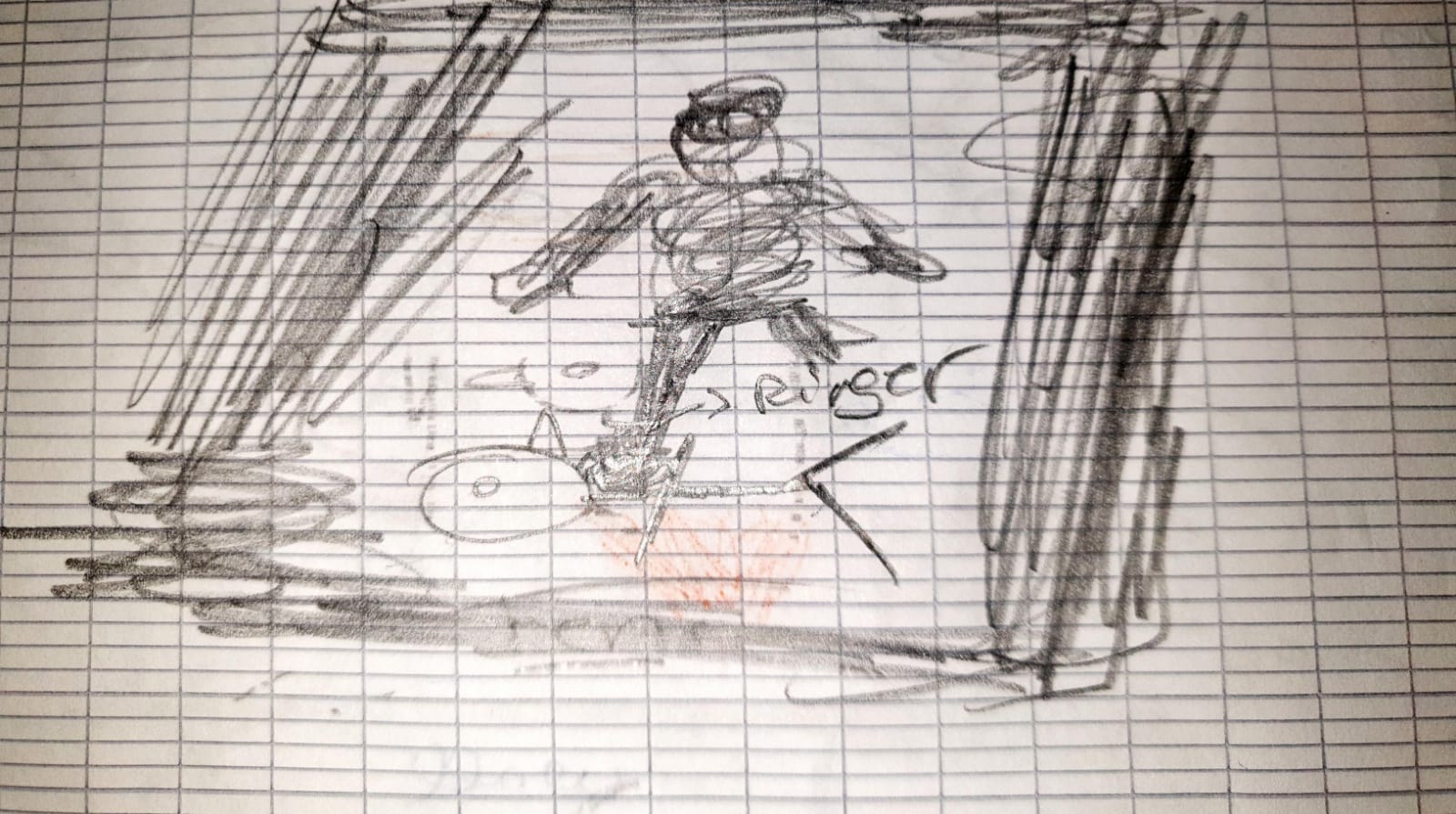
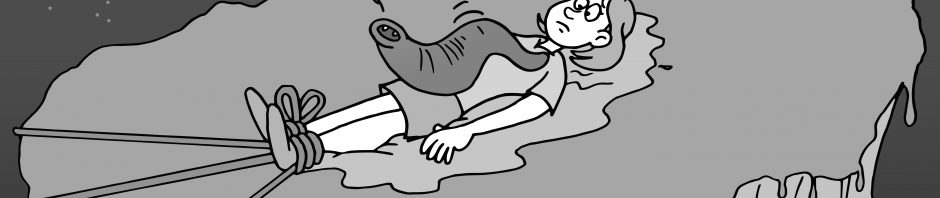
The metaphor was very simple: he was in a completely dark room, couldn’t see the walls but knew they were there. He was laying on his back on the floor with a soldier-like character having his left foot on his chest. He knew it was a soldier-like character because he could only see the shoe, which is called “Ringer” here in Lebanon. He could see nothing else from the character.
The digital nature of the metaphor made working with him very simple, given that he could neither stand up for himself nor be completely connected to the grounds of the situation, lying down completely. I got him to grow up, and he was able to create some movement, but the lightening up part was a bit of a challenge, as in Arabic it does not have the same linguistic ambiguity effect it has in English, and I am still playing around with words to see what else can be used. He then mentions that he has specific memories of being around his dad making these sounds around him when he was a kid and had to keep his mouth shut as it was his father. This was in a 30-minute conversation. We set a session for the following month to do some memory-based work on the memories that have a high emotional response related to them.
Two weeks later, I reached out to check on how he was doing, he replied: “Would you believe me if I told you that I feel better? I have no idea how, but I just am not noticing the sounds as much as I did before.” Because he experienced these triggers regularly at home, this suggested that some progress had occurred.
Metaphors of Movement can reduce some of the guesswork in changework, as uncovering the actual structure of a certain problem makes dealing with it much more straightforward and connected with the client’s experience.
Subjects covered: when to use Metaphors of Movement versus IEMT, meta-programs, motivation, working with children, business and management metaphors, passive/active factors, and more!
Do please remember to click like on the video, it really helps, and leave any additional questions or comments in the comments section on YouTube.
I’d like to share some of the interesting elements that came forth in the Metaphors of Movement training I taught in Boulder last year.
For those of you who are new to Metaphors of Movement (developed by Andrew Austin from the UK), the basic thing we ask is, “OK, the whole thing you came to me about, the whole problem, What is it like?” Then we notice what metaphor comes, such as, “It’s like I’m stuck in a rut… I’m on edge… I’m in the pit of despair… I’m in the dark… I’m banging my head against a brick wall… I can’t move forward… I don’t know which way to turn…”
You’ll start to hear these metaphors everywhere once you begin listening for them. And though they are a tiny portion of someone’s communication, they carry more information about someone’s experience than all the other words surrounding the metaphor. We’re used to ignoring the metaphor and paying attention to everything else the person tells u, the “story of woe” that focuses on examples of the problem, consequences of the problem, how we feel about the problem, or self-diagnosis. However, what Andrew Austin has found is that when we ignore all these words and instead focus on the metaphor, What it’s like, uddenly a world of information opens up to us about someone’s experience.
One woman from the training I taught last year had this metaphor for a problem situation:
“It’s like I’m at sea.”
Even this small start already tells us a lot. We can reflect back to her, “So you’re really immersed in this situation. You’re adrift, treading water. It’s sink or swim. You’re inundated. Sometimes you may be in over your head. And for anyone to get close to you, they’re going to have to get all wet for sure and put themselves at risk of getting swept away with whatever tide you’re in. You can understand how people who get close to you may think you’re a bit of a damper on the situation. And if someone doesn’t want to get their feet wet, there will always be a distance between you and that person. You’re not very grounded, so you can’t take steps of your own. And the currents that you’re caught in make you a colder and colder person…
This is just a start. There’s much more we can deduce just from the phrase “I’m at sea,” however we can learn even more when we ask about the full metaphorical landscape: “What are you standing on? And what’s to the left, right, front, back, and above?” When her group asked her these questions in the exercise on the first training day, here’s what she answered:
“I’m at sea. It’s like I’m in water that’s 3-4 ft. deep. The bottom is within reach, but I’m not standing on the bottom. I’m floating in the water, and the water is full of life, like what a sea diver would see all these wonderful things. There is endless water behind me. There’s a coastline way off to the left, and to the right, not as far, there’s an Island. In front of me, there is a coastline with people on it. Above is a blue sky.”
Her group focused mostly on pointing out the positive aspect, her surroundings being full of life and wonderful things. This left her feeling like she wasn’t getting the value of the process. This was a metaphor for a problem situation, and she came here to change. Now she just felt like people were telling her the situation was wonderful, and she knew that wasn’t the full picture, but didn’t have a clear understanding of what the full picture really was. So let’s look at what else we can add.
Having elicited the full metaphorical landscape, we now know she isn’t in this nearly as deep as one would have guessed from the phrase, “I’m at sea.” Also, she seems quite comfortable in this environment (as her group focused on). We can draw a simple picture of her metaphor like this (remembering that there is an island to her right, and a coastline to her left):
And now we can really seem like psychics, reflecting back idioms and elements that are literally true of the picture (I’ve marked out the idioms in italics):
“The right thing for you is totally isolated, but that’s only because of how you’ve positioned yourself. You look forward to this group of people who look down on you, if they see you at all… And they can never see your full self because, from their standpoint, they can’t see much beneath the surface, or if they can, it’s going to be a distorted view. You, on the other hand, are totally surrounded by this. You’re immersed in it. You can look down and see there’s a lot of lifebeneath the surface, and yet as you float here, you’re not taking a stand for yourself. Because what’s left for you here is “just coast.” Perhaps you’ve been coasting for a while now. You’re a drifter. You could get to the bottom of this, it’s within reach, but instead you choose to let yourself be supported by what’s around you, rather than supporting yourself. And it may be quite wonderful in many ways to be supported by your environment, but it keeps you from taking steps of your own. It keeps you from putting a foot down and standing up for yourself.
“And while you see what’s beneath the surface, and appreciate the life that’s there, you’ll always be a bit separate from that, because no matter how much you enjoy it here, this is not your environment. The only way to truly join that life is to give up breathing, and then you’d drown, the support you’re getting could kill you. You’re a visitor here. And while you may feel you are a deeper person than those standing on shore, they have a different perspective and a different understanding. They might see you and your sea creature friends as less evolved, not yet having grown the legs to crawl up onto land and stand up and support yourselves. And while you do have a certain depth that they lack, they likely just see you as a shallow person. And while you have a lot of depth in your background, that’s a depth that you’ve turned your back on, staying in this shallow place. And staying immersed in this makes you a bit of a cold person. And the longer you stay where you are, the colder you’ll get. And the funny thing is that while they don’t understand the depth of your experience, and they look down on you where you are, at the same time you look up to them, and you look forward to this group of people who see you as lessevolved. So I have to wonder, “Who is this person?” Some might call her a floater. Some might call her a drifter. But I think I know who she really is, she’s a low life.
“But if she started to support herself more, she’d look up to that group a little less. And while they’re what she’s facing now, she only looks forward to them because of the position she’s taken. And while people can be criticised for changing positions, it can be done if there’s something else she’d rather look forward to other than being looked down upon by people who have a more solid understanding than she does.”
I didn’t work with her in the training, so most of the above was not delivered to her when she was doing the exercise with her group. As I mentioned, her group had focused mostly on the positives in the metaphor, completely ignoring the negative, which is, of course, what she was already doing in her life before coming to the training. That’s one of the things that keeps us from changing. So on the next training day, she asked about this, and a lively discussion ensued, which I share with you below for a sneak peek inside a metaphors training. As you read, notice how she starts out by objecting and disagreeing with me. Yet the participants and I stay with the process of stating what’s literally true in the metaphor, and by the end, she is really resonating and in agreement. You’ll also get a glimpse of how the group explores these things together in the metaphor training.
Woman with the metaphor: “Yesterday when I was working, I didn’t get to that place of discomfort with it… Somehow in the setup yesterday, I felt like there wasn’t a place for me to enlarge the picture so that the discomfort of it could be revealed.”
NOTE: [Had she gotten the full idioms I listed above, she would have gotten this full picture that reveals the discomfort she’s wanting to connect with and recognize, the discomfort that will allow her to consider how to take her next steps to get somewhere better. Keep in mind that it’s easier to come up with a huge list as I’ve shared above when you have the time to think about it and write it out as I did for this blog. When working with clients, I’ll share in the session as many of the idioms that come to me at the moment, and then email over any further idioms that come to me later.] Mark: “So we want to be sure we’re including the full picture… Yesterday when I came over to your group I said, ‘You can understand how somebody might think this is a cold person.’ And you were like, ‘What?!’ So those are the kinds of elements you want to bring out. Because I don’t care how tropical this is, it’s going to be significantly below body temperature, that water. Even if it’s 80 degrees, if you hang out there forever, you’re going to become a colder person.”
[laughter]
Mark: “You know, if you have a problem, and there’s no solution, what’s the best thing you can do in the situation? It’s to build the most comfort possible. [Pointing to the picture] At least there’s a lot of wonderful sea life here you can hang out with. It’s not very evolved, but it’s something.”
[laughter] Woman with metaphor: “That’s a judgement. That’s a judgement.”
Mark: “Exactly, so get more of those judgments in there.”
NOTE: [What I mean by ‘get more of those judgments in there’ is don’t be timid about withholding insights that are accurate descriptions of the metaphor, especially if they may seem judgmental or mean, as those will likely be the insights that person has ignored, or never seen. By a certain definition, it is accurate to describe the fish and other species as “less evolved,” and yet she’s choosing to hang out with them. Bringing in this equally true description that is more negative is exactly what she was asking for. She complained that with all the “positive” descriptions her group had offered, she wasn’t “getting to the place of discomfort” she knew was there. If you make a judgement that is not true in the metaphor, then be prepared to offend. But if what you’re pointing out is literally true, even if it seems rude from the outside, the person with the metaphor usually experiences it as truly “getting” their situation, or bringing about useful insights they hadn’t noticed before. In this case, it takes a little longer than usual to get there, but as you keep reading, you’ll see how we do.]
Woman with metaphor: “Well, I won’t go into that.” Mark: “Now she’s defending her position, right?” Woman with metaphor: “Absolutely I am, I mean just depending on what sea life means.” Mark: “Exactly. [To group] So that’s what you want to be doing, right? She can have whatever experience she can have, and I can have whatever experience I can have.”
NOTE: [This is building on something shared earlier in the training. With metaphors work, we don’t have to be ‘nice’ and ‘in rapport’ with our client. In fact, we can be in a state that Andy calls ‘dis-rapport,’ where my experience as the guide doesn’t have to be linked or ‘stuck’ in rapport with my client. This allows a great deal of freedom and flexibility in delivering the insights that otherwise would seem too rude or blunt to say. Imagine a really good friend who is so close they swear in front of you and tell you what they really think because nothing could possibly threaten the relationship. That’s what we’re going for with ‘dis-rapport.’] Mark: [To group] “And you can understand how a lot of people might see this [pointing to metaphor] as less evolved, the life that she’s interacting with.” Woman with metaphor: “No, I have to say, I mean a lot of the examples that were presented yesterday, it was very… You know like somebody being in concrete, OK? And obviously, I think it was seen as something that was uncomfortable. But what I’m presenting is a situation where, yes, I am surrounded by comfort, but it isn’t the whole picture of what’s uncomfortable. So why I said it was a judgement is, it’s very evolved what’s going on around me, in this particular environment, and because of that, it makes it even harder for me to see what’s on the other side. I don’t know if that makes sense to you. It’s very compelling, it’s very engaging, it’s rich in life, that’s what I’ve said.” Mark: “Um hmm, right.” Woman with metaphor: “It’s rich in life.” Participant: “You’re also not a part of that life because your head’s above water, so you’re not interacting or a part of that sea life that’s underneath you, and you’re not with the people who are on the land either.” Woman with metaphor: “Oh, well, yesterday I was explaining that I was interacting with that life.” Participant: [pointing to picture] “Because in this one her head’s above water, and the sea life is beneath her.” Woman with metaphor: “I mean, I guess I… OK. I can explain that.” Mark: “So you’re interacting with the sea life with your hands and legs or something?” Woman with metaphor: “The beginning image was, at sea. OK, and so when you’re at sea and you’re not uncomfortable and you’re not drowning… So when that question came up [about the sea life], it’s like, ‘No, I am interacting with it, but the way it was drawn originally, it wouldn’t suggest that, so the drawing needed to be modified along the way.” Mark: “OK, so there’s like a starfish in this hand… and… stuff like that?” [adding to the picture some sea life that she’s touching.] Woman with metaphor: “Yeah, there’s activity.” Mark: “So you’re picking stuff up, or something?” Woman with metaphor: “OK, in my life today, my life is…” Mark: “No, let’s not go into that.” Woman with metaphor: “OK” Mark: “We’re doing metaphors.” Woman with metaphor: “OK, head above water, doesn’t mean… that means… you know, breathing air. You can’t always be under the water.” Mark: “So let me offer something, here. See how we can get into arguing about the meanings and interpretations?”
Woman with metaphor: “Umhmm” Mark: “That’s not what we want to do. That’s why we stick with the idioms, and what’s literally true of the metaphor.” Woman with the metaphor: “Put the water over the head if that makes it easier.” Mark: “No, it isn’t your job to change the metaphor to fit what someone says. It’s your metaphor, it is how it is. What you can do is just notice first if what someone says is actually true about the metaphor or not. If someone says something that’s not true of the metaphor, then definitely say, ‘No, that’s not true, look at the picture. Or say, ‘Wait, no, I’m interacting with the life,’ or whatever. Make those corrections, because that’s important. But when someone says something that’s literally true of the metaphor, notice how it lands for you.”
NOTE: [It’s interesting that within this metaphor, nothing has landed for her. She’s afloat and adrift. She could land if she wanted to, but she hasn’t touched down yet. So it isn’t surprising that she’s a bit afloat and adrift in this conversation about what it’s like.] Participant 2: “Can I ask a question? Because what I’m hearing her say, and I’m informed by a conversation I had with her, so I know a little bit. And we were talking about that word “evolution” and the problems with that word. Cultural problems. And so what I heard when she said about the sea life, ‘Well it’s not un-evolved,’ she was having a cultural argument with you about the interpretation.” Mark: “OK, great. So now through me saying it’s un-evolved we learn more about this situation.” [Speaking to woman with metaphor and pointing to the picture of her at sea] “So this is a place where you, in this position, you’re in a position to appreciate the variety of life, and all that it has to offer.” Woman with metaphor: “Yeah.” Mark: “These people” [pointing to the people on the coastline in the metaphor] “don’t have the same perspective. So we have a situation where you may see how evolved all of this is, and nobody else understands. They may see this person as spending all their time with stuff that’s way less evolved. How does that fit?” Woman with metaphor: “Um, yeah that’s… a piece of it, yeah.”
NOTE: [It could be further clarified that the people on shore have a different understanding than hers, and she isn’t even using her understanding, as she prefers to float and be supported by an environment that she isn’t suited for.] Mark: “Yeah, so that’s all we’re doing here, is we’re reflecting back what’s literally true of the situation, and if it’s literally true, then that’s going to resonate.” Woman with metaphor: “I just needed to get the coastline people, in the… The coastline that is accessible.” Mark: “Yeah,” [pointing to picture of the metaphor] “And so all you have to look forward to, are people who have no appreciation for what’s under the surface.” Participant 3: “That’s not how she described it in the exercise yesterday.” Woman with metaphor: “That’s fine, that’s true of the picture.” Mark: “This is how she described it, and this is literally true of the situation.” Participant 3: “But there are people there…” Mark: [pointing to elements of the picture.] “You can’t argue with this. She is looking forward, to people.” Participant 3: “Yesterday when we were doing the exercise, the people who were in reach, they were really interesting, and lively.” Mark: “So, she might be looking forward to people who are interesting and lively, they still have, ” Participant 3: “Yeah, the drawing was interesting and lively beneath the water. It was also interesting and lively people on the shore.” Mark: “Yeah, that doesn’t contradict what I just said.” [looking to woman with metaphor] “Right?” Woman with metaphor: “Right.” Mark: “People can be interesting and lively and still have no appreciation for what’s deeper.” Woman with metaphor: “Right.” Mark: “And that may be part of the problem.” Woman with metaphor: “Right.” Mark:“See how this, if you stick with what’s literally true… Don’t worry about what it means. If you go into meaning land, it’s so easy to start going into your own world, your own reality, and forget what’s actually here. And multiple conflicting things can be true in a metaphor. So, there can be contradictory things. If they’re both true of the metaphor, they will both be true. Life has paradoxes.” Woman with metaphor:“Exactly.” Mark:“So sticking to the idioms is really, really key. As long as we’re doing that, we know we’ll be on track. If we go into our own interpretations or meanings of it, or think that just because this is interesting, and that is interesting, that somehow that can’t coexist, then we’re going to be missing a lot that’s there.” Woman with metaphor:“That’s the absolute crux of it.” Mark:“Exactly, great.”
Another interesting thing happened later that day when we were exploring the taxonomy of “container metaphors.” There were lots of different container metaphors. Some people’s metaphors were that their feet were in blocks of cement, or they were trapped in a glass bottle, or standing in a kiddie pool, or a cardboard box. One man’s metaphor was like being in a pit that was over his head. In the Q & A after exploring container metaphors, I called on a lot of people, but I totally overlooked this man’s raised hand for a long time.
Afterwards, a friend who was in the training asked me, “Did you ignore him on purpose because he was in a pit? Were you intentionally interacting with him as if he was in a pit where you couldn’t see him, omeone easily overlooked?” I wish I could say that I did it intentionally, but in fact I didn’t realize his hand had been in the air for such a long time! I think this is even more interesting, and I don’t think it was just a coincidence because he was front and center in the room. I think this was an example of how our metaphors can manifest in the world, becoming self-confirming, self-fulfilling prophecies. It makes sense, because if a problem wasn’t self-reinforcing, how could it stick around so long?
If you have other thoughts on these metaphors or additional idioms to add, I hope you put them in the comments section below. And you are so welcome tojoin us for the training to see how this metaphor work lands for you.
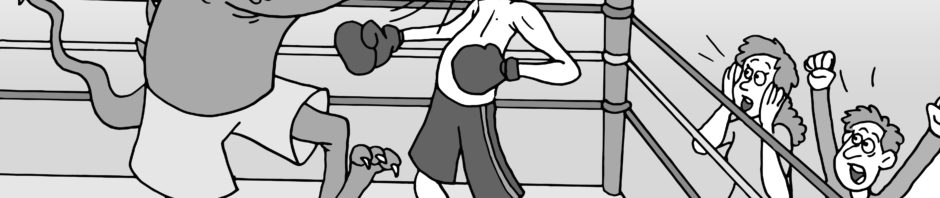
The Metaphor: “It’s like I’m in a boxing arena with a giant monster that keeps punching me in the face. All my family is cheering for me to keep fighting.“
The client suffers from an undiagnosed disease which makes them cold and weak all the time.
First, some idioms:
He’s probably going to lose this fight.
He is boxed in.
He is too small to win this fight.
The problem is monstrous.
It’s a dangerous situation.
The conflict is contained, there are rules and boundaries at play here.
The support from his family isn’t helping.
This fight/conflict provides some entertainment and recreation for the supporters.
He is conflicted.
The monster he faces is a heavy hitter.
He might be too small and weak to fight back.
This is a fight for survival.
(There’s a good list of boxing idioms here)
For me, this is the core idiom:The area of greatest impact on his life is what this client is facing. It is monstrous.
Ref: Google Etymology
Ergo: The monster is a warning.
Metaphor Taxonomies
The exact details of the boxing ring are not given, but if we assume that this metaphoric boxing ring has all the standard features, we will have the stage (supports), the ropes (boundaries and container), elevation (status), the bodily contact (hurts), and anthropomorphization of the monster and the family (stereotype of other people).
Putting these all together, this takes the session in a completely different direction from what might have been presupposed or expected.
This has many of the features of the stage metaphor, which is taught at level 3 in the MoM training program. Level 3 trainees will, of course, immediately be aware of precisely what to do with this metaphor.
In addition to this, we have the issue of the monster being both the monster and the people to whom the client relates in the same way as this monster. These will be people he has to face, and in doing so, ends up getting hurt. It is painful to have to face these people every day.
Level 2 trainees will be aware that the Hurts taxonomy is about relationships, specifically the permissions we give others in order to relate to us. When such relationships become painful, a good strategy is to change the relationship with the offending party by changing one’s position relative to them.
But it’s also about the face. He is punched repeatedly in the face. This almost certainly pertains to identity issues. It’s right there in front of him, punching him in the face. It hurts, and it appears monstrous to him. He is unlikely to be able to fight this for long. He must either succumb, submit, tap out, throw in the towel, or change his position.
As this occurs within the container of the boxing ring, we know that this situation was both inevitable and not of the client’s own making. This situation reflects not a character weakness or psychological problem of the client, but rather is a description of what the client and the client alone have to deal with.
This is not only his role and identity within the family unit with which he grew up, but his family outside of this unit are actively encouraging him to continue with this.
It is undoubtedly time for him to grow up and grow out of this.
Those family members who are cheering him on with this fight may well be in opposition to this personal growth and end up disappointed with him should he succeed in growing out of this identity conflict. As a result, the conflict may end up outside of the boxing ring and move out into the greater context.
The story of Moses from his birth to the Exodus would be a good analogous story from the classics to work with for this metaphor. If you have others, do please recommend them in the comment section below.
(Please note, the cartoon image above isn’t entirely correct to the client’s description below.)
The person is in severe pain, sitting crouched and holding the stomach. Surrounded by a cage-like structure, as if he has been jailed. With jail bars on all sides. Above a brick wall. Below is solid flooring.
Left-behind [direction] pool of dark blood.
The cage is within a room. well lit.
Sees two people in front together. Attached to one of them with thin strings of silver.
The person is on his toes. Not sitting, almost kneeling, face touching the ground.
The room is heavily guarded. It looks more like a prison. strong brick walls behind.
There is one small window in the forward-right corner, which is way beyond reach. Some light is coming in from there.
If this were a client, the first thing I’d be noting to myself is that this is a very guarded person. They are both trapped by their own situation and also quite defensive (i.e., they are defended/protected by those that cage them).
This is likely to be a very cagey person. They are easily judged. Easy to condemn. As they are likely to know this and feel this, they are going to talk carefully, choose their words carefully, and disguise the truth. Clients in this type of situation tend to worry, “How will my therapist judge me?”
Of course, the natural tendency for therapists to tell their clients the classic lie is, “I am not here to judge you,” but absolutely no one on the planet ever actually believes this. Judge them and do it harshly and vocally to get it out of the way. It builds trust.
Combined with the fact that this is a dual container metaphor, i.e., a container within a container, it would not be unsurprising if we saw some childish behaviours with this too. At the very least, we should expect to see [or for the client to feel] childish/immature emotions.
In real life, this is likely to be the person who “feels like a prisoner in their own home.” They have no freedom, are constantly being watched, have to follow orders, and are punished.
Trainees of Metaphors of Movement will already be aware that we will be asking the client to “grow up,” but it is important to understand what is going to happen when we do this.
To grow up out of the first container (the cage) will compromise the relationships with the other people that are outside of this container but remain within the greater outer container of the room. This is a dangerous situation, as evidenced by the pool of blood that has seemingly been left behind.
Left behind: discarded, disposed of, of no importance. Ergo: the bloodshed that has happened is not regarded as particularly important. This inevitably pertains to some conflict where someone was badly hurt emotionally. We don’t know who was hurt or how, but the consequences remain in the background as a reminder.
Our prisoner is attached to one of these people but not to the other. We do not know the consequences of this attachment or the nature of the relationship between the other two.
There is a small exit/opening/window behind that lets some light in on the situation, but this is not sufficient to permit escape from the situation.
Growing up out of this situation will not be easy, will almost inevitably result in some kind of conflict, harsh judgement, and punishment from the family. Growing up will serve as an escape, and generally, escapees can expect to receive greater punishment if they are caught.
Any coach or therapist working with this client will need to explore the consequences with the client before proceeding to do any change work. Working with the family may also be an excellent option, but the therapist will need to be careful not to become judge and jury as each family member tries to plead their case and win over the judgement to be in their favour.
The Metaphor: “There is this fat leech on the centre of my chest and reaches the end of my torso, feels heavy and dense, and I can’t get rid of it. No matter what I do, it’s back.”
In front: “A vast empty dark sky.”
Behind: “Hard wet earth; my back is touching it; I am laying on it, but it’s floating as if in outer space.”
Left: “Empty space.”
Right: “Floating white misty thing.”
What about your hands and legs? “I can’t see my feet, but they seem tied by a rope; hands are by my side.”
The client ends her description with: “It seems like I’m banished from life.”
So, to begin with, some idioms:
There’s something you might prefer to get off your chest.
Something is sucking your lifeblood right out of you, and it is quite a burden.
This thing has a life of its own, and it is taking yours.
There is nothing left for you.
There is nothing much right either.
Nothing to look forward to.
You are well grounded, but you are in the middle of nowhere.
You cannot take any steps to change your position.
You are not standing up for yourself or taking a stand in this situation.
You are bound to stay where you are regarding this.
You have not been able to let this go.
Except for the parasite, you are all alone.
Metaphor taxonomies
Primarily, we have a burden metaphor (responsibilities) and an anthropomorphisation (the stereotype of a class of people).
The environmental metaphor is an interesting one. She is grounded in the immediate context but not in the greater context.
The “hard wet earth” she is on is not connected to the planet earth. The immediate context of the “hard wet earth” enables her to be disconnected from everyone else. This is actually the real issue, but of course, the client’s attention is likely to be preoccupied with the leech on her chest. I would suspect that she directs other people’s attention to this aspect of her experience too.
The rope around her legs is a partial container. Or is it? (Pro-tip: the rope isn’t actually there, it just seems like it.)
Time Predication
It has been my observation that the aspect of time in metaphor is the thing that is consistently overlooked by MoM trainees and yet is one of the most important things to consider. Consideration of time in metaphor will yield significant information about the client’s meta-strategies and time-oriented meta-programs.
It is clear from the metaphor that for the client in this context, time moves and she is still.
Ergo, she is passive to time. As such, she will be likely to display learned helplessness and hopelessness, passivity, and resistance to intervention. In working with such clients, the coach may begin to feel their own vital force and energy being sucked out of them. As I asked one such client recently, “Do other therapists find that working with you is about as rewarding as throwing gold coins into a black hole?”
Suggestions for change and attempts at getting the client to change what they are doing are likely to be defeated by the helplessness.
In this metaphor, the client cannot take any steps (feet tied with rope), cannot stand up for herself (leech on chest), and might even have trouble catching her breath (leech on chest). Trying to get her to handle this might be too difficult too. After all, who in their right mind wants to handle giant leeches?
It should be noted that her position on this floating patch of hard wet earth renders her to be a passive passenger in this situation. As such, she has no control over the outcome or where she, or the situation, is going.
The situation is, of course, the patch of hard dry earth, and the relationship is support between her and the leech. This situation is the background to this entire thing. (Behind: “Hard wet earth, my back is touching it, I am laying on it, but it’s floating as if in outer space.“)
Something to ponder: what else do we know about the background to the client’s problem?
Expecting her to take active control of this situation is unrealistic and, of course, would require her to change her orientation to time, which may not be something she is able to do. We would not be able to get her to switch to she moves, time is still. Think about the implications this would have on the situation.
People who are passive to time (they are still, time moves) will be waiting for “things” to change. As such, the coach will need to be the creator of change rather than attempt to empower the client in this situation.
Intervention
As per the reasons stated above, there is little to be gained in attempting to empower the client or getting her to change. Much can potentially be gained by utilising the natural orientations of the client. She is passive, so I’ll be taking charge. She is helpless, I don’t expect her help in resolving this.
Her support is currently very limited to the “hard wet earth”, and in turn, he is the full support (or even “life support”) for the people who leech off her. These people keep her down and prevent her from standing up for herself. She is simply not strong enough to do this, and any coach attempting to help her to do this might accidentally be arranging her very real murder.
When looking at a metaphor, it is important to ascertain the elements that are created by the client (feed-forward behaviours) and those which are responses to the real world (feedback behaviours). The environmental forces may be active (i.e., the sucking leech) or passive (i.e., the hard wet earth). These forces interact (pre-date (e.g., the hard wet earth) and pre-date (e.g., the leech)) with the client’s active/passive/reactive nature. The problem is that of predation. This is a genuine victim, not someone who merely thinks she is.
Based on her time orientation, we know she is passive. The active forces within the environment are predating on her. She is the victim of a blood-sucking predator, and it would be a grave mistake to underestimate the seriousness of this situation that the client is presenting. She has a blood-sucking predator in her life that is isolating her from the rest of the world, preventing her from standing up for herself, and it keeps her tied up and bound.
Now, imagine we are walking down a strange road, and we find this scene. It’s OK, we know exactly what to do, “Just grow up and stand up for yourself,” we tell her.” Does this sound like good advice?
Clearly, this is not a therapy problem.
So, real-world environmental intervention is required beyond that of the therapy office: support groups, refuge, lawyers, debt managers, mediators, men with baseball bats, that sort of thing.
This situation will not be resolved by asking her to stand up for herself or by using a humorous or provocative approach. Baseball bats first, then look at the humorous side. To do good therapy, it is important to get the sequence of things in the correct order.
In considering the status differential, I don’t perceive any elevation in the metaphor. This is more about being disconnected from the earth rather than elevated above it. So therefore, I’d treat her as a potential equal, but an equal that needs my help. I’d regard her as one of my tribe, and I’d be reintroducing her to my tribe. I know the right people, I know the sort of people who know how to deal with blood-sucking predatory leeches like the one/s in her life. These are the people in the real world that I’d be connecting her to.
Summary: this is not a therapy problem until the real-world situation has been resolved.
“Now I’m standing on the floor. My head seems to be separated from my body (there is no neck). It’s not connected to whatever. The head feels as if consisting of a swarm of particles, drifting apart horizontally in all directions around. When it is needed to focus, I grab these particles together, hoping they will fit in the right places again. When I have the feeling I don’t get them collected in the right positions again, I am faced with difficulties in balance, coordination, and talking.
Do you know the meaning of:
Having no neck
A head that has no connection
A head consisting of a swarm of particles, drifting apart
Addendum: “this morning I realised it’s not my head that’s apart from my body, my brains are able to move away and back the way I wrote above.”
When analysing metaphors, it can be very easy to miss the obvious cues and focus on the more esoteric aspects. The first thing that catches my attention is the opening description, “I’m standing on the floor.” It is important to notice what is missing here: context. I ought to also point out that prefix to the word “now”.
Part of me would want to ask the Clean Language question, “… and then what happens?” but that would take us into a different area of exploration.
So it sounds like the person is grounded, but she doesn’t know where she stands. Either that or she does not care to tell us where she stands. As a result, how can we know where she stands relative to us, or where we may stand relative to her?
This is an issue about relationships and relating. So, if I were seeing her face-to-face as a client, I’d need to be on the lookout for subtle clues as to the type of relationship she is trying to create and match this against the context of the relationship we’d actually be having.
A really obvious example of the kind of thing is the patient who thinks of his cardiac surgeon as his friend and calls him “mate” in front of the assembled entourage during a ward round. There’s an obvious mismatch between context and outward relating from the patient. The surgeon may or may not reciprocate.
In less obvious situations, we may get some very subtle signs that are easy to miss. For example, in some family gatherings, the family members make lots of upbeat and positive noises towards each other, and as a result, everyone is satisfied that this is a functional family. But in that upbeat noise, there may be no meaningful communication expressed whatsoever. Any attempt to pass meaningful communication is matched with tension and discomfort.
As a result, the family all tacitly and non-verbally agree to collectively only exchange upbeat noises in order to keep one another at a safe emotional distance. Yet the family narrative is, “we are a very close and happy family,” which is collectively agreed upon, yet individually disputed by almost every family member when in private.
This would be easily missed by any casual observer, which is why what-is-not-communicated can be as important as what-is-communicated.
The next thing that stands out for me is that of strategy. Grabbing at particles to try and put them back in their place. There’s something about moving particles in that they tend to be very difficult to grab. Even if they could be grabbed, getting a whole swarm of them back to where they began seems like an impossible task.
So I am left wondering about the wisdom of such an endeavour. Some might say it’s a little bit of a brainless thing to do. Yet the failure to do so is met with some unpleasant physiological responses.
Even if they could be grabbed, getting a whole swarm of them back to where they began seems like an impossible task. So I am left wondering about the wisdom of such an endeavour. Some might say it’s a little bit of a brainless thing to do. Yet the failure to do so is met with some unpleasant physiological responses.
So this brings us to some possible boundary violations of metaphor. Clearly, her brains do not swarm about like particles, her head is not disconnected from her body, and having met the speaker of the metaphor, I can confirm she really does possess a neck.
Thus we have a boundary violation of associated identity, “I see myself…“
So I ask myself, how does she see herself? What does she see?
She sees herself as detached, her brain/mind/self in tiny pieces that don’t fit together. No matter how she tries, she (her self) doesn’t fit in. This lack of fit affects her good standing and her communication.
What we can be certain of with such a boundary violation category is that how she sees herself may mismatch how others see her.
So, what we have so far is:
She is grounded.
She doesn’t know, or fails to communicate, where she stands.
She sees herself as basically brainless.
She is not her true self.
I don’t know how to relate to her.
She relates to herself by trying to grasp parts of herself and put herself back into the right place.
And why does all this happen? Because she needs to focus.
Yet, focusing is what we do with our eyes. Sometimes we need to look closely at our thoughts, so we bring them into focus. This is a relationship between how we see and the distance of what we look at.
So, back to that first line again, “Now I’m standing on the floor.”
Now we can consider this line with a different set of filters. We can take a closer look at it. Personally, I’d meta-model with, “So what? Why should **I** care that you are standing on the floor?” and really insist on an answer and a discussion about it. This would both begin to open up the unspoken context but also enable me to begin to rationalise my own relationship to all this.
Possibly the best TED talk I have ever seen. Stephen Cave discusses how our intelligence shapes our narrative about death and how our narrative changes how we live.
The backstory: “My relationships metaphor. In the romantic sense. Some identity elements involved, as I’ve been repeatedly told how ugly I am since I was little.“
Metaphor: “It’s like I’m left on the shelf. In front of me is a sheer drop off a high shelf into a toy maker’s workshop. To my left is a vast expanse of wooden shelves covered in cobwebs. The same to the right. Behind me is the back of the shelf unit. I am aware of a toy maker working somewhere in front of me and women who have selected the toys they want.”
This metaphor invokes the spirit of Pinocchio, the toy who was treated like a boy, but wasn’t really ever a boy. He was just a toy, sculpted by his “father”, who wasn’t really his father… but was his creator. Pinocchio dreamed of being a boy and fabricated a lot of stories to that effect. But he never dreamed of being… a man.
Now, in terms of taxonomy, the first thing that stands out is that of The Elevations. He isn’t just left on the shelf. He is left on the top shelf. The most important shelf. The elevation of the shelf gives him the status, but it also makes him unreachable, hidden, forbidden… maybe even pornographic. Out of sight and out of mind for all who might casually glance upon him.
Of course, I cannot help but notice the passivity with regard to waiting to be selected by women choosing their toys.
For those who know he is there, he doesn’t matter. Out of sight and out of mind. He is just a plaything to be put away until he is required for other people’s purposes. Something to be used for the pleasure of others.
Of course, this is all just child’s play for someone like him. He can shelve all notions of manhood, as he is above his creator… his father, his Maker. We do not know if he was graven in His own image, but we do know he was put in an elevated position very early on, placed above that of all the others. Made to feel special… and awkward. After all, it is a difficult position to have to maintain, not to mention lonely.
Then, of course, there is the issue of the cobwebs (taxonomy: contamination = sin). It would suggest that this position is old, ignored and not maintained very well. Maybe it is forsaken by everyone else, including his Maker.
But regardless, our little toy maintains his duty and stays in position. To do anything would be to let himself down, and to let himself down in the eyes of his Maker would surely be a grave sin.
And so it will continue. Maintain the elevated position, stay on the shelf waiting to be chosen, rather than step down and come down to earth to be more grounded and to stand on his own two feet. To do so would be to give up the support that has been provided for so long, and that is the sin that the Creator may not be able to forgive.
Now, there is another taxonomy that is not too obvious, and it is that of the Situational Relational Positioning. Our toy here is in a position where he looks down on his creator. To step down from the shelf would be to come down to the same level as the man who looks down on; the man who gets his back up (think about it).
This is suggestive of contempt being the main reason as to why such a position is being maintained, as exemplified by the cartoon below. After all, there is nothing else that is left. Just emptiness.
The Dream: “I am a super sleuth person in a kind of Bond Film. A helicopter drops us off on a skyscraper building with smooth black glass (futuristic modern type). The helicopter on the landing pad is making an incredibly loud helicopter noise. I am holding on to the edge of the building with my fingertips. My super sleuth partner tells me I can let go because I have helicopter super powers and will fly down to the ground safely. I am doubtful. Why isn’t he doing that? I look down. There is the river Thames beneath me. I start lowering myself down the building like a scared spider woman. (The fear. Oh! The fear. That river Thames!!!)”
I’ll ignore the taxonomy and idioms for this one.
Dreams of falling or fear of falling are very common and can take many forms. The briefest of these dreams is the leg jerk experience, where one is dropping off to sleep and feels as though they have slipped on ice. Whilst this may come complete with a biological or neurological explanation, it also frequently comes with a brief dream image.
On my way home from a night shift in a mental health unit, I had this experience as I dropped off to sleep on the bus. I was surrounded by school children and depressed-looking people on their way to work, and in the falling experience I grabbed for my bag and snatched it as though in a panic, startling those immediately next to me. I was eyed suspiciously for the rest of the journey and the following day, I caught a different bus.
In movies, when people panic, they scream, and they scream a lot. In real life, however, people tend to scream only briefly when startled, a lot more when in great pain, and quite a lot when falling. And it seems that falling is one of the most archetypal in-built fears we have. It’s quite reasonable that we expect the ground, the planet beneath our feet, to support us, and when that support fails, it is akin to a certain death. It can feel a lot like the end of the world, or the end of us at the very least.
Think about experiences where the support you had from others was suddenly taken away with warning. It’s rarely a pleasant feeling.
There are other complicated experiences that can add interesting dimensions to this. For example, we are given the support we don’t need or want, but for various reasons are forced or obliged to accept it regardless. This is common in families and close relationships and can make things very complicated emotionally. Then, we allow a certain dependency on this support because it is the right thing to do, and then…well, they let us down.
Anyone who has experienced this first-hand will know what I am talking about here. It leads to a whole host of intense and seemingly irrational emotional responses in us. Mostly the desire to murder, though that could just be me.
Anyway, my own observation is that the people who do this to us will remain blissfully unaware of their behaviour and will continue doing it to us regardless of how you respond to or deal with them.
It is this complex set of experiences that is being played out in this particular dream. The helicopter being a mode of transport makes it more likely than not to be about a work situation, but there are too many counterexamples to be certain. My estimate is that there is about an 80% likelihood of a transportation metaphor possessing the theme of business/work.
So we have a helicopter dropping the dreamer off on top of a tall modernistic building. This is a high-status issue, and the dreamer is in an exciting role that may offer great adventure, but it also offers great personal risk.
Essentially, we can suggest that the support she had placed her in a difficult and risky position where she was placed at great risk of letting herself down.
This is a common political move in friendships and workplaces where someone wishes to deliberately sabotage another person. Encourage them into positions and roles where we know they will fail. I’ve known first-hand a number of situations where this has happened to people I know or people who came to consult me for help. Most of the time, though there is no conspiracy, it is just that the person encouraging the other isn’t actually as clever or as insightful into the capabilities of the other person as they thought they were.
Be wary of other people who think they know your capabilities. One personal example was the idiotic time I decided my life needed to be more interesting and so I went to do a weekend of parachuting out of an airplane. One-half day in a hanger pretending to be parachuting and then off we go. Let’s go jump, they all said. Getting ready to board the plane, I was so afraid because I knew so little about the whole thing that I simply refused to get in.
“Go on, you can do it,” they all said. “No,” I replied. They gave me reassurance, encouraged me, and told me everything would be fine. I refused and walked away from the plane and went home. I rarely allow myself to be put into situations, literal, metaphorical, social, or otherwise, simply because other people think it will be good for me (or good for them). I have found that, as a result, I am often considered rude.
I once was told, “Your problem is that you don’t like being told what to do.” Err, well, yes, naturally. Just think about the mindset of a person who’d say such a thing to another person with such conviction and yet not realise what they are saying.
Anyway, our dreamer is in the situation, and now the excitement of it all is starting to change as the support on which she was dependent is no longer available to her. The dreamer correctly wonders if her sleuth partner is correct about her super helicopter powers. She is hanging on by her fingertips, not wanting to let herself down.
So, she is caught in the complex conundrum of knowing her own abilities versus trusting her sleuth partner. If she stays, she will be hanging there forever… on the edge.
If she trusts her partner and the partner is correct, she might fly and be a high flyer. But only she can know for sure if she is able to support herself in the absence of being grounded and down to earth. Protip: She can’t fly. She will fall like a brick, and drop herself in it (i.e., the Thames) and once more struggle against the flow, or have to go with the flow in order to get grounded and secure again.
So this reduces it down to a simple choice. Continue to hang on in there, living on the edge. Or let go, take a fall and drop herself in it. The “it” into which she would drop has a very displeasing familiarity to it, “(The fear. Oh! The fear. That river Thames!!!)”
K asks: “I see large rubber bands around my head and connected to my wallet and large rubber bands going through my heart & connected to my wallet. Now it makes sense why it hurts to spend and to open my wallet. This is a hurt and attachment metaphor if i am correct… Since it is going through the body, what would you recommend?“
There are several interesting features to this metaphor, but first we’ll start with some idioms.
there’s a lot of tension here.
opening the wallet creates tension.
it is a bit of a stretch to spend money.
this tension is very heartfelt.
In terms of taxonomy, this metaphor has
"The Hurts" (relationships), the rubber bands penetrate through the body and threaten life.
"The Burdens" (responsibilities), the rubber bands function as a carried object, and the wallet is also a carried object.
"The Attachments" (double binds), the rubber bands form an attachment.
"The Containers" (inherited status), the rubber bands around the head form a partial container.
So, superficially, this may seem to be a simple metaphor, but in fact, it presents a highly complicated situation that will have no easy resolution.
If we begin with “The Container” element, the rubber bands around the head. This tells us that this portion of the experience is nothing new and originated earlier in childhood. The elastic nature of this partial container suggests that there is a belief component. As a result, the contemporary MoM processes for working with restricting containers would be rendered invalid in this metaphor. The probability would be that “growing up” would merely increase the tension and, so, may not be particularly beneficial.
The Attachment component reveals that when it comes to opening the wallet, the primary difficulty is a double bind: damned if you do, damned if you don’t. These attachments tend to follow the full 6-point list of Bateson (https://en.wikipedia.org/wiki/Double_bind). Bateson’s “necessary ingredients” were relativised to communication and familial relationships, but exactly the same list can be rendered to explain complex environmental situations such as financial and legal difficulties, work situations, and natural disasters.
The nature of such double binds and attachment metaphors is that “escape from the field is impossible,” which, of course, places significant aspects of the experience outside of the realm of therapeutic change. As such, the creation of kinaesthetic denial, common to so many psychotherapies, would be particularly problematic were it to be successful. In actual practice though, techniques that are effective at creating this category of change would merely fail, resulting in the client realising that the therapist fails to understand the nature of the situation whilst the therapist finding the client to be difficult or resistant to change.
“The Burden” aspect of this metaphor is the most revealing. Ultimately, for the practitioner, this would be a consideration of intended outcome versus applied strategy. The exploration would be about where is he going with this burden and thus invokes the considerations of direction, distance, mode, and rate of travel.
Remember, with attachments “escape from the field is impossible” and yet this particular attachment is perfectly portable. I shall leave it to the reader to calculate what can be inferred from this.
However, there is, of course, the all-important clue of “The Hurts” component. The Hurts are typically about the nature of relationships we form with other people, the positions we adopt, and so on. “The Hurts” also implies a recurring schema, a recurring theme that exists in relationships that can often be problematic.
What we know about the particular nature of a relationship is that it is very heartfelt. It also has a beat to it. A pulse. A rhythm. (Please note: money doesn’t have a beat, it has a flow, like liquid).
Now some things can be beaten. So can some people, and so can some problems.
The question here is whether this is the best approach to take. It probably isn’t. Beating a dog doesn’t make it a better dog, it doesn’t even make it go away. Beating a problem follows the same structure, and the results aren’t always much different from those of the dog.
Can this problem be beaten? Probably. But will it help?
I shall leave it to the MoM trainee to see if they can elaborate on this further in the comments section below.
Now, this is a bit of a challenging one. Generally, 5 words or more are needed for a full analysis, and here we just have a condensed 4-word statement. But still, let’s see what can be done with this.
First off, we start with some idioms.
You don’t have much life left inside you.
You are one of the living dead, just a zombie.
You don’t have much of a life.
You are rotten on the inside, but you hide this on the outside.
There is something inside you that is going rotten.
Your life is as good as over.
You are lacking a life of your own.
A cold person.
Now, because of the structure of this death, i.e., inside, we can be fairly sure that this person has problems communicating this to significant others. This is a secret death, an inner change masked by what is on the outside. The phrase “smiling depression” is sometimes used informally for someone who feels deeply depressed while appearing happy on the outside.
A person in this position may attempt to tell others how awful they feel and often no one believes them or takes them seriously. One only needs to see the news stories that follow a young suicide where people wax lyrical about how shocking it was because they always seemed so happy and confident and had everything to live for. A suicide may appear inexplicable to others because no one suspected that anything was wrong.
There’s a social script for an emotional death, and if you don’t follow it, the seriousness of your emotional situation may well just be ignored by everyone around you or simply disregarded.
Now, what we know from this metaphor is that it is about the body and the death of the body. This is a logical extension of “The Hurts”, or metaphor of emotional injury, and this is specifically about identity, a mismatch between what the person experiences themselves to be and how others see them to be.
Now, think about these two possible scenarios:
1. Dead on the outside, alive on the inside. 2. Dead on the inside, alive on the outside.
What has died here is not the outer identity (i.e., what others see), but rather the inner identity, of how they see and experience themselves. Chances are high that no one will have noticed.
Die on the outside, then everyone will see that something is different and that there is very clearly a problem.
So, what we have here is a situation whereby the person is maintaining a state of falsehood in the relationships they hold with others.
Self-analysis in this situation may well feel like an autopsy; it’s all too late to change or do anything about it, it’s all over anyway. The only thing that is left is the falsely positive view that others hold of the client.
So, in terms of exploring metaphors with this client, I’d be interested in knowing the mechanism of the death. This will reveal much about how the person relates to others and begin to give us some indications of what to change.
Here is something worth mentioning at this juncture: physical injury metaphors, “The Hurts,” reveal a person’s emotional and relational schemas, i.e., the recurring themes and patterns in their emotional life.
What we know here is that they have reached a threshold and cannot support such a damaging schema any longer. Things will need to change. They will need to change the way they relate to other people, their position in the world, and so on.
…they need to create a better life for themselves.
The metaphor:Saw self. So, what am I standing on? Bare feet on red-hot coals. To left, intense fire. Front fire. Right freezing cold ice. Behind nothing… as in no existence. Step left or forward, incinerated. Right freeze. Back… Don’t exist.
So initially, the client “sees herself”, a classic “Boundary Violation of Associated Identity” to which the typical response is, “So what are you, the observer, standing on?” For those to whom this makes no sense whatsoever, please see this video before reading on:
So, fire to the front and left, ice to the right, nothing behind. Standing on hot coals. Let’s begin with some idioms:
time to hot-foot it out of there.
there is nothing in the background of this situation.
what is right leaves you cold.
what is left will destroy you.
what you look forward to will destroy you.
in a very difficult situation.
standing in an impossible position.
Something that hasn’t been taught in the MoM trainings, but is worth pointing out here is Alchemical symbolism. Take a look at Crowley’s Thoth card, “Art”. These are archetypal themes that are explored as part of the curriculum for The Historia Illius Itineris.
Students of magickal symbolism may like to consider which direction (i.e., north, south, east, or west) the client is facing in this metaphor. More on this shortly.
So, to identity: who or what is she?
The Ice Queen/Ice Maiden?
The fuel added to the fire?
Someone who is either hot or cold, or nothing at all.
Now let’s consider this thing about magickal symbolism: classic archetypal imagery. Normally in metaphor, the person is orientated to the north (you’ll have to join The Historia Illius Itineris if you want to know more about that), however in this metaphor it is apparent that the client is not facing that way; she is, in fact, facing to the south.
The elements correspond as follows:
North = earth
South = fire
East = air
West = water
Just draw the metaphor and you will see which way she is facing. So we know what is missing: the physical element of earth. She has placed this behind her where she is not able to see it. “There is NO THING behind all this” “there is no back GROUND.”
Thus, we know from the client’s description of her experience that taking any step in any direction doesn’t seem to help at all; in fact, it makes it worse.
We could challenge the boundary violation of “there is nothing behind”, but this would most likely be futile.
What we would ask the client to do is rather simple: she needs to turn herself around and face that which is behind, that which is hidden, that which is… occult.
The dream:“I’m on the top level of a castle and there are people with me. There’s a tsunami coming, and I’m contemplating the structure of the building and trying to work out whether it will withstand the force (should it be high enough). I’m also contemplating death and what it will be like. As I look to my left and my right, I can see green hills and, at the top of them, really well-built castles that look like French châteaus. As I see them, I know that we can’t make it up to them and we are basically waiting for our fate. Behind me is a valley that stretches off into the horizon.“
First, let’s start with some idioms:
a man’s home is his castle.
he’s the king of the castle.
he’s the top guy, guy at the top.
even though he is on top of things, there is a disaster coming.
he’s in a difficult position.
he lives in dangerous times.
he is under threat of getting wiped out.
he is in a defensive position, but his defences are down (i.e. when compared to the châteaus).
there are forces at work that are out of his control.
he is becoming aware of the dangerous nature of things.
In terms of taxonomy, there are a number of interesting features. The castle, as container, denotes inherited status. Castles themselves tend to serve more as a status symbol and locus of governance over and above that of practical function. In the event of an invasion or siege, few castles can sustain their prisoners for long. Container metaphors are about birth-family, and by comparison, there are others that are in a far better position than this one when considering the coming threat. But all things are relative. When a tsunami is coming, then a castle at the top of a hill is at the best advantage. During normal climactic conditions, being more down-to-earth and connected with the surroundings may be the greater advantage.
The elevations play a part here too in terms of acquired status. The castle is not in such an elevated position. As a general rule, being equal to ground level is “normal” or baseline; higher than this is acquired status, lower than this is decreased status, relative to baseline. Long-term happiness seems to be hugely dependent on living at baseline.
With the dreamer being in an elevated position within his container (i.e., the castle), this suggests that the dreamer has an elevated status within his birth-family. This may be that he has a career that is highly regarded or maybe he has the role of “the head of the family.”
And this tells us where the threat is heading. It is a threat to his family. There are outside forces that threaten to change this family structure forever, unless they are strong enough to withstand this threatened event. They will need to pull together. Their bonds will be severely tested should this event occur.
Whilst not inherent in the metaphor, there is the potential for an “immersion” metaphor. Immersion metaphors are about unavoidable, external circumstances over which the person has no influence or control. Immersions tend to be little more than bad luck, rather than resulting from anything the individual has created themselves.
And herein lies a possibility of what this event may pertain to. Shame.
Shame metaphors tend to be about contamination, much like sin is perceived by the Christian church. Such contamination is dealt with via cleansing, albeit by washing away the sin; baptism with water; blessing the temple with fire; and cleansing the world with a great big flood to kill off all the wickedness.
And here’s where it gets complicated. When the world was flooded, not everyone was sinful or contaminated, and I’m sure that there was at least one good guy killed in that flood. Shame is an aspect of experience that is attributed by others (there are exceptions, but that is too lengthy to go into here) and not everyone has done anything at all to be ashamed of. However, that doesn’t stop other people from making such an attribution. Gossip mongers and false accusers do a great deal of this.
So do some therapists, inadvertently helping people to feel bad about things that they have no reason to feel bad about.
So, in this dream, there is no shame, but there is a major solution to shame that is coming his way whether he likes it or not. It’s an unfair attribution that has no place in this world, yet it exists and it might be happening anyway.
Only those of a higher position will escape it. Their elevated positions protect them from such unfairness. It’s just in the nature of things.
Clinical/hospital setting.Person is tied with hands behind their back to a pole and the flames/heat are rising up.Behind is a door. To the right is a brick wall, and on the wall is a blank whiteboard.
To the left is an operating table with a small closet. In front is a room with a big sink with taps on it. The people in front of him are in disagreement. Below is gravel and above it’s just white, but it’s not a ceiling.
First some idioms:
This is a situation that has a lot at stake. There seems to have been a bit of a witch hunt and this really is a matter of life or death. If only he was free enough to be able to change his position on things, everything could be different. It’s the kind of situation that would get a guy all hot and bothered. He will find himself burning up, getting quite hot under the collar.
It’s not an easy situation to get to grips with at all because, no matter what, his hands are tied in this situation. It’s not that he has cold feet, it’s that he has no choice. He cannot back out of this situation.
When he thinks about what is right, he draws a blank. It just all seems a bit bored. The writing is not on the wall for him just yet, though.
Because when he looks at what is left for him, there may be some operations that can be brought to the table. But there may be a skeleton or two in the closet waiting to surprise everyone. Our man may suspect that someone is hiding in the closet.
If he were free to do so, he could hotfoot it out of there and move on from all this bother. He would be able to wash his hands of this situation and cool down. His hands would be clean.
He looks forward to a disagreement, especially as he is the one who has been condemned in this situation.
Looking at this from a metaphoric taxonomy perspective, we can be sure that even though this situation itself may be a recent event, we can know that this is a recurring feature in the client’s life and that he has felt this way for much of his adult life (container metaphor).
What is interesting is the feature of both the fire and the sink. This issue is about “not shame“. All of the features in the metaphor are an antidote to shame (which would be a contamination metaphor). Thus, the emotion that this client experiences in these situations arises so that he doesn’t feel shame.
The dream:I was with some old nursing school friends, and they talked me into a boating trip. (I don’t do boats). Even though I was supposed to be with one of them in the boat, I ended up alone and panicking in an origami boat made of paper with inadequate paddles/oars . (I think they were kitchen spatulas). I got swept away on this paper boat. Ahhhh! The terror. Inevitably, it capsized/sank and I ended up swimming in the Tyne river with two strong undercurrents. I chose the current that took me to shore where some olden day ship building industry was still ongoing. I got out of the river as if it were a swimming pool. Old nursing school friends are nowhere to be seen.
Transportation metaphors such as this commonly refer to the world of work and business. There are many business metaphor structures; shipping is one example. We can talk about launching a business, getting other people on board, running a tight ship, and so on. Construction metaphors are also common in that we can talk about building a business, a business plan, a blueprint, building on solid foundations, and so on.
One of the problems that can arise with transportation modes is the level of control that the traveller can exert over the 4 criteria for reaching an outcome: mode of travel, rate of travel, direction of travel, and distance of travel.
When one is up shit creek without a paddle, then it is very easy to be carried away and end up somewhere that one doesn’t wish to be.
And so we have a similar situation here. Thus, at the beginning of the dream, the dreamer is entering into a situation whereby she relinquishes control of where she is going to end up. Only when she goes completely overboard is she able to go with the flow and exert some control over her destiny.
Of course, the vehicle for her transportation is woefully inadequate, and it seems like the wrong paperwork got her into trouble, and her whole world turns upside down.
As a result, she ends up immersed in something outside of her control, but still manages to avoid getting in too deep, even though she may well be in at the deep end. With two currents trying to take her in different directions, luckily she chooses to go along with the one that enables her to end up in a more secure place. It’s a sure thing.
Unfortunately, this whole sequence of happenings meant that she lost friends.
The metaphor: It‘s a picture of a room like a prison cell. The square is a hole in the ceiling where the only light is coming from. The character at position ‘A’ sat on a chair appears to be me. The character at position ‘B’ is where I first disassociated to, then I jumped to position ‘C’, which is to the left and above of position B and also outside of the room. From position C, I am looking into the room and have no sense of a body.
When I try and see what it’s left, right, etc from position C, all I can see is what I have drawn (it’s like it’s all in front of me and there is nothing else around me).
I have tried forcing myself to view the situation from the other positions, but I can’t associate and see it from the other perspectives.
This is a classic “boundary violation of associated identity” where the person “sees themselves.” This is often confusing to people trained in models such as NLP, where associated/dissociated is a common distinction.
When it comes to things like memory, we can be either associated, i.e., we see it through our own eyes, or dissociated, i.e., we see ourselves in the memory and we see it as though we are an observer.
The structure of memory is interesting in that it may possess movement of time, in that it is a movie, or it may be a snapshot in time, as in it’s a still picture. Memory can also be contextualised in that it may have a boundary or border around it, it may be two-dimensional and so on. NLP trainees will be familiar with the submodality distinctions in memory.
“Metaphor,” however, is characteristically different in that metaphor extends infinitely in all directions. It is never confined within a contextual boundary or confined within a submodality distinction. As a result, we can never be dissociated from our metaphoric experiences; we are always in an observer position and never see ourselves.
For example, one chap who sat in front of me told me, with quite a level of self-assurance, “I’m dead. I have no life, my life is over.” He told me those things as though this was the absolute truth.
When I asked how he knew this, he told me that he saw himself in a coffin.
Now, the naive MoMer might then try to build the metaphor from the position of the coffin, but this would be an error. It is not him that is in the coffin. He is the observer, not what he observes, so I would ask what is to his left, what is to his right, and so on, from the position of the observer and not from the position of the coffin.
And here is where the magic starts to happen. For so many people, they have never actually considered who they really are, they have always assumed themselves to be the person other people have told them to be. They see an externalised concept of themselves and assume something like that is them reflected back at them.
But it isn’t.
In this instance, the person sees themselves seeing themselves (it is not a double dissociation in NLP terms), but from the position of the real them, the observer, they have no body.
So he is a nobody. But he sees himself as being a somebody, but that somebody isn’t really him. He is at a distance from that somebody that he isn’t.
Evidently, then, this is an issue about identity. He is a no body; he doesn’t know who he really is. He lacks form and substance; he is disconnected from his true feelings, from his body. He is disconnected from his true self.
So he lives like a ghost, a spook. He is also an outsider. Maybe he wants to come in from the cold. But at least he is free. The false “self” that sees is trapped, a prisoner, contained.
He is quite transparent about it all, though, even if he doesn’t realise it himself. This room he looks at is possibly one of his regular haunts. It’s a place he goes to try and find himself.
This is common with actors and other lost souls. And many people are actors, even if they’ve never considered working on a stage. They spend their lives pretending to be some body else, for reasons noble or otherwise.
One of the problems faced by a person in such a situation is that they are never really fully present; there is always a big part of them missing or absent. It is like they are an observer, but never a participant. They may regularly feel that weird dissociation experience as though they are not sure they are dreaming and need to pinch themselves to see if they are awake.
They may also crave danger and risk to try and get the feeling of being alive, to feel something, anything. Otherwise, life for them lacks any feeling.
The dream: “I am in a dingy multi storey carpark stood with the floor extending to the left and behind ending with typical walls and an open view to a sparse typical urban landscape and I’m on a high floor. In front-left of me is a winding corkscrew access drive to all floors. Going up or down the corkscrew yields the same situation.
I realised I didn’t know what is to the right. I MoMed this image and found a warm and brightly lit opening to a very pleasant shopping mall, curving off out of sight to my front. It feels inviting and all things good.”
We have found that MoM dream analysis works best on the short punctuated dreams that conclude with waking up. Most of the time such dreams are largely without a narrative and are little more than a situation or event. For example, a personal dream I use is that of sitting in a plane, in the cockpit. The plane hits some wires and crashes. That is all. In total it’s no more than a couple of seconds of real time. Analysis of such a dream can yield a huge amount of information that is otherwise hidden from conscious access.
So, to the dream described above. The car park as a context is important. The qualities of this car park are also important.
It is multi-storey. Many levels. Multiple stories.
It is dingy (English expression meaning dark, run-down, damp, uninspiring). These are unlikely to be stories of hope and happiness. He can change his story any time he chooses, but it won’t help.
Left-in-front is a corkscrew access drive. The choice of expression here is unlikely to be accidental. It is not a spiral, it is a corkscrew. Using this corkscrew does not change the situation, it achieves nothing.
The dreamer is high … in an elevated position, but this does little to improve the experience. It’s merely a place to park for a while, not a place to reside. But residing there does set him apart from everyone else, giving him a prime position to look down on the way that they all live their lives. Himself, he has put all that behind him.
No vehicle is mentioned, suggesting that the dreamer lacks the right drive for this place. He is not a driven individual, but is someone who can readily move from one story to another.
I shall leave it to the reader to decide what we can tell about the shopping mall. Please use the comments section below.