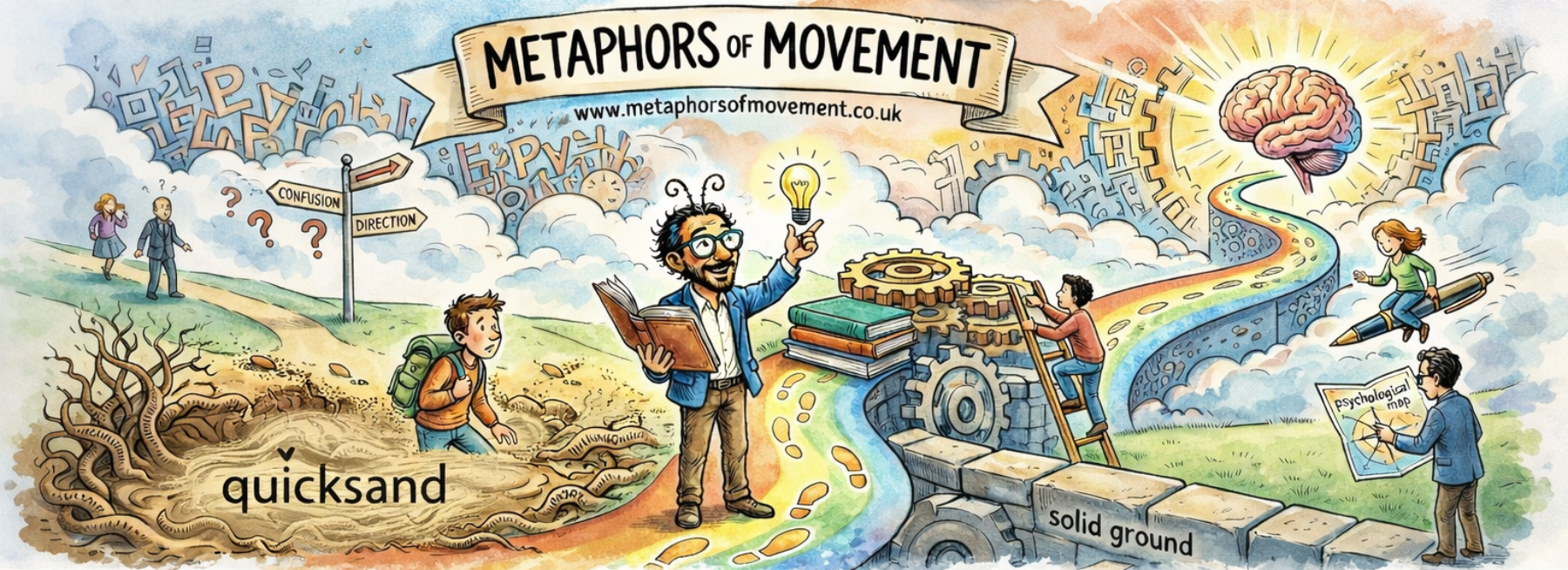
Comparing Metaphors of Movement and Clean Language
A Comparative Analysis of Methodology, Philosophy, and Clinical Application
Metaphors have long been recognised as powerful tools for accessing the unconscious mind in therapeutic settings. Two prominent methodologies, Andrew T. Austin’s Metaphors of Movement and James Lawley and Penny Tompkins’ Clean Language, utilise metaphorical frameworks to facilitate personal change. While both approaches share a client-centred ethos, they diverge significantly in their theoretical foundations, methodologies, and practical applications.

Introduction
Metaphors offer a symbolic language through which individuals can explore complex emotions, behaviours, and experiences that may otherwise remain inaccessible. Developed by Andrew T. Austin, Metaphors of Movement (MoM) focuses on movement-related metaphors to uncover problem structures, particularly in challenging clinical cases.
In contrast, Clean Language, originally developed by David Grove and systematised by Lawley and Tompkins, emphasises minimal therapist influence to explore client-generated metaphors. This analysis examines the origins and practical implications of these approaches to provide clarity for practitioners.
Background and Development
Metaphors of Movement
Developed by Andrew T. Austin, this pragmatic framework was designed for chronic or “uncooperative” cases. It focuses on how clients physically organise meaning through movement-related language (e.g., “stuck” or “at sea”) and often incorporates drama, props, and re-enactments.
Clean Language
Developed by David Grove for trauma work, Clean Language uses a set of “clean” questions designed to minimise therapist projection. It allows the client’s own symbolic world to evolve and self-organise through a structured framework known as Symbolic Modelling.
Key Methodological Differences
| Aspect | Metaphors of Movement | Clean Language |
|---|---|---|
| Focus | Coping behaviours via movement metaphors | Symbolic exploration with minimal influence |
| Therapist Role | Directive; offering suggestions and guidance | Non-intrusive; avoiding content imposition |
| Client Assumption | Clients may lack resources; need direction | Clients can self-resolve through development |
| Techniques | Drama, props, and re-enactments | Clean questioning sequences |
Theoretical and Practical Implications
Metaphors of Movement operates as a practical intervention model. It does not aim to explain human behaviour globally but focuses on immediate behavioural change. The directive nature requires practitioners to manage their input carefully to avoid bias.
Conversely, Clean Language is grounded in self-organising systems theory. It posits that metaphorical landscapes can self-resolve when explored cleanly. The trade-off is often efficiency; while MoM facilitates rapid change, Clean Language prioritises absolute client autonomy.
Training and Conclusion
Training in Metaphors of Movement involves learning to match and expand metaphors using lateral thinking and “The Compass” (e.g., Level 6.0 Time Portal). Clean Language training focuses on the discipline of staying out of the client’s metaphorical space through mastery of non-contaminating questions.
In conclusion, MoM offers a directive methodology for challenging cases, while Clean Language provides a non-intrusive framework for autonomous discovery. Practitioners choose between them based on client needs and therapeutic goals.
Advance Your Practice
Explore the practical tools of Metaphors of Movement to enhance your clinical results with chronic or complex cases.
References
- Andreas, M. (2020). A Metaphors of Movement Case Example: At Sea. markandreas.com
- Austin, A. T. (2025). Metaphors of Movement Overview. metaphorsofmovement.co.uk
- Lawley, J., & Tompkins, P. (2000). Metaphors in Mind: Transformation through Symbolic Modelling. Developing Company Press.
- Sullivan, W., & Rees, J. (2008). Clean Language: Revealing Metaphors and Opening Minds. Crown House Publishing.
