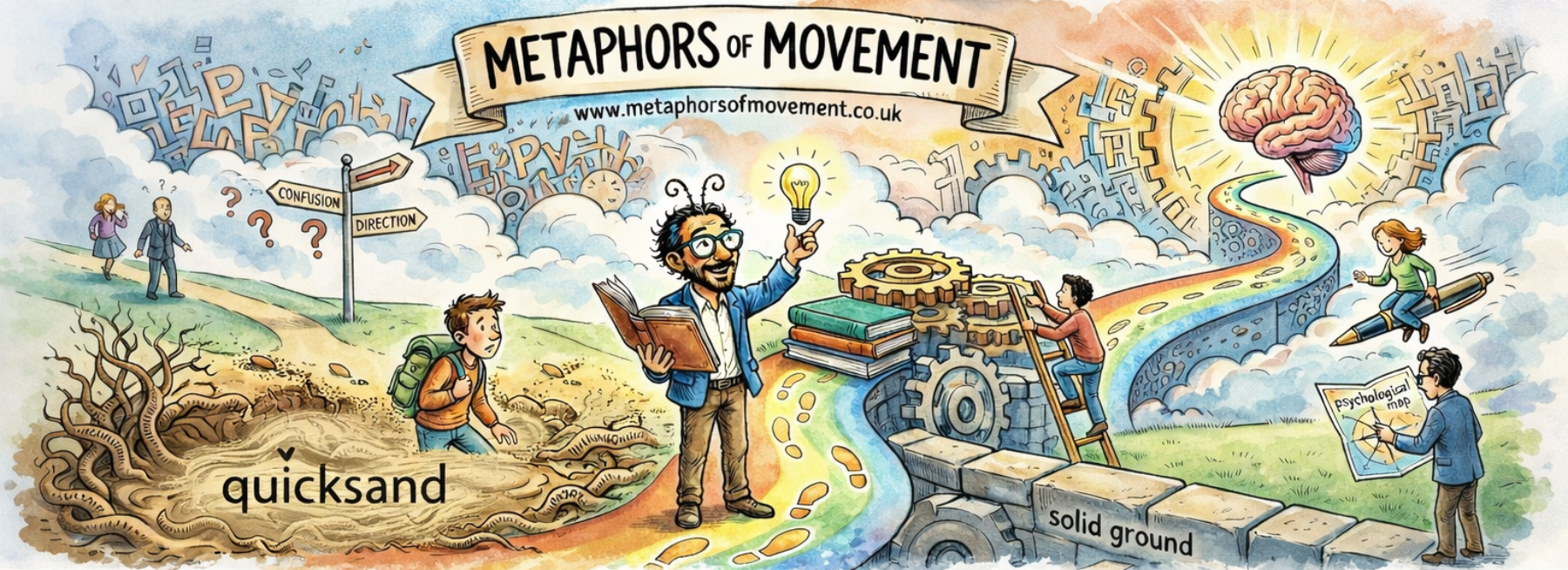
Some of The Origins of Metaphors of Movement
From Linguistic Expression to Embodied Structure by Andrew T. Austin
Metaphors of Movement did not emerge as a stylistic use of metaphor, nor as an extension of narrative or symbolic storytelling traditions. It developed from direct observation of how people physically organise meaning.Its origins lie in the observation that everyday expressions describing thought, emotion, and action are not merely figures of speech but are systematically embodied in posture, gesture, orientation, and movement.
Physiological Consistency in Metaphorical Language
Early observations arose from asking deceptively simple questions. When individuals described looking back on their lives with shame, they were asked to physically enact the act of looking back. A consistent pattern emerged: people preferred one shoulder over the other, and changing the direction of the movement altered the emotional quality of the experience.
This suggested that metaphorical expressions were not abstract descriptions, but spatially encoded actions with physiological correlates. The metaphor was not interpreted cognitively; it was generated kinaesthetically.
Directional Bias and Linguistic Asymmetry
In English, certain directions carry evaluative weight. Forward is associated with aspiration and progress, while behind is associated with history, loss, or avoidance. These absences were not symbolic; they were experienced as literal blanks or darkness. Movement became impossible not because of fear, but because there was nowhere represented to move into.
From Effects to Causation in Metaphorical Structure
Much therapeutic work attends to the effects of metaphorical experience. Metaphors of Movement instead asks: what is doing the tying, and how is it structured? By examining how metaphors are generated, patterns of causation became visible. Constraints, restraints, obstacles, and containers each required different responses.
Map, Territory, and Kinaesthetic Denial
Techniques designed to soften uncomfortable representations often result in denial.
When obstacles are removed metaphorically without altering behaviour, individuals are trained to
ignore reality rather than navigate it. This produces fragile competence where functioning
deteriorates outside supportive contexts.
Obstacles, Injuries, Containers, and Restraints
Effective change depends on matching the intervention to the metaphorical structure:
- Containers: Digital boundaries (in or out).
- Injuries: Require healing and recovery time, not reframing.
- Obstacles: Demand navigation and redirection.
- Restraints: Require release or unbinding.
Movement as Structural Reorganisation
The core insight is that psychological problems are maintained by the spatial organisation of experience. Change is achieved by reorganising movement. When people can stand, face, and step differently, their relationship to the world changes accordingly.
A shift from symbolic interpretation to operational design: building change into the body.
