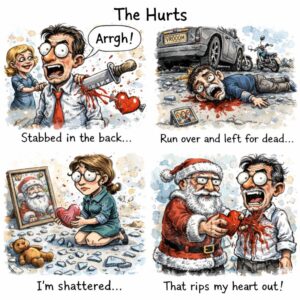
Emotions as physical injury or threat of physical injury
The Hurts are specifically about relationships. Mostly between people, but also less commonly about relationships with inanimate objects (e.g., a car, motorcycle, or an object of sentimental value), animals and pets, spiritual and religious entities, and popular cultural figures such as Santa Claus, movie and pop stars, fashion idols, etc.
These relationships manifest in physical-injury metaphors, and thus it is appropriate to refer to emotional health and emotional well-being. Typically, the person with this bias was regarded as the “sensitive child.”
Key traits
I estimate that about 15% of the population has this bias. A minority when compared to other biases of emotional experience, these adults with “The Hurts” can often be identified easily by the following key traits:
- They are destined to find that their emotions remain unacknowledged by their partner(s).
- The bathroom/kitchen cabinet is stocked with home remedies, dietary supplements, health foods, herbal remedies, and vitamins.
- They are much more emotional than their peers, with a wider range of emotions and of longer duration.
- They experience higher emotional intensity than others without this bias. They are often regarded as “sensitive.”
Two people with this bias tend to form a rapid, emotionally intense, and exciting friendship or relationship, marked by a powerful experience of emotional recognition that often ends quickly and is characterised by high emotional intensity. Two lovers with this bias will tend to draw each other into the “dark side” of their emotions, which is frequently moderated by alcohol, drugs, and activities of harm.
Characteristics of this bias
- Emotional state and welfare are significantly affected by the presence of other people.
- Do not tend to find the company of other people to be restful. Tolerance of other people’s company tends to have a time limit. For example, they may be fine when having guests for dinner for the first hour, but after that, they begin to feel that everyone should leave. Thresholds tend to range from 45 to 90 minutes.
- Needs greater periods of solitude away from other people than average.
- Not very good at maintaining contact with people.
- Affected kinaesthetically by the behaviours of other people towards each other, even if not personally involved.
- Is aware of things occurring inside relationships between people, even when the involved parties appear unaware of it themselves.
- A tendency towards a strong sense of moral justice.
- Don’t work well in teams; a tendency to self-employment or unemployment, or regular short-term employment before changing jobs.
- Dislike for competitive sports (in about 50% of people with the Hurts Bias).
- Replaying of minor micro-social events and behaviours (“I cannot believe I said that”) after social gatherings, accompanied by high levels of self-recrimination.
- Thus, people with this bias are prone to depression and loneliness, with regret being the primary feature.
- When ill-dignified, a tendency towards abuse and pleasure of the body.
- At greater risk from alcohol and drug use, anorexia/bulimia, deliberate self-harm (such as cutting), creative suicide fantasy, and promiscuity.
- Feel emotions “in the body.”
- A tendency to somatisation of emotions (i.e., “mystery”/non-medical physical problems such as stress rash, stomach ache, general annoyances such as aches and pains, stiff neck).
- A minority of people with this bias may have frequent difficulty differentiating between “stress” and a physical health problem.
- A tendency towards mystical leanings and self-exploration, exploring different states of self and ways of being.
- Experiences of synaesthesia. For example, hearing the sounds of cannons firing when viewing a painting of an artillery battle.
- Sometimes experiences kinaesthetics external to the body, leading to a tendency to beliefs in “healing”, auras, experiencing the “hidden world” (occult), and the mystical.

Common roles adopted
The Miserable Hermit (withdraws from society, introspective rumination, negative self-analysis).
The Mystic (adopts esoteric interests, explores the darkness inside themselves, obsesses on “healing”).
Cultural image: Suffering leads to spiritual enlightenment, suffering teaches transcendence.
Slogan: “What doesn’t kill me, makes me stronger.”
Common idioms that are suggestive of “The Hurts”
Loss of a body part
“Heart ripped out.”
“Guts ripped out.”
“Feels like part of me is missing.”
Damage to the body
“Brokenhearted.”
“Stabbed in the back.”
“It was like a slap in the face.”
“I’m hurt.”
Destruction of the body
“I feel cut to pieces.”
“I’m in pieces.”
“I’m in bits.”
“I’m torn apart.”
“Tears me from limb to limb.”
“I need to pull myself together.”
Asphyxia
“I feel suffocated by this relationship.”
“I don’t have room to breathe.”
“She has a stranglehold on me.”
Dying
“I’m dying here.”
“I’m very run down.”
“I can’t live like this.”
Death
“I feel like I died that day.”
“My life is as good as over.”
“I’m devastated.”
“It kills me.”
“I don’t have a life.”
“I’m a shadow/ghost of my former self.”
Download the 13-page PDF on “The Hurts”
“Who Turned Out The Light?”
Right-click and “save as…” to download, or simply click to open in a new window.
