The Architecture of Suffering
Moving Beyond Passivity in Clinical Practice
People are very good at suffering. And there are a number of different suffering styles, some prefer to suffer in silence, others will see a problem that is shared as equal to a problem that is halved, others will share in the suffering, and of course, some prefer to suffer alone.All too often in counselling and therapy, the therapy session will consist of little more than exploring the client’s model of suffering. By the end of therapy, the client has a better model and a better set of distinctions by which they understand their suffering. They may have more words, be more eloquent in their description, and be better able to explain how they feel and how they suffer.
But they don’t necessarily suffer less. They simply learn to suffer it better.
If the person is exposed to a diagnosing clinician, they may well explain their suffering in phrases and terms that fit diagnostic models and so emerge with a name for their suffering, a label, a diagnosis.Equipped with a diagnosis, this diagnostic frame is usually cross-matched against prescription protocols to ensure the appropriate medication is prescribed to provide relief.
The Trap of Passivity
“The client is entirely passive and does not need to do anything different in order that the hope of relief from their suffering is offered. The relief comes not through a change in behaviour, but rather in being able to describe their pain properly and then to take the appropriate medication.”
When this process is applied to behaviour or to psychological and emotional suffering, the client remains trapped by the effect of the problem rather than the source.
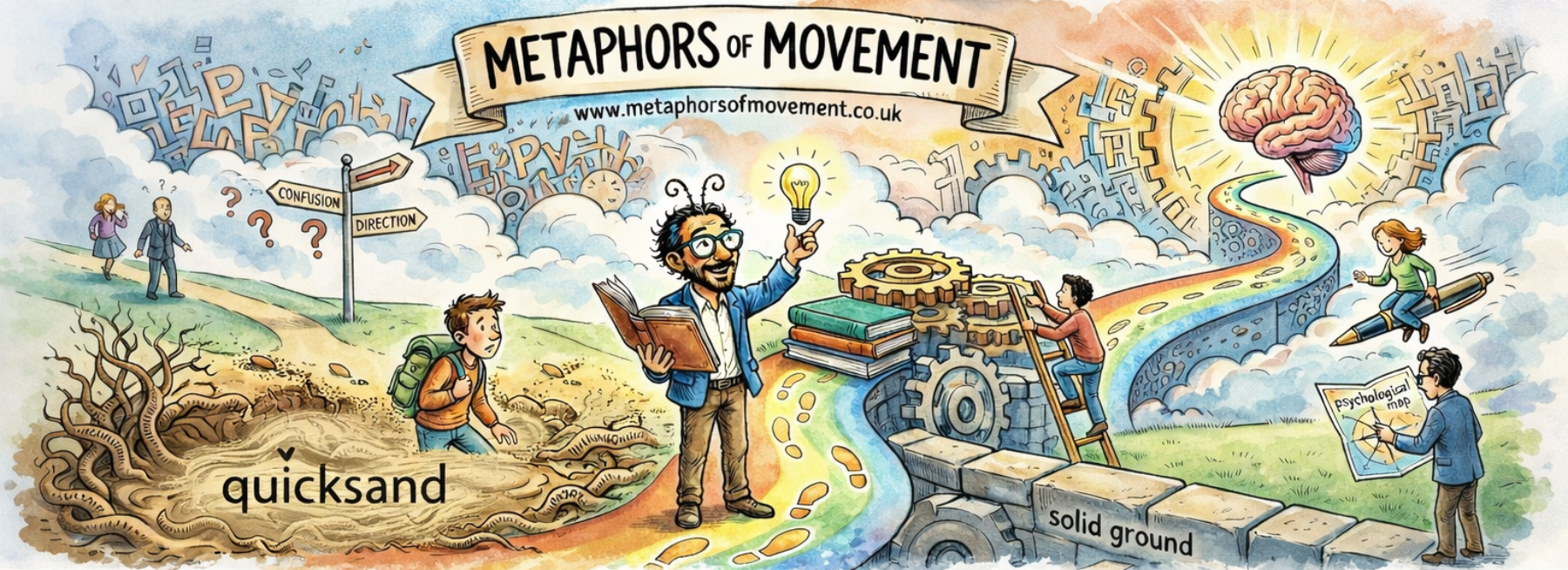
The “Metaphors of…” models are designed for clients who do not wish to be trapped by passivity and to engage them at an experiential and behavioural level, creating change at the source of the problem rather than at its effects.
For details of consultancy and bespoke training, please contact:
Andrew T. Austin (Somerset, UK)
Email: freshnewbrain@gmail.com
Suffering Styles Assessment
Identifying the Structural Patterns of Emotional Distress
Use the following distinctions to identify the client’s primary mode of suffering. Remember, the goal of therapy is often mistakenly set to “suffer better” rather than to “stop suffering.”
1. The Stoic (Suffering in Silence)
The client presents as ‘fine’ or ‘contained’ while maintaining a rigid internal posture.
- Metaphorical Sign: High walls, internal containers, or frozen landscapes.
- Clinical Risk: They may improve their ‘mask’ without ever addressing the internal damage.
2. The Sharer (Problem Halved)
The client believes that eloquent description is the same as resolution.
- Metaphorical Sign: An emphasis on ‘talking about the map’ rather than moving through the territory.
- Clinical Risk: Therapy becomes a social ritual of sharing rather than a vehicle for change.
3. The Collector (Suffering Together)
Suffering is used as a bonding mechanism to find ‘others like me.’
- Metaphorical Sign: Crowded spaces, group labels, or shared burdens.
- Clinical Risk: Recovery is seen as a betrayal of the group identity or shared diagnostic label.
4. The Hermit (Suffering Alone)
Total isolation within the problem structure.
- Metaphorical Sign: Remote islands, deep pits, or locked rooms.
- Clinical Risk: The therapist is viewed as an ‘intruder’ rather than a guide.
The Passivity Check
Evaluate the client’s current treatment model. Is the relief expected to come through behavioural movement or passive description?
PASSIVE MODE
Labeling, Medication, Reframing, “Understanding.”
ACTIVE MODE
Metaphors of Movement, Action-taking, Structural Change.
Move from the ‘Effect’ to the ‘Source’ of the problem.
