Metaphors of Time and the Organisation of Experience
Decoding the Spatial and Structural Logic of Chronology
Time is one of the most pervasive organising principles in human experience. It is embedded in language, emotion, motivation, and identity, yet it is rarely examined directly. Rather than being experienced as an abstract dimension, time is almost always structured metaphorically. These metaphors are not decorative; they determine how people remember, anticipate, value, and act.From a Metaphors of Movement perspective, time is not simply something people are “in.” It is something that moves, is moved toward, is entered, exited, accumulated, spent, wasted, controlled, or lost. The way time is metaphorically organised profoundly shapes behaviour, experience, personality characteristics, and so much more, often without conscious awareness.
Timeless Metaphors and Frozen Experience
A striking feature of many metaphors is their timeless quality. People frequently describe experiences that have persisted unchanged for years or decades using metaphors that imply ongoing immediacy. Someone may feel as though they are drowning, suffocating, or under attack, not as a historical event, but as a continuous present; it’s a perpetual happening, never progressing to a conclusion.
In such cases, time does not progress; there is no chronology; the metaphor has no beginning, middle, or end. Unlike dreams, which tend to unfold sequentially, these metaphorical experiences remain suspended. The individual is not remembering the event; they are still inside it. Psychological distress is therefore maintained not by memory, but by temporal arrest.
This timelessness explains why certain problems feel exhausting and inescapable. Without temporal movement, there is no opportunity for resolution, completion, or recovery. The experience is perpetually “about to happen” or “still happening,” even when the external circumstances have long since passed.
Emotion and Time Orientation
Emotions reliably reveal how time is being organised. Guilt is predominantly retrospective, requiring orientation toward the past. Anxiety, by contrast, is usually prospective, focused on what has not yet occurred. Anger tends to be anchored in the present moment, experienced as immediate and urgent.
These orientations are not merely descriptive; they constrain behaviour. A person absorbed in guilt is unlikely to plan effectively for the future, while a person dominated by anxiety may struggle to take responsibility for the past. Emotional states, therefore, act as temporal indicators, revealing where attention and agency are positioned.
Time as Moving Object and Moving Self
One fundamental distinction in time metaphors concerns movement. Time may be experienced as a moving object, i.e. events approaching, looming, or passing, or as a stationary structure toward which the individual moves. These two configurations produce very different subjective experiences.
When time moves toward the individual, it can feel intrusive, pressurising, or uncontrollable. Deadlines approach, birthdays loom, and time runs out. When individuals move toward time, there is often a greater sense of agency and organisation. One can prepare, pace oneself, or even divert course.
Speed, Size, and the Mechanisms of Time
Time is frequently described in terms of speed. It flies, drags, crawls, or stands still. These variations are experiential rather than objective, influenced by engagement, novelty, and emotional intensity.
Time is also assigned size and mass. Events can be close or far away, long or short, heavy or light. A future event may feel enormous and overwhelming, while a past event may shrink into insignificance. Angles and gradients further shape the time experience. A sudden drop suggests immediacy and danger (“a rapid decline”), while a gradual slope implies extended duration and adjustment.
Time as Container
Time is commonly organised into containers: seconds, minutes, hours, days, weeks, and years. These containers create a shared framework for coordination, yet their subjective size/distance varies widely between individuals. What constitutes “a minute” or “just around the corner” differs dramatically depending on context and experience.
Time as Commodity and Identity
One of the most influential time metaphors is time as a commodity. Time is spent, wasted, saved, invested, shared, given, or taken. In many cultures, time is explicitly exchanged for money, embedding economic value directly into temporal experience.
How individuals value their time often reflects how they value themselves. When time is perceived as scarce or costly, its use becomes morally charged. Wasting time can provoke guilt or shame, while using time “wisely” reinforces identity and self-worth.
A Taxonomy of Time Metaphors
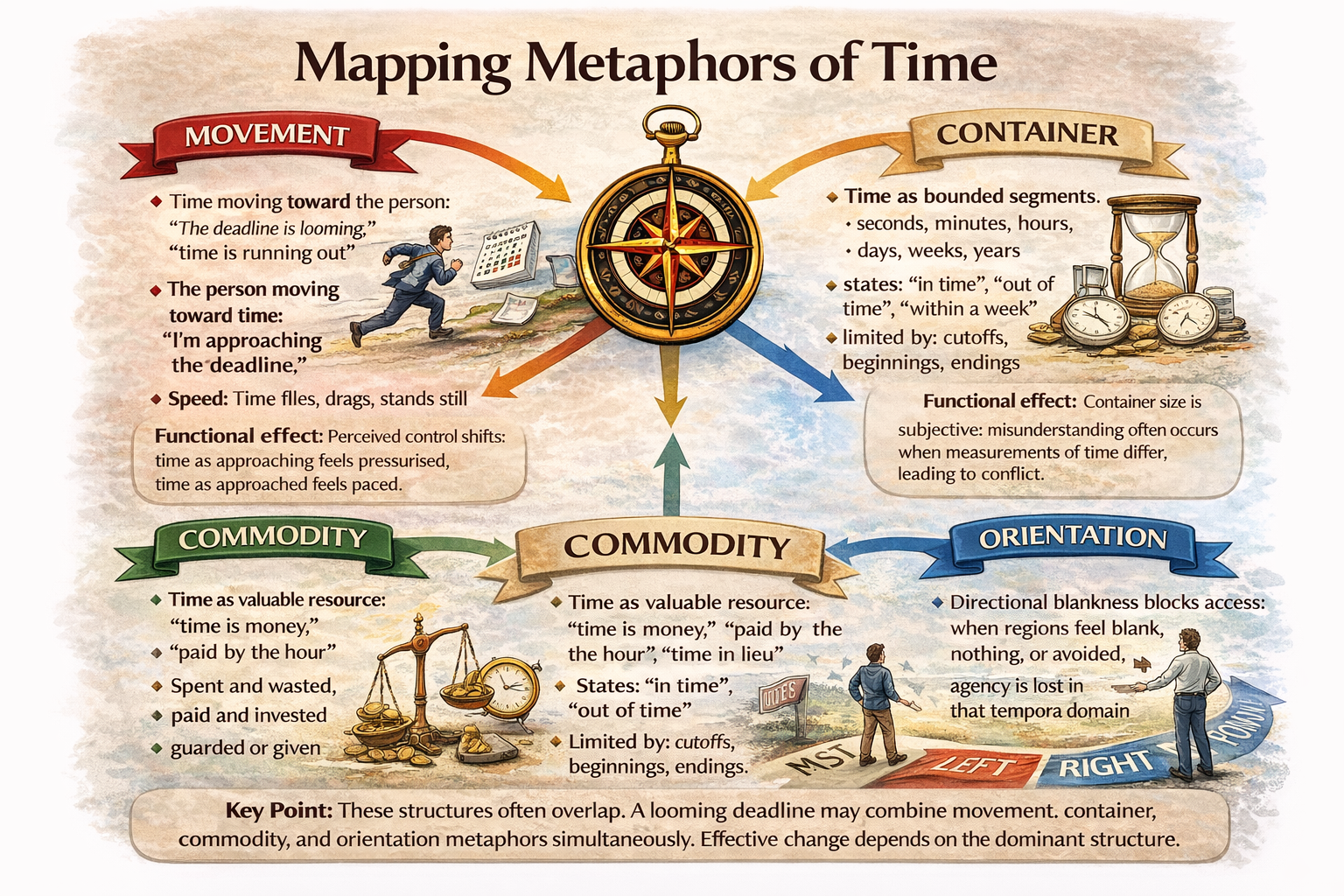
Time is not experienced as a neutral dimension. It is organised through recurring metaphorical structures that shape emotion, motivation, behaviour, and identity.
1. Time as Movement
Determines perceived control. When time approaches, experience feels pressured. When the individual approaches time, agency is accessible.
2. Time as Container
Subjective measurement. Misalignment leads to conflict (e.g., mismatched definitions of “soon”).
3. Time as Commodity
Links time to self-worth and exchange rules. Conflict arises when value systems differ (e.g., billable vs. free).
4. Time as Orientation
Organised spatially (Behind = Past; Forward = Aspiration; Right = Duty). Blank or blocked directions make movement into those domains impossible.
Clinical Presentations
| Time Metaphor | Typical Presentation | Leverage Point |
|---|---|---|
| Movement | Anxiety, Burnout, Panic. | Identify who is moving. Map speed/momentum. Restore agency. |
| Container | Procrastination, Overwhelm. | Elicit container size. Right-size units and buffer time. |
| Commodity | Guilt, Value Conflicts. | Surface exchange rules. Recode into bounded ownership. |
| Orientation | Rumination, Stagnation. | Map directional accessibility. Restore navigable space. |
Time as Design, Not Destination
Understanding metaphors of time is not merely a matter of intellectual insight. It is about restoring movement to an experience where it had previously stopped. When time begins to move, behaviour again follows.
