Negative Prototypal Experiences: Learning How to Experience the World
Why “Prototypal Experiences” Matter
Human development does not occur in a vacuum. Across most societies, there are recurring, culturally patterned experiences that become “expected” life events. When these events are benign, they often operate as background scaffolding. When they are aversive, especially when they involve powerlessness, exclusion, humiliation, or betrayal, then they can become formative templates for how a person expects the world to work, what they anticipate from others, and what they believe about themselves.
These experiences are prototypical in the sense that they are:
- Common enough to be culturally normalised (or treated as inevitable).
- Repeated across generations via institutions and family practices.
- Implicitly educational, teaching “how the world is” without explicit instruction.
- Often unquestioned because “everyone goes through it” (or is assumed to).
A key point is that not all populations share the same “normal” developmental experiences. For example, formal schooling at a fixed age is historically and culturally contingent. Some societies use corporal punishment, and others do not; some emphasise communal inclusion while others tolerate ranking and exclusion. When an experience becomes widespread within a culture, it can shape both individual psychology and broader social norms, often invisibly, because the experience is taken for granted.
Schooling as Enculturation: A Worked Example
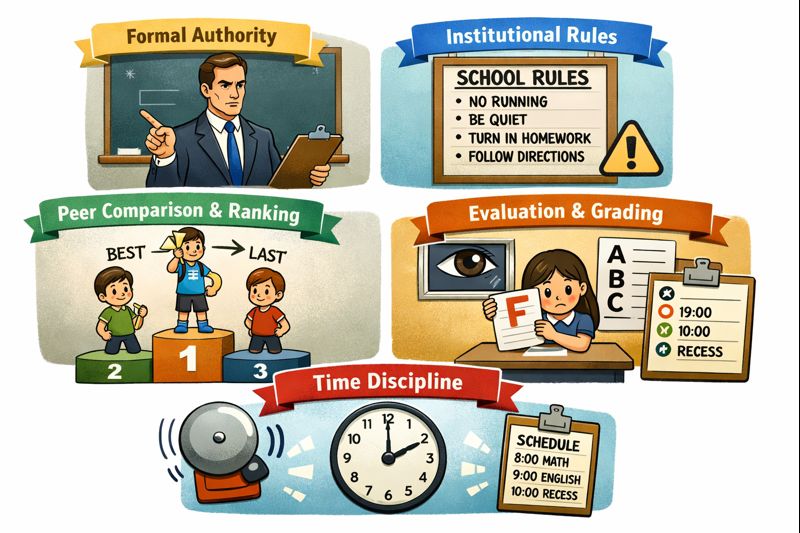
One of the clearest examples of a culturally structured prototypal experience is the first day of school. For many people, it represents the first sustained exposure to:
- formal authority outside the family,
- institutional rules that apply regardless of personal preference,
- peer comparison, ranking, and selection dynamics,
- evaluation (being watched, judged, or graded),
- time discipline (bells, schedules, permission structures).
In this sense, schooling functions as an enculturation system: it teaches not only academic skills, but also how to behave in structured groups, how to relate to authority, and what forms of compliance or resistance are rewarded.
For some, the first day of school is encoded as curiosity or excitement. For others, it becomes a concentrated negative imprint involving separation, uncertainty, exposure, and loss of control. The same external event can be encoded very differently depending on relational context, temperament, and the meaning assigned at the time.
Defining “Negative Prototypal Experiences”
Negative prototypal experiences are common developmental events that carry aversive affect and teach implicit lessons about:
- Safety: “I’m not safe; danger can arrive without warning.”
- Belonging: “Inclusion is conditional; I can be rejected.”
- Status: “I must compete; I can be ranked.”
- Justice: “Fairness is unreliable; I can be punished even when innocent.”
- Trust: “People I rely on may betray me.”
- Agency: “What matters happens to me; I cannot stop it.”
Many of these experiences are passive, with the locus of control outside the individual. As a result, they often organise around helplessness, appeasement, hypervigilance, or emotional withdrawal. These are not pathologies in themselves; they are frequently adaptive responses that become costly when they generalise and persist.
Two Classes of Prototypal Negativity
Passive / Received (Control Outside Self)
Organised around themes of powerlessness, exposure, and injustice:
- Your first day of school.
- Being abandoned or lost as a child.
- Being deliberately excluded or picked last.
- Being bullied or betrayed.
- Being unfairly blamed or punished.
- Being laughed at or mocked.
- Experiencing a parent’s anger or sorrow.
- Humiliation through loss of bodily control.
- Death of a loved pet.
Active / Perpetrated (Control Inside Self)
Organised around shame, guilt, and moral conflict:
- Picking on another child or sibling.
- Betraying someone else’s trust.
- Dropping a friend for someone more popular.
- Tormenting or harming an animal.
- Knowingly taking credit for others’ work.
- Cheating or borrowing with no intent to return.
Common Pattern Libraries for Exploration
Exclusion and Rank
Social vigilance, rejection sensitivity, and pre-emptive withdrawal.
Injustice and Punishment
Chronic self-justification, suppressed anger, and authority distrust.
Betrayal
Relational suspicion, over-control, or emotional distancing.
Parental States
Parentification and threat conditioning around conflict.
Exposure
Fear of exposure and somatic anxiety loops.
Working with Active Harm Without Collapsing into Shame
When working with perpetrated actions, the clinical aim is integration rather than self-condemnation. Key distinctions include responsibility versus identity, guilt and shame, and repair versus punishment.
MoM work often focuses on transforming scenes of exposure or permanent identity-marking into metaphorical representations that preserve responsibility without identity collapse.
Negative prototypal experiences function as implicit training events in how the world, relationships, and the self operate. Because they are common, they often go unexamined. Using the MoM basic protocol enables the identification, updating, and integration of these hidden learnings, retaining useful realism while reducing unnecessary suffering.
Prototypal Imprint Audit
Mapping Foundational Life Events to Adult Behavioural Templates
Use this audit to identify which Negative Prototypal Experiences have formed the templates for your client’s current reasoning. Identify the Class of experience and the resulting Lesson learned.
| Template Area | Prototypal Trigger Event | Adult Manifestation |
|---|---|---|
| Safety & Protection | Being lost as a child; Experiencing a parent’s rage; Unfair punishment. | Hypervigilance; Fear of the “other shoe dropping”; Somatic anxiety loops. |
| Belonging & Status | First day of school; Being picked last; Being deliberately excluded. | Pre-emptive withdrawal; Rejection sensitivity; Competitive identity-marking. |
| Trust & Agency | Betrayal by a trusted peer; Death of a pet; Being set up or used. | Relational suspicion; Excessive self-reliance; Feeling like “life happens to me.” |
| Moral Integrity | (Active) Bullying a sibling; Cheating; Harming an animal. | Chronic guilt; Identity collapse; Imposter syndrome; Fear of “being found out.” |
The Feedback Loop of Prototypal Learning
The Clinical Pivot
When you identify a prototypal imprint, the MoM practitioner asks: “Where does this experience place you in your current landscape?”
If the first day of school was a “loss of control,” the client may still be standing in a metaphor where they are “waiting for the bell to ring” before they feel permitted to move. The work is to update the permission structure, not just the memory.
Integrate the past to unlock the future.
