Individual Change: Well-Formed Outcomes
Models of Suffering and Desperation for an Outcome
People are very good at suffering. And there are a number of different suffering styles, some prefer to suffer in silence, others will see a problem that is shared as equal to a problem that is halved, others will share in the suffering, and of course, some prefer to suffer alone.
All too often in counselling and therapy, the therapy session will consist of little more than exploring the client’s model of suffering. By the end of therapy, the client has a better model and a clearer set of distinctions for understanding their suffering. They may have more words, be more eloquent in their description, and be better able to explain how they feel and how they suffer.
But they don’t necessarily suffer less. They simply learn to suffer it better.
If the person is exposed to a diagnosing clinician, they may well explain their suffering in phrases and terms that fit diagnostic models and so emerge with a name for their suffering, a label, a diagnosis. Not necessarily a good outcome.
Equipped with a diagnosis, this diagnostic frame is usually cross-matched against prescription protocols to ensure the appropriate medication is prescribed to provide relief.
The Trap of Passivity
The client is entirely passive and does not need to do anything different in order that the hope of relief from their suffering is offered. The relief comes not through a change in behaviour, but rather in being able to describe their pain properly and then to take the appropriate medication.
The Problem with Positive Outcomes
In personal development and self-improvement, the problem is largely ignored. Instead, the focus is on outcomes: getting what you want, attracting the things you want into your life, being a better person, getting more successful, and so on. Workshop participants are told that they just need to believe in themselves and that they can have the outcome in life that they want. They can be rich, they can be happy, they can be successful; they just need to believe in themselves.
In NLP, the term “well-formed outcomes” emerged to define how an outcome should be conceptualised. A set of parameters gave NLP practitioners a guideline to follow. But at the workshops and big events, the big carrot of the magical outcome gets dangled. But here’s the problem:
Anyone who is in the position of personal suffering can distract themselves with the fantasy of a better life. Anyone can make pictures in their mind of being a millionaire, having better sex, having better relationships, being more popular, being more successful, and so on. Merely making such pictures in their minds can make a person feel better, albeit temporarily. But they do feel better, but this doesn’t mean that they will ever actually achieve the outcome, no matter how well formed it is. Simply feeling better is no measurement of change, yet when the client or workshop participant reports feeling better, the outcome is usually considered to have been achieved.
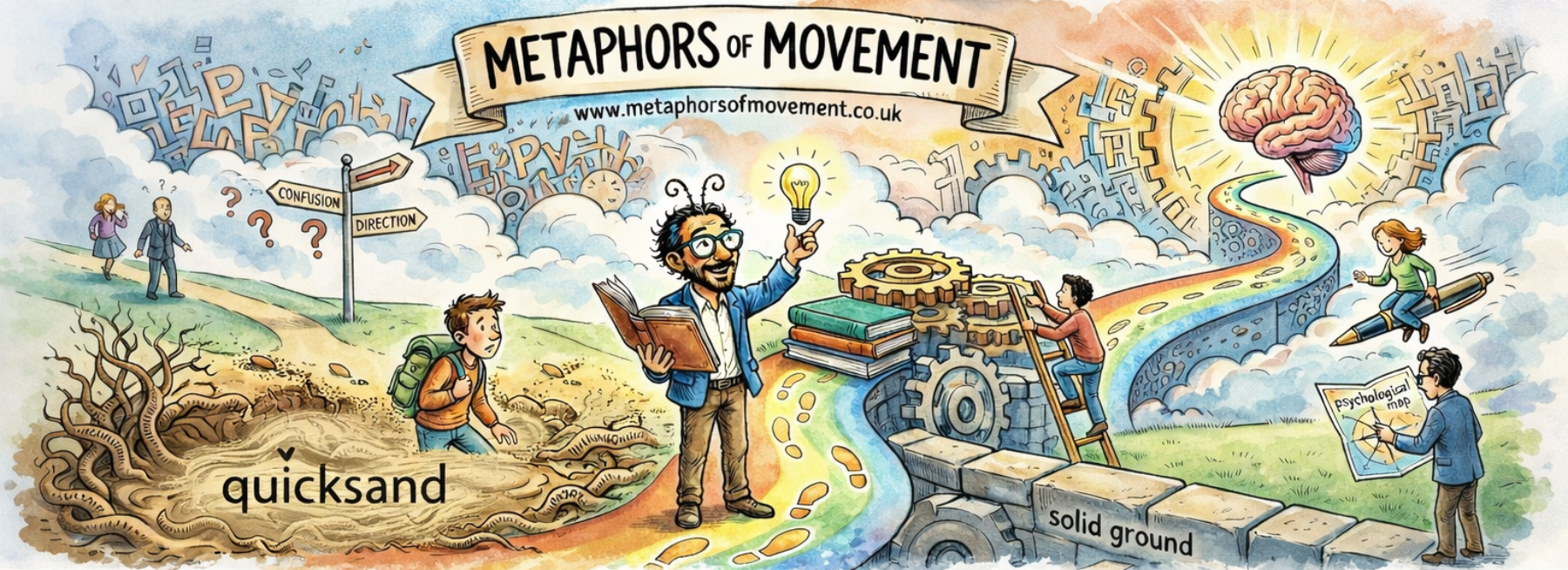
The “Metaphors of…” models are designed for clients who do not wish to be trapped by this passivity and to engage them at an experiential and behavioural level to create change at the source of the problem rather than at the effect of the problem.
Explore Metaphors of Movement Training
Fantasy vs. Behavioural Outcome Audit
Testing the Structural Integrity of the “Well-Formed Outcome”
Use these four diagnostic tests to determine if the client is engaging in passive distraction or active movement.
| The Diagnostic Test | Signs of Fantasy Distraction | Signs of Behavioural Movement |
|---|---|---|
| 1. The Locality Test | The outcome is “elsewhere” or “in another world.” The client looks “away” to describe it. | The outcome involves the current landscape. Changes are made to the Ground beneath the feet. |
| 2. The Affective Test | Client reports “feeling better” immediately, often with a glazed or dreamy expression. | The client may feel more resistance or weight as the reality of the required action sets in. |
| 3. The Agency Test | Outcome relies on “attracting” things or people changing. The client is a recipient. | Outcome requires a specific Kinetic action (stepping, pushing, lifting) by the client. |
| 4. The Structural Test | The “Problem” remains in the background while the “Outcome” is a separate picture. | The “Problem” structure (the Wall, the Pit, the Mud) is the source of the change. |
The Structural Difference: Outcome vs. Problem Source
The MoM Clinical Rule:
If the client’s outcome makes them “feel better” without changing their Position or Posture in the current metaphor, you have likely facilitated a fantasy distraction. Stop exploring the outcome and return to the Obstruction or the Burdens that are actually holding them in place.
Stop chasing carrots. Start moving the ground.
