Selling Success versus Identifying a Problem
A Positional Model of Psychological Change
Much contemporary personal development and therapeutic discourse is structured around the promise of outcomes. Individuals are invited to imagine a better future, a desirable destination, or an improved version of themselves and are encouraged to pursue this imagined endpoint as the solution to their difficulties. This approach is rhetorically effective because it simplifies complexity into aspiration. It offers a clear promise, a vivid image, and a sense of certainty. Yet this model often obscures a more fundamental issue: problems are not always resolved by merely orienting toward success. This is the Pollyanna mindset of so many practitioners of the alphabet therapies, where a simple solution-focused intervention (“think about this, not that“) failed to address the deeper underlying social, familial, psychological, biological and systemic issues that keep people stuck. Instead, they are frequently sustained by the position a person occupies within their relational, psychological, and existential landscape.
A positional model of change challenges the assumption that psychological difficulty is primarily a failure to reach a desired outcome. Rather, it proposes that distress arises from where and how an individual is situated in relation to their world. From this perspective, meaningful change does not begin with promises of success but with a careful examination of position, orientation, and movement.
The Appeal and Limits of Outcome-Oriented Change
Outcome-oriented models of change operate on an implicit hierarchy of places. One’s current position (“where I stand”) is framed as inadequate, while the promised destination is portrayed as superior and desirable. The narrative suggests that movement is linear and simplistic, i.e. once the correct destination is reached, the problem is resolved. This framing assumes both stability and finality, implying that life can be organised around the attainment of fixed endpoints. This is primarily an outcome-focused model that largely ignores the process and the individual’s capacity, agency and interest.
While outcomes can provide motivation and direction, they are poorly suited to the realities of lived experience. Human lives unfold dynamically, shaped by changing contexts, relationships, identities, and constraints. The assumption that a single destination will permanently resolve dissatisfaction neglects the ongoing nature of adaptation. It also risks invalidating the present position, encouraging people to disengage from their current circumstances rather than understand them.
Moreover, outcome-based models often externalise responsibility for change. The promise of success becomes something to be delivered, rather than something that emerges through engagement, adjustment, and movement. When the promised outcome fails to materialise, individuals are left with disappointment rather than understanding.
Position as the Primary Unit of Change
A positional model reframes psychological work around the question of where a person stands. Position is not merely a physical metaphor; it encompasses identity, role, values, relationships, and orientation toward experience. To know one’s position is to understand how one is placed in relation to others, to the past and future, and to the demands of the present.

Many individuals seek therapeutic support not because of isolated symptoms but because they experience dissatisfaction with their place in the world. They may feel misaligned with their environment, compelled to perform identities that do not fit, or trapped in relational arrangements that require continual compromise. In such cases, distress reflects a positional mismatch rather than a failure of effort or motivation.
By identifying position, psychological work shifts from symptom removal to situational understanding. The task becomes one of locating the self accurately within a wider landscape and recognising how that placement generates particular emotional and behavioural consequences.
Orientation, Direction, and Distance
Once the position is identified, the question of movement arises. Movement is defined by several interrelated variables: direction, distance, step quality, and momentum. Direction concerns where movement is oriented, i.e. forward, backwards, left, right, or toward what has previously been avoided. Distance refers to the extent to which one intends to move, recognising that significant change does not always require dramatic relocation; sometimes a single step is sufficient to alter one’s relationship to a problem.
Orientation plays a crucial role in determining meaning. What lies ahead, behind, to the left, or to the right is not fixed; it is contingent on how/what a person is facing. A change in orientation can radically reorganise experience without any change in external circumstances. By turning toward something previously ignored or away from something habitually confronted, individuals can alter their relationship to past events, present challenges, and future possibilities.
Relational Effects of Positional Change
Position is always relational. Changing one’s position does not merely alter internal experience; it reshapes relationships to people, situations, and meanings. Moving closer to what is supportive often increases distance from what is harmful, while stepping away from one element of life may bring another into clearer focus.
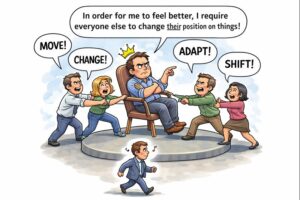
A common resistance to change arises when individuals attempt to maintain a fixed position while demanding that others move instead (“In order for me to feel better, I require everyone else to change their position on things. This stance assumes that the environment should adapt to the individual’s immobility. While this may feel justified, albeit somewhat narcissistic, it often perpetuates conflict and stagnation. A positional approach does not require others to change first; it emphasises the agency inherent in repositioning oneself.
Facing the Past and Reorienting the Self
Reorientation can involve confronting aspects of experience that have been placed behind or deliberately avoided. Turning toward the past, for example, often disrupts comfort and familiarity. What was once ignored becomes central, while previously valued directions recede from view. This process can feel destabilising, yet it may be necessary for genuine integration.
Facing the past does not imply remaining there. Rather, it allows for recalibration of orientation so that future movement is informed rather than constrained by what has gone before. The discomfort associated with such reorientation reflects not pathology but adjustment to a new perceptual organisation.
From Promises to Practice
A positional model of change rejects the simplistic promise of success in favour of disciplined exploration of placement, orientation, and movement. Rather than offering guarantees, it provides tools for understanding and navigating complexity. Its value lies not in delivering predetermined outcomes but in enabling individuals to locate themselves accurately and move intentionally within their lives.
By shifting attention from destinations to positioning, psychological work becomes less about selling futures and more about cultivating agency in the present. Change emerges not as a reward for compliance but as a consequence of informed movement. In this sense, the task of therapy is not to promise a better place, but to help individuals understand where they stand and how they might step differently.

