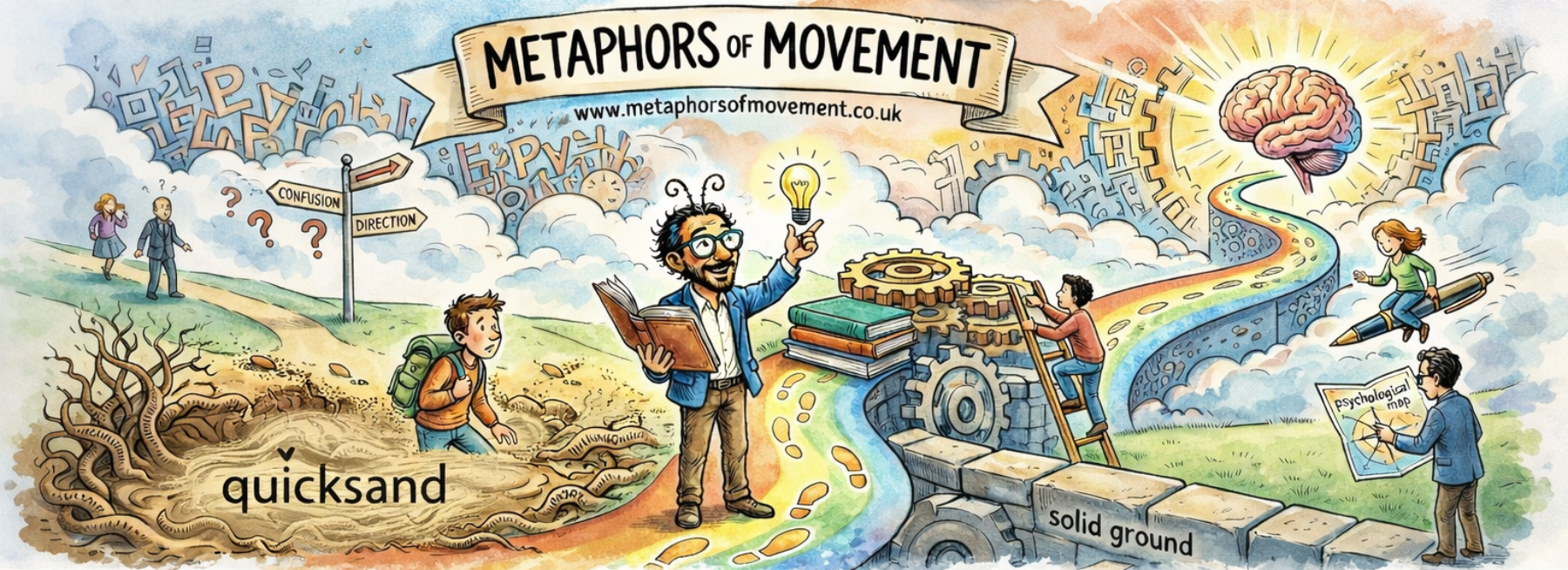
Metaphors of Movement (MoM) is a clinically grounded approach that treats metaphor not as decoration, but as the structure of our inner experience. How people talk about being “stuck,”
“moving forward,” “under pressure,” or “going in circles” reveals a detailed map of how they are organising their reality.
This page brings together the core MoM foundations, language models, and applications from across the website into one central hub. From embodied metaphor and spatial language to business consulting, management, and depression work, you can use this as your starting point to explore:
- How embodied and spatial metaphors structure psychological movement
- The Compass model for understanding direction and orientation
- Autogenic metaphors: meaning that emerges from within
- The story behind Metaphors of Movement and its creator, Andrew T. Austin
- How MoM applies to business, coaching, staff development & organisational change
- The relationship between MoM and Clean Language
- Metaphors of depression and how movement-based intervention works in practice
On This Page
Direct Links to the Source Articles

Foundations: Embodied Metaphor & Psychological Movement
Metaphors of Movement starts from a simple but powerful observation: we experience life as movement through space. We talk about “moving on,” “going back,” “being held down,” “getting over it,” or “being stuck in a rut.”
These are not just poetic flourishes: they are literal descriptions of how the nervous system is organising experience.
The article Embodied Metaphor and the Structure of Psychological Movement explores how metaphor lives in the body: posture, tension, direction, weight, and distance. When a client says, “it’s like carrying a heavy load uphill,” Metaphors of Movement treats “load” and “uphill” as precise information rather than vague symbolism.
- Embodied: metaphors show up as sensations, postures and impulses to move (or freeze).
- Structured: there is a coherent internal “map”: a landscape, a direction, a set of rules and constraints.
- Action-orienting: the metaphor quietly tells the person what they believe they must do, can’t do, or are forbidden to do.
Seen this way, “psychological movement” means how someone can or cannot move through the metaphorical world they are describing. Change work becomes a process of making that world explicit and then renegotiating it.
Spatial & Kinetic Language
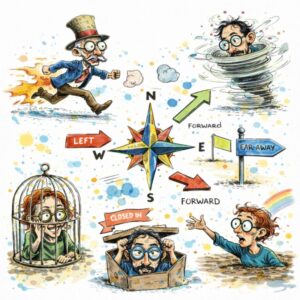
Metaphors of Movement pays particular attention to spatial and kinetic language: words that describe where things are and how they move.
This includes:
- Direction words: forwards, back, up, down, left, right, around, across
- Speed and momentum: rushing, dragging, stuck, spinning, slowing down
- Distance and proximity: far away, too close, out of reach, just ahead
- Boundaries and containers: in, out, inside, outside, trapped, closed in
These phrases show how movement and location words encode the “geometry” of someone’s inner world.
Instead of translating the metaphor into abstract psychology (“You feel anxious”), the practitioner stays with the literal language (“You’re under pressure, with no room to move”) and explores what that implies:
- Where exactly are you in this metaphorical space?
- What’s in front, behind, above, below, to the sides?
- What’s moving? What mustn’t move? What would happen if it did?
Practical implication: every time a client uses a movement or location word, they’re handing you a piece of their map. MoM trains you to recognise and use those pieces deliberately.
The Compass: Mapping Direction & Orientation
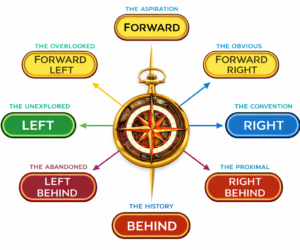
The Compass is one of the core organising models in Metaphors of Movement. It treats directional words as reliable indicators of how a person is orienting themselves in relation to:
- Past and future (behind/ahead)
- Options and alternatives (left/right)
- Status, rank and exposure (up/down)
Horizontal Directions
- Forwards: what we move toward; hopes, goals, “the way ahead”.
- Behind: what’s back there; history, causes, what we’re trying to escape.
- Left/Right: choices, values, what is “left” vs what is “right” for me.
Vertical Axis
- Up: promotion, success, visibility, exposure, “rising to the top”.
- Down: collapse, failure, humiliation, “falling from grace”.
By mapping a client’s metaphors to the Compass, practitioners can see why certain moves feel impossible.
For example, a client who must “move forward” to succeed but feels they will “fall” if seen by others has a built-in conflict between forward and up/down.
Autogenic Metaphor: Meaning Born from Within
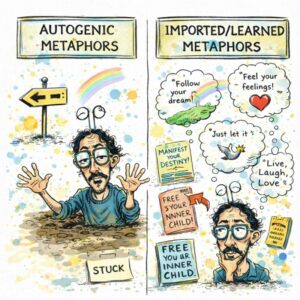
Not all metaphors are equal. Metaphors of Movement distinguishes between:
- Autogenic metaphors: phrases and images that arise naturally from the client’s own experience.
- Imported/learned metaphors: clichés and slogans taken from culture, self-help and therapy.
The article The Power of Autogenic Metaphor: Meaning Born from Within focuses on those spontaneously arising metaphors that feel oddly specific, vivid, and sometimes strange. These are often packed with information about how a problem is maintained: far more than generic therapy language like “self-esteem,” “inner child,” or “limiting belief.”
In MoM work, the practitioner:
- Listens closely for client-generated metaphors.
- Resists the temptation to translate them into abstract theory.
- Explores the metaphorical world as if it were literally true.

About Metaphors of Movement
The main About Metaphors of Movement page sets out the project as an exploration of the “symbolic architecture” of the mind. Rather than treating people’s stories as random, MoM looks for underlying metaphorical structures:
- Journeys, paths and destinations
- Walls, pits, cages and other obstructions
- Loads, burdens and things carried
- Levels, heights and status structures
- Water, immersion, drowning and flooding
MoM is:
- Experiential: clients often stand, walk and physically enact their metaphors.
- Non-interpretive: the practitioner does not impose symbolic meanings from a book.
- Pragmatic: the aim is not to explain why someone is like this, but to change how they move in their map.

About Andrew T. Austin
Metaphors of Movement was developed by Andrew T. Austin, a clinician, therapist and trainer with decades of experience in complex mental health work.
Andrew is also known for creating Integral Eye Movement Therapy (IEMT) and for his book The Rainbow Machine: Tales From a Neurolinguist’s Journal. His work is characterised by:
- A strong clinical orientation: models are built from real-world cases, not theory alone.
- Humour, directness and a low tolerance for “therapy theatre” or guru-culture.
- A focus on what actually changes behaviour rather than on sounding clever or spiritual.
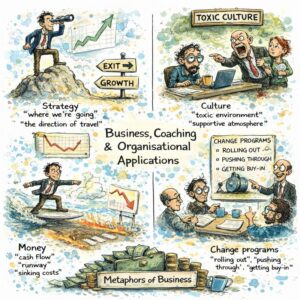
Business, Coaching & Organisational Applications
Metaphors of Movement is not just for therapy rooms. The same metaphor structures that drive personal problems also shape how businesses, teams and leaders think about:
- Strategy (“where we’re going”, “the direction of travel”)
- Culture (“toxic environment”, “supportive atmosphere”)
- Money (“cash flow”, “runway”, “sinking costs”)
- Change programs (“rolling out”, “pushing through”, “getting buy-in”)
Metaphors of Business
The Metaphors of Business page describes how MoM can be used as a forensic tool to examine:
- Business identity: how owners and leaders metaphorically describe their organisation.
- Business structure: whether the metaphor supports or sabotages the chosen strategy.
- Message congruence: whether branding, internal communication and leadership metaphors align.
A business that sees itself as “a ship in a storm” will make very different decisions than one that sees itself as “a high-speed train” or “a family home.”
Business Coaching
On the Business Coaching
page, you’ll find examples of how single phrases (“I need a cash injection”, “We’re bleeding money”) reveal:
- How the business is being personified (as a patient, a baby, a machine, a battlefield).
- What roles people are unconsciously stepping into (parent, doctor, rescuer, victim, soldier).
- Where loyalty, risk and decision-making really sit: beyond the numbers in the business plan.
MoM-style business coaching doesn’t just improve “mindset”: it reframes the entire metaphor the business is being run from.
Staff Development Training
Traditional staff development can feel like box-ticking. The Staff Development Training page highlights a different approach: using Metaphors of Movement to get staff genuinely interested in how they and their colleagues talk about work.
- Hearing the metaphors behind complaints, conflict and disengagement.
- Noticing where departments literally “pull in different directions”.
- Opening up communication where it was previously blocked or adversarial.
MoM-based training days are designed to be lively, thought-provoking and often very funny: while quietly changing how people listen to one another.
Organisational & Corporate Change
Change initiatives fail when the change metaphor clashes with how people actually experience their work.
The page on Organisational and Corporate Change focuses on using MoM to:
- Identify the metaphors already running in an organisation (“climbing the ladder”, “stuck in the trenches”).
- Spot where leadership metaphors and staff metaphors conflict.
- Design change messaging that actually fits the lived experience of staff.
When the metaphors of change match the metaphors of daily life, resistance drops and movement becomes possible.
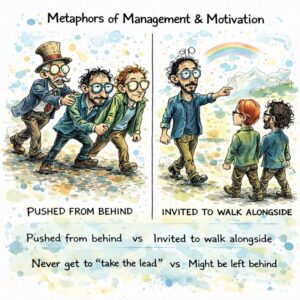
Metaphors of Management & Motivation
How managers talk about “motivating” people reveals the relational geometry of their leadership style.
The Metaphors of Management and Motivation article gives examples such as:
- “I’m right behind my team and give them a push when required.”
- “I lead from the front and stay one step ahead.”
Both statements sound positive, but they imply very different experiences for staff:
- Being “pushed from behind” vs being “invited to walk alongside”.
- Never getting to “take the lead” vs being “left behind”.
Metaphors of Movement offers a way to:
- Map out leadership metaphors across a team or organisation.
- Explore how those metaphors impact morale, initiative and accountability.
- Develop alternative metaphors that better fit the outcomes you want (e.g. guiding, accompanying, sharing the load).

Metaphors of Movement & Clean Language
Metaphors of Movement and Clean Language both take metaphor seriously: but they do so in different ways.
Shared Ground
- Both treat client metaphors as central, not incidental.
- Both avoid imposing pre-packaged symbolic “meanings”.
- Both aim to uncover the structure of experience rather than chase surface content.
Key Differences (Very Simply)
- Metaphors of Movement: more directive and performative; uses drama, movement and physical space; often focused on stuck patterns and coping behaviours.
- Clean Language: more neutral and non-directive; uses a defined set of “clean questions”; often focused on allowing a metaphor landscape to evolve in its own way.
Many practitioners find the two approaches complement each other: Clean Language for certain clients and contexts, MoM for others, or a blend of both, used intentionally.

Metaphors of Depression: Movement, Meaning & Therapeutic Intervention
The article Metaphors of Depression: Movement, Meaning and Therapeutic Intervention applies MoM principles to one of the most common: and often most stubborn: clinical presentations: depression.
Depressed clients frequently use metaphors like:
- “It’s like wading through treacle.”
- “I’m under a dark cloud.”
- “Nothing moves: everything is heavy.”
- “I can’t see a way out.”
Instead of translating these into diagnostic language, MoM explores them literally:
- Where is the treacle, exactly? How deep is it? What happens if you stop moving?
- Where is the cloud? Is it above, around, inside? Does it move? Does light get through?
- What would count as “movement” in this landscape: and what would make that movement unsafe?
This approach helps uncover why standard advice (“think positively”, “get out more”) often fails. Within the metaphor, those “solutions” may be impossible, dangerous, or structurally blocked. Effective intervention starts with changing the geometry of the metaphor itself.
Choosing Where to Go Next
Use this hub depending on your interests:
1. You’re New to Metaphors of Movement
- Start with About Metaphors of Movement.
- Then explore Embodied Metaphor & Psychological Movement and Spatial & Kinetic Language.
- Finish with The Compass for a clear structural map.
2. You’re a Therapist or Coach
- Read The Power of Autogenic Metaphor and Clean Language.
- Study Metaphors of Depression as an applied case.
- Bookmark the individual article links for supervision, study groups or CPD discussions.
3. You’re in Business, Leadership or Organisational Work
- Focus on Metaphors of Business, Business Coaching, Staff Development and Organisational Change.
- Then explore Metaphors of Management & Motivation for leadership applications.
4. You’re Curious About the Origin Story
- Read About Andrew T. Austin.
- Then explore the wider MoM site (writings, trainings, and The Metaphor Society).
All of the individual pages linked above go into much greater depth. This pillar page is designed to help visitors and search engines alike understand how these pieces fit together into one coherent model: Metaphors of Movement.
