
Metaphors of Depression: Movement, Meaning, and Therapeutic Intervention
Based on Andrew T. Austin (2017), “Metaphors of Depression (Movement)”
▶
Watch: Metaphors of Depression (Movement) with Andrew T. Austin
Introduction
Depression is most commonly framed within contemporary clinical discourse as a medical disorder characterised by neurochemical imbalance, genetic predisposition, and affective dysregulation. While this framework has produced valuable pharmacological and diagnostic tools, it often overlooks a crucial dimension of depressive experience: how depression is lived, described, and organised experientially by the individual.
Central to this approach is the proposition that people do not merely report depression; they communicate it continuously through idiomatic and spatial language that reveals how their experience is organised. These metaphors are not incidental figures of speech but form the primary structure of the problem itself.
Depression, Time, and Cognitive Impairment
Severe depression is frequently accompanied by profound disturbances in cognition and temporal perception. Subjectively, time ceases to move forward; suffering appears endless, with each day experienced as an awful extension of the last.
From a neuropsychological perspective, these symptoms are often associated with reduced activity in the frontal lobes. The individual may struggle to retrieve nouns, organise thoughts, or maintain a coherent narrative. Recognising these neurological correlates clarifies the necessity of interventions that both stimulate neurological activity and engage experiential meaning.
Movement as an Organising Principle
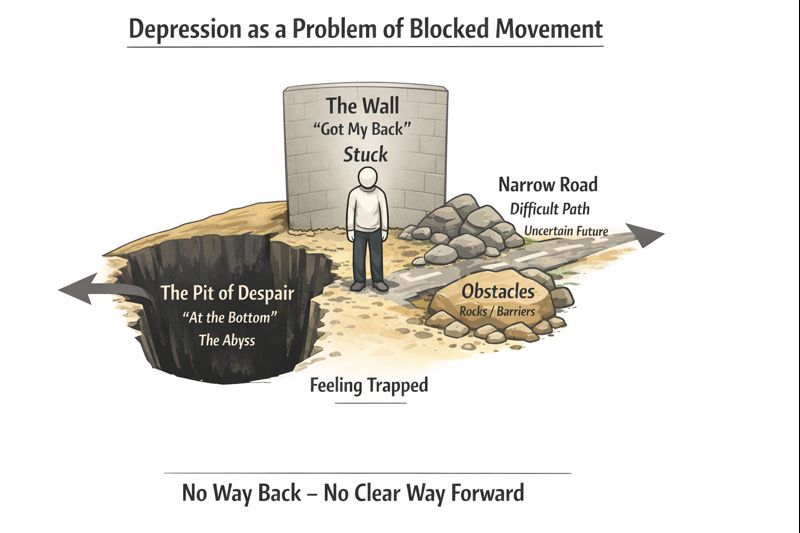
A defining feature of depressive language is its reliance on metaphors of movement, or, more precisely, the absence of movement. Common expressions such as “I’m stuck,” “I can’t move forward,” or “I’m at the bottom” reveal an experiential world organised around blocked trajectories.
Depression is not simply a mood state but a lived geography. Individuals locate themselves in pits, against walls, or at the edge of abysses. These spatial constructions are spontaneously generated descriptions of how the person experiences their situation.
Idiomatic Communication and Its Dismissal
When a person states they are “in a pit of despair,” this is often translated into diagnostic shorthand, i.e., “major depressive disorder.” This translation constitutes a fundamental therapeutic error. By replacing the client’s experiential map with a generic explanatory model, practitioners risk diagnosing the wrong problem.
The Structure of the Problem and Failed Solutions

Individuals frequently invest years in strategies such as pushing forward, positive thinking, or medication, all while remaining stuck. The critical insight in Metaphors of Movement is that the attempted solution often shares the same structure as the problem itself.
For example, a person who experiences themselves as “trapped in a pit” may believe the solution is to “move forward.” Yet within the metaphor, moving forward may be impossible or even lead to walking into a wall. The persistence of the solution maintains the problem.
Applying Coping Strategies to the Metaphor
Austin’s approach involves eliciting the client’s real-world coping behaviours and applying them directly to the metaphorical scenario. For instance, if alcohol is used to cope, the therapist may imagine advising a person in a literal pit to keep walking into the wall and providing whiskey when they collide with it.
Rather than being told their strategy does not work, the client recognises its absurdity for themselves. This creates space for new possibilities to emerge organically, without forced reframing or imposed optimism.
Mental Health and Accuracy
This model redefines mental health not as happiness or comfort, but as the accuracy with which an individual assesses their circumstances. A person may be deeply unhappy and yet psychologically intact if their suffering corresponds accurately to their situation.
Therapeutic change does not come from being pushed forward, but from no longer insisting on moving in the wrong way. When individuals see clearly how their experience is organised, new forms of movement become possible.
Study the Metaphors of Depression
Learn to work directly with the structure of depressive experience through clinical training in Metaphors of Movement.
Clinician’s Quick-Reference
Identifying & Avoiding Common Errors in the Treatment of Depression
1. The Translation Error
The Error: Hearing idiomatic language (“I’m in a pit”) and immediately translating it into diagnostic shorthand (“Major Depressive Disorder”).
The Consequence: You delete the structural data of the problem. You treat an abstract “disorder” instead of the literal “pit” the client is inhabiting.
2. The Incongruent Solution
The Error: Prescribing a “forward-moving” solution (goal setting, motivation) to a “downward” or “stuck” structure.
The Consequence: If the client is against a wall, “moving forward” just means walking into that wall harder. This increases the sense of failure.
3. The Comfort Trap
The Error: Prioritising “feeling better” (state management, relaxation) over structural accuracy.
The Consequence: Temporary relief masks the structural problem without resolving it. It is the therapeutic equivalent of giving a man in a cage a sedative.
4. The Potential Fallacy
The Error: Focusing on “limitless potential” or “future possibilities” while the client is currently immobilised.
The Consequence: Highlighting where the client could be (but isn’t) creates a painful gap that further induces shame and perceived inadequacy.
The MoM Clinical Shift
Instead of prescribing change, focus on recognition. When a client sees the absurdity of their attempted solution (e.g., trying to walk forward while in a pit), they naturally abandon the ineffective strategy. Mental health is accuracy in assessing the current terrain.
