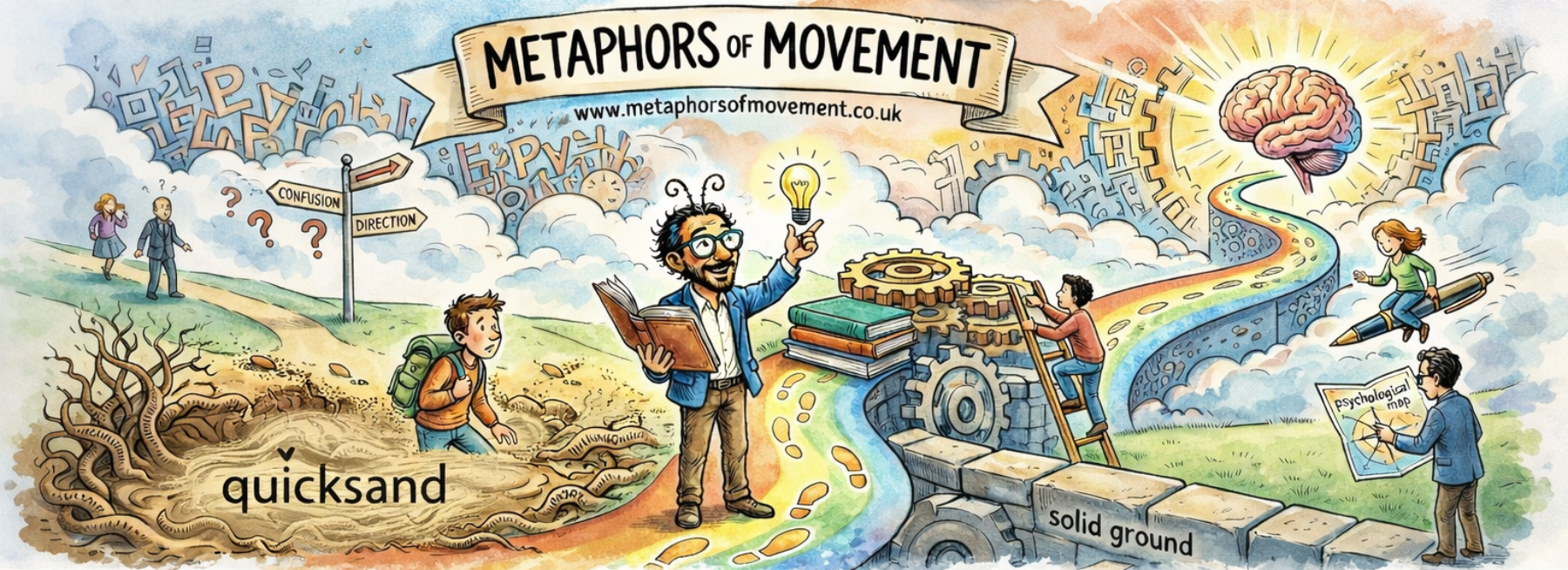
Writings: Exploring Metaphors of Movement
The Writings section of Metaphors of Movement gathers Andrew T. Austin’s essays and longer pieces on how metaphors organise experience, emotion, behaviour, and identity. This page is designed as a guided map: a place to start, understand how the articles fit together, and decide what to read next.
Whether you are a therapist, coach, trainer, or simply fascinated by how people “live inside” their metaphors, use this pillar page to navigate key themes: therapy and mind, time and memory, suffering and punishment, money and status, and the geometry of relationships and surveillance.
On this page
- Metaphors of therapy, mind & emotion
- Time, simulation & the organisation of experience
- Suffering, “the hurts” & punishment
- Money, business, success & status
- Space, relationship & surveillance metaphors
- Metaphors of movement & motion (core framework)
- Further concepts & resources
- More writings & latest blog posts
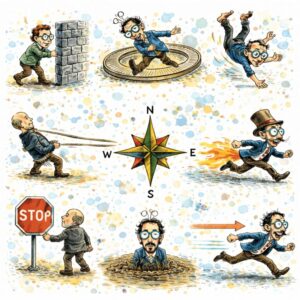
Metaphors of Movement & Motion (core framework)
At the centre of this body of work is the idea that psychological experience is organised through metaphors of movement: approach and avoidance, advance and retreat, blockage, looping, collapse, acceleration, and arrest.
Rather than treating thoughts and emotions as abstract mental content, Metaphors of Movement focuses on how people experience themselves as moving, or being unable to move, through internal and relational worlds.
Metaphors of Movement and Motion
This hub page brings together the core essays that define the movement-based approach: how problems stabilise through metaphorical motion patterns, how change occurs when those patterns shift, and why many conventional interventions fail by ignoring the client’s lived geometry of experience.
If you are new to Metaphors of Movement, this is the conceptual backbone that makes sense of everything else on this page.
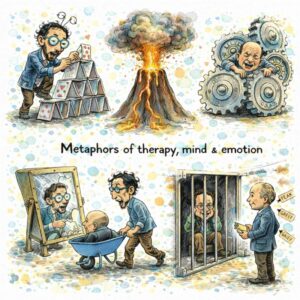
Metaphors of therapy, mind & emotion
These writings examine how therapeutic models, emotional states, and change techniques are built on distinct metaphorical structures. They are especially useful for practitioners who want to move beyond technique into the underlying architecture of experience.
Metaphors of Therapy and Mind
This article contrasts how different therapeutic approaches implicitly imagine “the mind” and “therapy” itself, as a machine to repair, a narrative to rewrite, an energy to balance, or a landscape to move through. It shows how these root metaphors shape what change is considered possible, which problems “make sense”, and which kinds of clients each model inadvertently excludes. Readers gain a clearer understanding of why some methods resonate deeply while others feel like a poor fit, even when they are technically competent.
Metaphors of Emotion
Emotional life is treated not as vague “feelings” but as structured metaphors: being under pressure, weighed down, boiling over, frozen, and so on. The article explores how these metaphors reveal how a person is positioned in relation to their emotional experience, i.e. trapped by it, carrying it, immersed in it, or separated from it, and how precise questioning can open new directions of movement.
Metaphors of Depression: Movement, Meaning, and Therapeutic Intervention
Depression is often described through metaphors of stuckness, heaviness, downward motion, and isolation. This piece maps those metaphors in detail and shows how Metaphors of Movement works with them, not by arguing with experience, but by exploring the metaphorical terrain until new forms of movement become visible. Particularly relevant for practitioners who find standard reframing, CBT, or “positive thinking” approaches ineffective or invalidating.
Submodalities
A critical examination of the NLP concept of submodalities, contrasted with the movement-based logic of Metaphors of Movement. Rather than endlessly adjusting internal pictures, the focus is on the kind of world the client’s metaphor describes and how that world constrains or enables movement.
Well-Formed Outcomes
This article examines the hidden metaphors inside outcome-focused language and how they can conflict with a client’s lived experience. It invites practitioners to listen for the client’s existing metaphor first, before imposing goals that may be irrelevant or harmful.
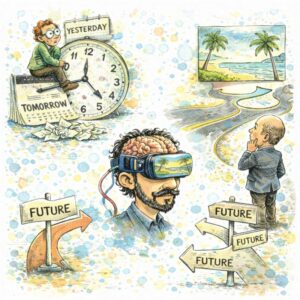
Time, simulation & the organisation of experience
These writings explore how time is metaphorically organised and how the brain constructs meaning through simulation.
Metaphors of Time and the Organisation of Experience
An exploration of time as line, container, resource, or moving entity, and how rigid or frozen time metaphors shape regret, anticipation, and memory.
Situated Simulation in the Human Conceptual System
An accessible overview of embodied cognition and how metaphorical language activates simulations of posture, movement, and relationship.

Suffering, “the hurts” & punishment
These essays focus on how suffering becomes structurally encoded through early experience, threat, and learned punishment.
Individual Change: Models of Suffering
A mapping of recurring metaphorical patterns of suffering, such as burdens, traps, loops, and impossible tasks, and how naming the model opens movement.
Negative Prototypal Experiences
How ordinary formative experiences become enduring templates for identity, authority, and belonging.
“The Hurts”
A focused look at recurring metaphorical injuries that clients often normalise but continue to live inside.
Punishment, Double Binds and Parental Threats to Survival
An exploration of punishment metaphors and how internalised threat structures govern adult behaviour.
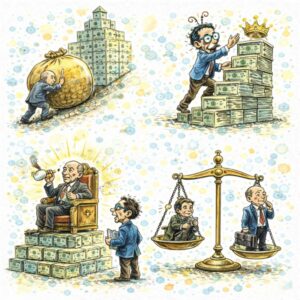
Money, business, success & status
These writings examine how symbolic worlds of money, worth, and success interact with real-world business and practice.
Metaphors of Money
Money as safety, poison, fuel, or constraint and why technical knowledge alone rarely resolves money problems.
Internet Marketing and the Problem of Rockets
A critique of explosive growth metaphors in marketing and their psychological consequences.
Selling Success Versus Identifying Problem
Why accurate problem mapping matters more than aspirational promises.
Columns, Pedestals, and the Architecture of Status
How architectural metaphors structure admiration, pressure, impostor syndrome, and fear of falling.
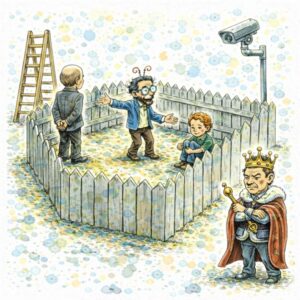
Space, relationship & surveillance metaphors
A focus on spatial metaphors that organise relationships, boundaries, power, and being seen.
Panopticon
Surveillance, self-regulation, and the metaphor of the unseen watcher.
Relationship Position and the Geometry of Interaction
How relational language reveals distance, hierarchy, conflict, and loyalty.
Further concepts & resources
These supporting pages extend the main themes with reference material, specialist concepts, visual examples, and links for further study.
Biases
A reference table of recurring metaphor classes and the everyday idioms associated with them.
Introjection
An introduction to introjects and introjection, with particular reference to Professor Sam Vaknin’s account of narcissistic dynamics.
The Dominance Hierarchy of Interpersonal Space
A working model for mapping how people, objects, places, symbols, roles, ideas, and relationships acquire value within human interaction.
Boundary Violations
An introduction to the Metaphors of Movement concept of boundary violations within metaphor elicitation.
Metaphor Cartoons
A visual archive of cartoons illustrating familiar metaphors, predicaments, and patterns of movement.
Metaphors Links and Resources
Links to researchers, practitioners, and organisations whose work has informed the wider study of metaphor and mental space.
External Resources
A direct route to selected external material, including the Milton H. Erickson Foundation.
More writings & latest blog posts
The blog contains newer articles, shorter pieces, and ongoing explorations that expand the themes above.
Visit the Metaphors of Movement Blog
How to use this page
This pillar page is your navigation hub for the Writings section. Bookmark it and return as your interests shift.
Pay attention to which metaphors feel familiar or uncomfortable; those reactions often point to where exploration is most alive.
