The Dominance Hierarchy of Interpersonal Space
A skeletal model for mapping how people, objects, places, symbols, roles, ideas and relationships acquire value within human interaction.
1. The Core Proposition
Value is not located only inside a person, object, place, title or idea.
Value emerges in the space between:
- the thing being valued
- the person or group perceiving it
- the meanings attached to it
- the social recognition surrounding it
- the behaviours it produces
This model treats interpersonal space as a field in which meanings are ranked, defended, negotiated, transferred and contested.
2. The Basic Formula
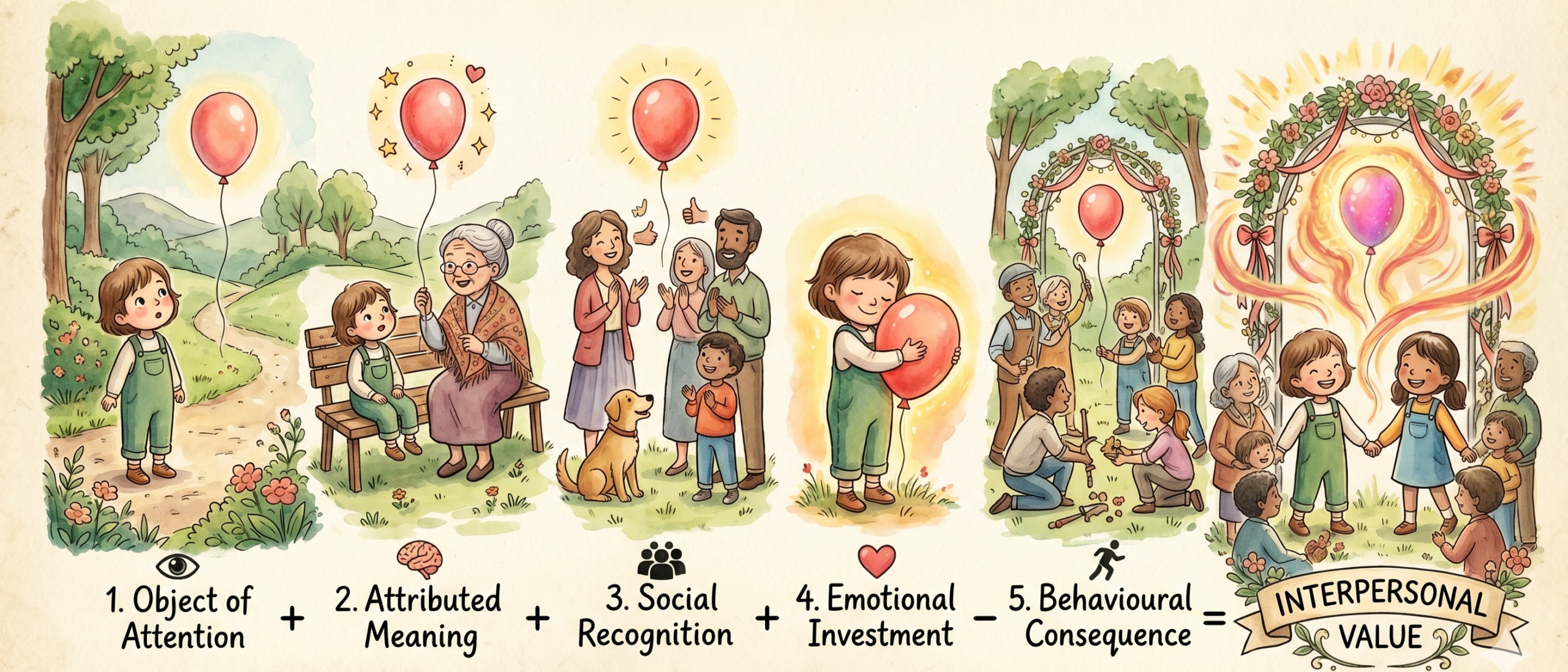
Object of Attention + Attributed Meaning + Social Recognition + Emotional Investment + Behavioural Consequence = Interpersonal Value
Or, more simply:
Things become valuable when people organise meaning and behaviour around them.
3. The DHIS Model
(To illustrate this model in action, the points of reference below have been completed using the working example of a Professional Psychotherapy Diploma).
Stage 1: The Object of Attention
This is the person, place, object, symbol, idea, event, title, memory or identity marker being evaluated.
Reference Example: A Professional Psychotherapy Diploma.
- What is being valued?
- What is being protected?
- What is being pursued?
- What is being rejected?
- What is being fought over?
Stage 2: The Material or Observable Base
Before meaning is added, what is the thing in its simplest observable form?
Reference Example: A physical piece of thick parchment paper with ink printed on it, featuring a name, a date, a gold foil stamp, and handwritten signatures.
- What is it physically?
- What can be observed?
- What is its ordinary function?
- What would it be without the added story?
At the material level, this is simply: a piece of printed paper.
Stage 3: The Attribution of Meaning
This is the story, association or symbolic charge attached to the object of attention.
Reference Example: It represents years of rigorous academic study, personal sacrifice, clinical competence, authority, and the ethical right to treat vulnerable clients.
- What story has been attached to it?
- Who says it matters?
- What does it represent?
- What memory, identity or status does it carry?
- What does it mean to those involved?
This matters because it is associated with: proof of competence, hard-earned professional identity, and clinical authority.
Stage 4: The Interpersonal Field
Value increases or decreases according to how many people recognise, share, validate or contest the attributed meaning.
Reference Example: The meaning is validated by the professional licensing board, colleagues, insurance companies, and prospective clients. It might be ignored or contested by uncredentialed “life coaches” or alternative healers.
- Who recognises this value?
- Who rejects it?
- Who benefits from it?
- Who is expected to respect it?
- Which group maintains the meaning?
- Which group challenges it?
This value is maintained by: the professional governing body, clinical peers, and a public that demands certified experts.
Stage 5: The Hierarchical Ranking
Not all meanings are equal. Some meanings outrank others. The hierarchy determines what is treated as ordinary, important, prestigious, sacred, shameful, dangerous or untouchable.
Reference Example: It holds high prestige and acts as a strict gatekeeping mechanism. It outranks informal experience, but might be outranked by a PhD or a Medical Doctorate in certain clinical settings.
- Where does this sit in the hierarchy?
- What does it outrank?
- What outranks it?
- Is it trivial, useful, prestigious, sacred or forbidden?
- Who gets to decide its rank?
Within this interpersonal field, this is ranked as: high prestige / a gatekeeping necessity.
Stage 6: Emotional Charge
The position of the object in the hierarchy determines the emotional intensity surrounding it.
Reference Example: Immense pride, professional security, fear of having it revoked, and indignation/anger if someone suggests the qualification is worthless or inferior.
- What feelings arise around it?
- Pride? Shame? Grief? Anger? Devotion? Envy? Fear? Belonging?
The dominant emotional charge attached to this is: pride in achievement and protective defensiveness of the profession’s status.
Stage 7: Behavioural Consequence
The reality of the value is shown by what people are prepared to do because of it.
Reference Example: People will pay thousands of pounds to acquire it, frame it prominently on an office wall, pay expensive annual renewal fees to maintain it, and strictly abide by its ethical codes to avoid losing it.
- What will people pay for it?
- What will they sacrifice for it?
- What will they defend, avoid, attack, or preserve?
- What will they refuse to negotiate?
The value becomes visible when people: invest years of their life to obtain it and aggressively defend their exclusive right to practice under its title.
Stage 8: Boundary and Ownership
Highly ranked values tend to create boundaries. These boundaries define who belongs, who has authority, who may speak, who may use the symbol, and who is excluded.
Reference Example: Only those who pass the exams own the title. The licensing board retains ultimate ownership and can revoke it. Misuse includes practicing without it, which is legally or socially punished.
- Who claims ownership?
- Who is allowed access? Who is excluded?
- Who has permission to define its meaning?
- What counts as misuse or betrayal?
The boundary around this value is maintained by: legal gatekeepers, ethical codes of conduct, and professional associations who determine who is allowed to practice.
Stage 9: Contest and Rival Meaning
Conflict occurs when two or more parties attach different meanings to the same object of attention, or rank the same meaning differently.
Reference Example: A bio-medical psychiatrist might view the psychotherapy diploma as a “lesser” qualification compared to medical school, while the therapist views it as representing “deeper, more authentic psychological expertise.”
- Who disagrees about its meaning?
- What rival meanings exist?
- What does each side believe is at stake?
- Which meanings are compatible or mutually exclusive?
The conflict arises because one party sees this as an inferior qualification compared to a medical degree, while another sees it as the ultimate standard for psychological healing and insight.
Stage 10: Stabilisation or Collapse
An interpersonal value system remains stable only while enough people continue to recognise, perform and defend it. It weakens when recognition fades, stories change, authority collapses, or rival meanings become stronger.
Reference Example: The diploma’s value remains stable as long as the law supports it and clients seek it out. It would collapse if the governing body were exposed in a massive corruption scandal or if the government entirely deregulated the mental health industry.
- What keeps this value stable?
- What threatens it?
- What would cause people to stop caring?
- What would increase its value?
- What would devalue it?
This value remains stable so long as: the governing body maintains its legal/social authority, and the public continues to place trust in credentialed experts.
4. The Full Template
| Layer | Question | Completed Reference (Example) |
|---|---|---|
| 1. Object of Attention | What is being valued? | A Professional Psychotherapy Diploma |
| 2. Observable Base | What is it before meaning is added? | A piece of printed paper with ink, dates, and signatures |
| 3. Attribution | What story, memory or identity is attached? | Proof of competence, authority, and ethical standards |
| 4. Interpersonal Field | Who recognises or contests this value? | Validated by licensing boards and peers; contested by uncredentialed practitioners |
| 5. Hierarchical Rank | How highly is it ranked? | High prestige; serves as a mandatory gatekeeper for trust |
| 6. Emotional Charge | What feelings are organised around it? | Pride, security, and defensive indignation if challenged |
| 7. Behavioural Consequence | What do people do because of it? | Frame it on walls, pay renewal fees, and exclude those without it |
| 8. Boundary and Ownership | Who controls access, use or interpretation? | The professional association controls who may use the title |
| 9. Rival Meaning | What competing interpretations exist? | “Deep psychological expertise” vs. “Inferior to a medical degree” |
| 10. Stability or Collapse | What keeps the value alive or causes it to decay? | Stable while legally backed; collapses if deregulated or discredited |
5. Diagnostic Questions
To Identify the Value
- What are people treating as important?
- What are they unwilling to treat as ordinary?
- What do they protect from criticism?
- What do they elevate above practical usefulness?
To Identify the Hierarchy
- What is above what?
- What must be respected first?
- What cannot be questioned without consequence?
- What gives someone status in this field?
To Identify the Interpersonal Field
- Who has to agree for the value to hold?
- Who can remove the value?
- Who can increase it?
- Who is punished for not recognising it?
To Identify the Behavioural Reality
- What does this make people do?
- What does this stop people doing?
- What costs will people accept for it?
- What risks will they take for it?
6. The Model in One Sentence
The dominance hierarchy of interpersonal space is the ranked system of meanings through which people assign value, status, emotional force and behavioural obligation to objects, places, people, ideas and symbols.
7. Completed Working Template
Object of attention: A Professional Psychotherapy Diploma
Observable base: A piece of printed paper with ink, names, dates, and signatures
Attributed meaning: Proof of psychological competence, professional authority, and an ethical code
Who recognises the value: Licensing boards, clinical peers, and prospective therapy clients
Who contests the value: Unregulated life coaches or practitioners of alternative/rival paradigms
Position in hierarchy: High prestige; functions as a sacred gatekeeping requirement for the profession
Emotional charge: Intense pride, professional security, and protective defensiveness
Behavioural consequences: Hanging it on a wall, paying annual dues, and adhering strictly to a board’s rules
Boundaries and ownership: The professional association grants and revokes it; individuals merely hold it
Rival meanings: “Authentic healing expertise” versus “Rigid, academic gatekeeping”
Conditions that sustain it: Legal backing, cultural trust in science/therapy, and institutional authority
Conditions that would devalue it: Systemic deregulation of the industry or a massive public scandal involving the governing body
8. Condensed Skeleton
- What is the thing?
- What does it mean?
- Who says it means that?
- How highly is it ranked?
- What emotion does it carry?
- What behaviour does it produce?
- Who controls it?
- Who contests it?
- What keeps it valuable?
- What would make its value collapse?
