Working with Aphantasia in Metaphors of Movement by Masha Bennett
One of the common assumptions in therapeutic metaphor work is that people can, in some way, access internal imagery: to visualise, to see things “in their mind’s eye”. Even when this imagery is vague, blurry or fleeting (as my own typically is), it is often treated as the primary medium through which metaphor unfolds and can be explored.
However, this assumption does not always hold. Occasionally, we may encounter people affected by severe forms of aphantasia: not simply someone who reports some level of difficulty with visualising, but someone who cannot access internal imagery at all.
Whilst the prevalence of aphantasia in the general population is estimated to be around 4%, this includes cases of the so-called “visual imagery weakness” (e.g. affected individuals may still be able to see some dim or vague images); however, the extreme form of aphantasia is thought to only affect 0.8% of the population, in whom imagery is altogether absent (Dance et al., 2022).
This raises an interesting and important question for Metaphors of Movement: what happens when the visual inner landscape is not available, e.g. as in cases of severe aphantasia?
R., one of the participants of my recent Metaphors of Movement training, had reservations about joining the course, as she could not access any inner imagery whatsoever.
However, we found that she was still able to engage meaningfully in the training and successfully work with her own metaphors and those of others through a series of practical adaptations. R. has kindly given me permission to share these findings with the wider Metaphors of Movement community.
What emerged was not a limitation of the model, but rather a demonstration of its flexibility when grounded in embodiment.
When working on her own metaphor, in the absence of visual elements R. was able to rely on her felt sense; she physically adopted the body position that corresponded to her posture within the metaphor, allowing the experience to emerge through the body rather than through imagery.
R. also found that she needed to draw her own metaphor. Drawings produced by other participants when they played the role of a therapist during practical exercises often did not resonate, and it was difficult for her to make suggestions on how these should be corrected.
When movement was involved in working with the metaphor, R. enacted it physically, for example by taking steps, sitting down, standing up. I often give my students a choice whether to do this, instead of simply visualising movement, and some find it helpful, but on this occasion, it appeared necessary, not optional.
“In effect, the metaphor was not “seen” internally but instead felt and constructed through action, orientation, and interaction with the physical environment.”
When in the role of a therapist, eliciting metaphors and guiding others through this work, a different set of adaptations became necessary for R. She found that she needed to write down the client’s description of the metaphor landscape before attempting to draw it; that is, details such as what was to the left, right, in front, or behind had to be explicitly recorded and organised first. She was then able to produce a drawing based on the written description.
This suggests that, in the absence of internal imagery, spatial cognition may be supported through language and structured external representation.
R.’s experience highlights something fundamental about metaphor work: imagery is not the mechanism; it is just one possible interface. The underlying processes appear to be grounded in embodiment, spatial orientation, relational positioning, and movement.
If someone reports difficulty visualising, it may not be a barrier to effective work. Instead, it invites flexibility in approach. This might include encouraging physical enactment of metaphor, working explicitly with spatial language, and inviting the individual to feel rather than see the metaphor.
Where imagery is absent, the metaphor may still exist and can be effectively explored and utilised in the context of the Metaphors of Movement model. For R., most of the components of this work, including idiomisation, testing out the real-world coping strategy (“Strange Road”), taking steps, and so on, turned out to be just as relevant and significant as they were to those participants who could see clear images in their mind’s eye.
I would love to hear from any Metaphors of Movement practitioners or trainees who are aphantasic themselves or work with clients who cannot access imagery, and to learn about any adjustments to the model that you have found useful in such cases.
Meteor: Etymology, Semantic Drift, and the Metaphors of Sudden Motion
Abstract
“What goes up, must come down.”
The word meteor occupies a distinctive position at the intersection of cosmology, philosophy, and metaphor. While commonly understood today as a fiery object streaking across the night sky, meteor originally referred to anything suspended in the air, a meaning far broader and more abstract than its modern usage. This page traces the etymology of meteor from Ancient Greek through medieval natural philosophy to contemporary English, mapping its derivative forms (meteoric, meteorology, meteoroid) and the idiomatic expressions that encode its metaphorical force. Particular attention is paid to how meteor functions within a Metaphors of Movement framework: signifying sudden appearance, rapid ascent, transience, and uncontrolled descent.
In idiomatic expressions, meteors initially rise.
Greek Origins: meteōros (“Lifted Up, Suspended”)
The English word meteor derives from the Ancient Greek adjective μετέωρος (meteōros), meaning:
raised up
lofty
suspended in mid-air
aloft, unsettled
Crucially, meteōros does not originally imply fire, rock, or space. It denotes a state of suspension between realms, neither grounded nor celestial. The term is composed of:
μετά (meta): between, among, beyond
ἀείρω (aeírō): to lift, raise up
Etymologically, meteōros signifies “that which is raised up between,” a formulation that later proves highly fertile for metaphorical interpretation involving instability, impermanence, and dramatic transition.
Classical Philosophy: The Meteor as a Middle-Realm Phenomenon
In classical Greek philosophy, particularly in Aristotelian natural science, meteōra referred to all phenomena occurring between the earth and the fixed heavens. In his treatise Meteorologica, Aristotle examined clouds, rain, wind, lightning, comets, atmospheric fires, and falling stones.
These phenomena belonged to the sub-lunary realm: the mutable, unstable region beneath the Moon, in contrast to the perfect and eternal heavens beyond it. A “meteor” was therefore not a discrete object but a process in motion, often transient, unpredictable, and difficult to categorise.
This framing is central to later metaphorical uses: meteors are things that appear suddenly, move dramatically, and disappear without permanence.
Latin and Medieval Transmission
The Greek term entered Latin as meteorum and meteora, retaining its broad meaning of aerial or atmospheric phenomena. Medieval scholastic texts, still grounded in Aristotelian cosmology, used the term “meteor” to denote lightning, halos, comets, falling stars, and unusual celestial phenomena.
Only with the decline of Aristotelian physics during the early modern period did the term begin to narrow in meaning.
Scientific Narrowing: From Atmosphere to Space Object
By the eighteenth and nineteenth centuries, meteor acquired its modern technical sense:
meteor: the visible streak of light caused by an object burning in the atmosphere
meteoroid: the object while still in space
meteorite: the fragment that reaches the ground
From a metaphorical perspective, this narrowing is historically late and conceptually reductive. Linguistically, it obscures the word’s original emphasis on suspension, instability, and transition.
Derivative Forms and Semantic Fields
Meteoric
The adjective meteoric preserves much of the metaphorical power lost by the noun meteor. Its dominant connotations include:
suddenness
rapidity
spectacle
brevity
instability
Common examples include “a meteoric rise to fame” or “a meteoric career.” Within a Metaphors of Movement framework, meteoric implies high upward velocity without structural support, often carrying an implicit expectation of collapse or disappearance.
Meteorology
Despite popular misunderstanding, meteorology does not originally mean the study of space objects. It literally refers to the study of things suspended in the air, preserving the older Greek sense of meteōra.
Meteorite
The meteorite represents semantic closure: that which was once suspended but has fallen and become grounded. Conceptually, it is the failure of suspension.
The word meteorite comes from Greek roots: meteoron (“thing high up”) and the suffix -ite, meaning it’s a rock from the sky, specifically the stony remnant of a meteor (shooting star) that falls to Earth. While meteor originally denoted any atmospheric phenomenon, meteorite emerged in the 19th century to refer to space rocks that hit Earth, derived from the meteor process (meteor + -ite).
The suffix “-ite” has several meanings, most commonly denoting a person from a place or follower of a belief (like Israelite, Thatcherite), a mineral or fossil (like granite, ammonite), or a chemical compound/product (like sulfite, dynamite), often originating from Greek or Latin roots related to “stone” or “belonging to”. It can also signify a segment of a body part (like somite) or a type of salt from an “-ous” acid (like phosphite).
Idioms and Fixed Expressions
English idioms involving meteors are remarkably consistent in their movement logic:
a meteoric rise: rapid ascent with minimal preparation
to rise like a meteor: sudden visibility and dramatic entry
burn bright and fade: brilliance without duration
Principally, the unspoken suggestion is that it’s an earth rock falling back down.
Metaphors of Movement Analysis
Within a Metaphors of Movement model, meteor belongs to a distinctive cluster characterised by:
upward then downward motion
extreme speed
lack of control
high visibility
short duration
This makes the meteor metaphor particularly useful for describing careers, social influence, fame, emotional surges, ideologies, and trends. A meteoric trajectory is movement without containment.
Psychological and Cultural Resonance
Meteor metaphors persist because they encode a cultural ambivalence: awe at rapid ascent paired with anxiety about impermanence. In psychological and narrative contexts, meteoric movement often signals externally driven validation, fragile self-structure, and unsustainable pacing. This is something heavily promoted by predatory gurus in the personal development/personal success/financial freedom industry.
The warning implicit in the metaphor is not against success, but against velocity that exceeds integration.
Not everything that rises is ready to remain aloft. As idiot life coaches like to say, “shoot for the stars, if you miss, you will land on the moon.” They present this as a positive.
Etymology: From the Latin root iacere (to throw), evolving through jectus (“thrown”).
This family of words has produced a network of meanings in English, all centred around the metaphor of throwing, whether of objects, thoughts, emotions, or actions.
Understanding the Root
The root -ject conveys the core idea of throwing or casting. Each prefix modifies the direction or intent of the action; for example, inject (throw in), reject (throw back), and project (throw forward).
List of -ject Words and Meanings
Word
Prefix Origin
Literal Meaning
Modern Usage
Abject
ab- = away
Thrown away
Wretched, degraded, miserable
Adjective
ad- = to
Thrown to (a noun)
A word that modifies a noun
Conjecture
con- = together
Thrown together
An inference or educated guess
Deject
de- = down
Thrown down
To make low in spirit
Eject
e-/ex- = out
Thrown out
To expel or remove
Inject
in- = into
Thrown into
To introduce (a substance or idea)
Interject
inter- = between
Thrown between
To interrupt with a remark
Object
ob- = against
Thrown against
To oppose; or a thing perceived
Project
pro- = forward
Thrown forward
To plan, predict, or extend outward
Reject
re- = back
Thrown back
To refuse, discard, or disapprove
Subject
sub- = under
Thrown under
Under authority; a topic of discussion
Trajectory
tra-/trans- = across
Thrown across
The path of a moving object
Retroject
retro- = backwards
Thrown back (in time)
To attribute something to the past
Disject
dis- = apart
Thrown apart
To scatter or disperse
Superject
super- = above
Thrown above
Philosophical term (A.N. Whitehead): a transcendent being
Derived Forms
-jection → The act of throwing (e.g. ejection, rejection, projection).
-jective → Having the quality of throwing (e.g. subjective, projective).
-jecture → The process of mental “throwing together” (e.g. conjecture).
Metaphorical Insights
In Metaphors of Movement, language built around -ject reflects embodied metaphors of direction and agency:
“Thrown down” states (dejection, abjection) depict loss of power and position.
“Thrown forward” (projection) shows aspiration, intent, and creation.
“Thrown against” (objection) expresses confrontation or boundary.
“Thrown together” (conjecture) marks synthesis and meaning-making.
These linguistic patterns mirror how people describe internal states, ambitions, and struggles, making the -ject family especially relevant in metaphor analysis and therapeutic dialogue.
Summary Table of Symbolic Directions
Direction
Prefix
Example
Symbolic Interpretation
Down
de-, ab-
deject, abject
Suppression, shame, defeat
Out
e-, ex-
eject
Expulsion, rejection, exclusion
Forward
pro-
project
Ambition, creativity, goal-setting
Against
ob-
object
Resistance, defence, confrontation
Into
in-
inject
Introduction, penetration, influence
Under
sub-
subject
Submission, governance, hierarchy
Together
con-
conjecture
Integration, synthesis, guessing
Across
tra-/trans-
trajectory
Movement, progress, destiny
References
Harper, D. (2024). Online Etymology Dictionary.
Oxford English Dictionary, entries for -ject and related prefixes.
Whitehead, A.N. (1929). Process and Reality, introduction of the term superject.
Primary Metaphors: Embodied Co-Occurrence and Recurring Mappings
Primary metaphors are conventional mappings that arise from everyday embodied co-occurrences between sensorimotor experiences and more abstract subjective experiences. Rather than being arbitrary figures of speech, they are learned automatically through repeated correlation in infancy and early childhood (e.g., being held by a caregiver is both warm and affectionate), yielding entrenched cross-domain mappings such as AFFECTION IS WARMTH. These mappings subsequently structure linguistic expressions, conceptual inferences, and patterns of attention in adult cognition.
Origins and Core Idea
The concept of primary metaphors originates within cognitive linguistics, particularly from the work of George Lakoff, Mark Johnson, and Joseph Grady. While Conceptual Metaphor Theory (Lakoff & Johnson, 1980) established that metaphor is foundational to thought, primary metaphor theory (Grady, 1997) refines this by proposing that many complex metaphors are composed from simpler, experientially grounded mappings learned via correlation (not mere resemblance). These correlations are products of everyday bodily interactions with the world.
Mechanism: From Co-Occurrence to Mapping
Embodied co-activation: A child experiences two domains together, for example physical warmth and affectionate touch.
Conventionalization: The association stabilises as a mapping (A → B) that guides language and inference.
Composition: Multiple primary metaphors combine into more complex metaphoric networks (e.g., INTIMACY IS CLOSENESS + AFFECTION IS WARMTH → rich descriptions of relationships).
Canonical Examples
AFFECTION IS WARMTH: “a warm welcome,” “cold person,” “heated embrace.”
MORE IS UP , “prices went up,” “turn the volume down.”
GOOD IS UP / BAD IS DOWN , “spirits lifted,” “feeling down.”
INTIMACY IS CLOSENESS , “we’re very close,” “they’ve grown apart.”
DIFFICULTIES ARE BURDENS , “carry a heavy load,” “lighten your burden.”
IMPORTANCE IS WEIGHT , “a weighty matter,” “light reading.”
Evidence and Methods
Linguistic evidence appears in cross-linguistic corpora where similar expressions recur systematically (e.g., verticality terms for quantity or affect). Behavioural and priming studies suggest bidirectional influences (e.g., holding a warm drink can increase judgments of interpersonal warmth). Developmental accounts emphasise early caregiver-infant interactions (temperature, proximity, balance, force dynamics) as sources of tightly coupled experiences that scaffold abstract reasoning.
Primary vs. Complex Metaphors
Primary metaphors are atomic mappings (e.g., WARMTH → AFFECTION). Complex metaphors (e.g., LOVE IS A JOURNEY) are built by composing several primary metaphors (e.g., RELATIONSHIP PROGRESS IS MOTION, PURPOSES ARE DESTINATIONS, DIFFICULTIES ARE OBSTACLES). Recognising this compositionality helps analysts and practitioners diagnose which embodied schemas are doing the explanatory work in discourse, and how shifting the base mapping can reorganise inferences.
Cross-Linguistic and Cultural Considerations
Many primary metaphors show wide cross-linguistic distribution (e.g., MORE IS UP, GOOD IS UP) due to shared bodily experiences and the physical structure of environments. Nonetheless, variability does occur, shaped by local ecology, cultural practices, and lexicalisation patterns (e.g., temperature terms, spatial frames of reference). Primary metaphor theory predicts both convergence (resulting from universal co-occurrences) and divergence (resulting from cultural niche construction).
Implications for Analysis and Practice
Discourse and rhetoric: Identify which primary mappings are active and how they steer evaluation and policy (e.g., “crime surge” invokes MORE IS UP and FORCES ARE FLUIDS).
Education and science communication: Choose primary-aligned metaphors that scaffold novices without misleading (e.g., energy “flow” vs. conservation).
Therapy and coaching: Elicit clients’ metaphors and trace them to primary mappings (burdens, distances, heights, temperatures). Adjust the base mapping to shift felt sense and options for action.
Design and UX: Leverage embodied schemas (up/down, near/far, balance, containment) to enhance intuitiveness.
Critiques and Limitations
Universality claims: Some argue that “universals” can be overstated; careful cross-cultural work is required.
Directionality: Not all mappings are equally entrenched or unidirectional; context can reverse or neutralise effects.
Over-extension: Explanations risk circularity if not constrained by independent behavioural or developmental evidence.
Primary metaphors explain how abstract thought is scaffolded by bodily experience. Through repeated co-occurrences in early life, simple, domain-crossing mappings become conventional and productive, structuring language, inference, and social judgment. Understanding these mappings clarifies why certain metaphors feel intuitive, how they can be recombined into complex conceptual systems, and how shifting the underlying embodied schema can reshape meaning and action.
References
Grady, J. (1997). Foundations of Meaning: Primary Metaphors and Primary Scenes. PhD dissertation, UC Berkeley.
Lakoff, G., & Johnson, M. (1980). Metaphors We Live By. University of Chicago Press.
Núñez, R., & Sweetser, E. (2006). With the future behind them: Evidence from Aymara. Cognitive Science, 30(3), 401-450.
Williams, L. E., & Bargh, J. A. (2008). Experiencing physical warmth promotes interpersonal warmth. Science, 322(5901), 606-607.
Max Black’s Interaction Model of Metaphor: Mapping Systems and Emergent Meaning
Max Black’s work transformed twentieth-century metaphor theory by arguing that metaphors do not merely substitute one term for another, nor simply compare two pre-existing entities. Rather, a metaphor functions through an interaction between two systems of implications, what earlier theorists (for example, I. A. Richards) would call the vehicle and the tenor. In Black’s account, the vehicle brings a structured network of associated ideas (its “system”) that selectively filters and re-describes the tenor, producing emergent meaning that was not present in either term alone.
Focus, Frame, and the System of Implications
Black distinguishes between the focus (the conspicuously metaphorical expression) and the frame (the surrounding literal context in which the expression appears). The vehicle’s “associated commonplaces”, culturally shared and inferentially connected attributes, are projected onto the tenor via the focus/frame configuration. This projection is not a one-way imposition but a mutually shaping interaction: the tenor constrains which vehicle-implications are relevant, while the vehicle organises our attention to (and re-descriptions of) the tenor’s features.
Interaction as Mapping Between Systems
In contemporary terms, Black’s model anticipates a view of metaphor as mapping between structured domains. The vehicle supplies a source system of implications; the tenor provides a target system with its own attributes. Through interaction, selected implications from the source are mapped onto the target, yielding a new pattern of predicates for the tenor. For instance, in “Time is a river,” the vehicle (river) contributes implications of flow, directionality, and irreversibility, which reframe the tenor (time) and generate new inferences (e.g., “we cannot step into the same river twice” → non-repeatability of moments).
Emergence, Not Substitution
Crucially, Black rejects substitution (metaphor as ornament or shorthand) and comparison (metaphor as explicit likeness) theories in favour of interaction. The result is emergent, meaning that predicates and perspectives are not merely retrieved from a lexicon but are produced by the dynamic interplay between systems. This helps explain why metaphors can be cognitively productive, theory-generating, and even explanatory in science (e.g., “genes as codes,” “the brain as a computer,” “the immune system as an army”).
Relation to Richards and Later Developments
Black builds directly on Richards’ (1936) tenor-vehicle distinction but formalises it in terms of systems and associated commonplaces, making the interaction more explicit and theory-laden. His account also foreshadows later Conceptual Metaphor Theory (Lakoff & Johnson, 1980), which generalises the idea of cross-domain mappings and emphasises embodiment. Where Black focuses on semantic and cultural implication-systems, later work elaborates the cognitive architecture (e.g., source-target domain mappings, image schemas, and primary metaphors).
Implications for Analysis and Practice
Critical analysis: Identify the vehicle’s commonplace implications and show how they select features of the tenor. Ask: which traits are being imported, which are suppressed, and to what rhetorical effect?
Therapeutic work: Elicit the client’s vehicle system (the images they use) and examine how those implications are structuring the client’s understanding of the tenor (self, problem, relationship). Changing the vehicle changes the system of implications, thus inviting new meanings.
Scientific discourse: Track how metaphor vehicles (“field,” “network,” “ecosystem”) encourage specific inferential patterns and research heuristics, while potentially hiding alternatives.
Max Black reconceived metaphor as an engine of semantic innovation. By treating both sides of the metaphor as structured systems and emphasising their interaction, he accounted for how metaphors reorganise what we notice, the predicates we ascribe, and the inferences we make. This model remains central to contemporary work in linguistics, philosophy of language, rhetoric, and applied fields, ranging from psychotherapy to science communication.
References
Black, M. (1954-55). Metaphor. Proceedings of the Aristotelian Society, 55, 273-294.
Black, M. (1962). Models and Metaphors: Studies in Language and Philosophy. Cornell University Press.
Richards, I. A. (1936). The Philosophy of Rhetoric. Oxford University Press.
Lakoff, G., & Johnson, M. (1980). Metaphors We Live By. University of Chicago Press.
In the study of metaphor, one of the foundational contributions came from I. A. Richards (1936) in his work The Philosophy of Rhetoric.
Richards moved metaphor theory beyond ornamentation and decoration (as emphasised in classical rhetoric) and proposed a dynamic view in which metaphors are understood as an interaction between two components: the tenor and the vehicle.
Defining Tenor and Vehicle
Richards defined the tenor as the underlying subject or concept that the metaphor seeks to illuminate, while the vehicle is the image or idea through which the tenor is expressed. In the metaphor “time is a thief,” the tenor is time, and the vehicle is thief. The metaphor draws its meaning from the interplay between these two elements.
“In every metaphor there are two thoughts of different things active together and supported by a single word, or phrase, whose meaning is a resultant of their interaction.” I. A. Richards, The Philosophy of Rhetoric (1936)
The Tension Between Tenor and Vehicle
The power of a metaphor lies not in the direct substitution of one word for another, but in the tension or interaction between the tenor and the vehicle. The reader or listener must negotiate the similarities and differences between the two domains, discovering new meaning through their juxtaposition.
This tension resists full resolution: the metaphor is not a literal equivalence but a productive gap that stimulates new ways of understanding. For example, describing time as a thief suggests loss, stealth, and irreversibility, while simultaneously acknowledging that time is not a literal criminal agent. The tension compels the audience to explore the metaphor’s implications, generating layered and often novel insights.
Significance in Metaphor Theory
Richards’ Interaction Theory marked a turning point in metaphor scholarship. Instead of viewing metaphor as ornamental language (as Aristotle had argued), Richards highlighted its cognitive and semantic productivity.
This view paved the way for later developments, including Max Black’s elaboration of the interaction theory in the mid-20th century and, eventually, the Conceptual Metaphor Theory of Lakoff and Johnson (1980).
Applications Beyond Literature
The tenor-vehicle framework is still applied in modern disciplines such as linguistics, discourse analysis, and psychotherapy. For instance, in therapeutic contexts, metaphors often emerge spontaneously from clients: the tenor might be their experience of depression, while the vehicle could be a metaphor like “a heavy weight” or “a dark cloud.”
The therapist works with the tension between these elements to uncover implicit meanings, identity structures, or coping mechanisms.
Richards’ Interaction Theory reframed metaphor as a process of negotiation between subject and image, opening the door for richer accounts of how metaphors function in thought and language. The tension between tenor and vehicle is not a flaw but the very mechanism by which metaphors stimulate interpretation, creativity, and new understanding.
References
Richards, I. A. (1936). The Philosophy of Rhetoric. Oxford University Press.
Black, M. (1962). Models and Metaphors: Studies in Language and Philosophy. Cornell University Press.
Lakoff, G., & Johnson, M. (1980). Metaphors We Live By. University of Chicago Press.
In psychology and social dynamics, metaphors like pedestals, pillars, and columns often hold deeper meanings that influence our understanding of social anxiety and personal expectations. This article delves into these metaphors, exploring how they contribute to an individual’s experience of anxiety, status, and interpersonal relationships. Drawing from a recent video lecture, we will unpack the significance of these metaphors and their impact on both personal and social levels.
The Metaphor of Pedestals and Pillars
Pedestals and pillars, when used metaphorically, symbolise the elevated positions that others place individuals in. These positions often come with high expectations and significant pressure, leading to feelings of vulnerability and social anxiety. The metaphor of being “on a pedestal” suggests that any misstep could result in a fall, thus immobilising the individual and intensifying their anxiety.
Individuals placed on pedestals may appear aloof or disconnected in social contexts, further exacerbating their isolation. This metaphor is not merely a linguistic tool but reflects a psychological state where the individual feels trapped by the expectations placed upon them.
Social Dynamics and Expectations
The dynamics of pedestals and pillars are evident in various romantic, professional, and familial relationships. When someone is elevated in status, whether in the workplace or a personal relationship, and a status differential is created. This differential often forces the person on the pedestal to meet unrealistic expectations, leading to inevitable disappointment and strained relationships.
For example, in a professional setting, an individual brought in as an expert or a “wiz kid” may face resentment from colleagues, especially if they fail to live up to the hype. This creates a tense environment where the individual is judged not on their merits but on the elevated expectations set by others.
The Role of Childhood and Upbringing
Childhood experiences are crucial in how these metaphors affect individuals later in life. Children placed on pedestals by their parents are often burdened with the pressure to achieve greatness, leading to heightened anxiety and social stress as they grow older. These individuals, having been conditioned to meet high expectations, may struggle with feelings of inadequacy despite their achievements.
The metaphorical pedestal in childhood can lead to a lifetime of anxiety, where the individual constantly seeks validation and support, unable to find solid ground due to the elevated expectations that have been ingrained in them.
The Link Between Status and Anxiety
A key argument presented in the video is that all forms of anxiety, particularly social anxiety, have a status component. The speaker asserts that anxiety often stems from a perceived elevation in status, where the individual feels pressured to meet the expectations associated with their elevated position. This is particularly evident in social settings, where the fear of being judged or failing to perform can lead to significant anxiety.
The speaker challenges the notion that anxiety can exist without a status component, emphasising that status and anxiety are inherently linked.
Architectural Metaphors and Their Psychological Impact
The video also explores the architectural significance of columns, particularly the Ionic, Doric, and Corinthian orders. These columns, deeply rooted in cultural and architectural heritage, symbolise various qualities such as wisdom, strength, and beauty. The speaker uses these architectural metaphors to draw parallels with the psychological states of individuals who feel they are standing on these metaphorical pillars.
For instance, an Ionic column, often associated with wisdom, may symbolise the unrealistic expectations placed on someone to always make wise decisions, leading to anxiety and fear of failure.
The metaphors of pedestals, pillars, and columns are not just linguistic constructs but are deeply embedded in our psychological and social frameworks. These metaphors influence how individuals perceive themselves and interact with others, particularly concerning social anxiety and personal expectations. Understanding these metaphors can provide valuable insights into the nature of anxiety and help individuals navigate the pressures of elevated expectations.
Those interested in exploring these concepts should consider attending relevant workshops or reading more about the psychological impact of metaphors on social dynamics. Understanding these metaphors can significantly influence your approach to personal and professional relationships, leading to a more balanced and less anxiety-driven life.
The Origins of Metaphors of Movement: An Interview with Andrew T. Austin
Andrew T. Austin, the creator of Metaphors of Movement and Integral Eye Movement Therapy (IEMT), recently shared insights into the development of his innovative therapeutic approach. Here are the key takeaways from the interview:
The Catalyst: Charles Faulkner
Austin credits Charles Faulkner as a significant catalyst for the development of Metaphors of Movement. After attending Faulkner’s presentations, Austin found himself “completely bamboozled” but intrigued, which sparked an inward journey of reflection.
A Convergence of Influences
The development of Metaphors of Movement was influenced by several factors:
Austin’s work with IEMT and identity work
Exposure to Clean Language techniques
Experience with challenging clients in mental health
A New Way of Listening
Austin began to hear people’s expressions differently, focusing on the literal meaning of idiomatic phrases rather than interpreting them. This shift allowed him to uncover the underlying structures in people’s representations of their experiences.
The Richness of Autogenic Metaphors
Austin emphasises the extraordinary data density found in autogenic metaphors, believing that we’ve only scratched the surface of their potential. He suggests that future practitioners may uncover even more applications and insights.
A Response to Traditional Therapeutic Models
Metaphors of Movement was developed partly as a response to the limitations Austin observed in traditional therapeutic approaches, including:
The need for clients to “play along” in hypnosis or NLP
The challenge of working with resistant or non-compliant clients
The disconnect between increasing numbers of therapists and declining global mental health
The Future of Metaphors of Movement
Austin views his work as an ongoing exploration, focused on codifying and teaching the skill set to others. He emphasises the importance of honesty in therapy and a realistic approach to expectations and outcomes.
For those interested in learning more about this unique therapeutic approach, both Andrew T. Austin and the interviewer offer training in Metaphors of Movement.
In this video, I have a conversation with Andrew T. Austin about human behaviour and psychology. We explore several interesting topics.
We discuss how people approach planning and problem-solving differently, using an example from my relationship. Andrew explains the concepts of feeding forward and feeding back in human responses.
We explore childhood experiences and their impact on adult behaviour, touching on topics such as parental anger and over-regulation. Andrew shares perspectives on how these experiences shape our emotional responses and coping mechanisms.
The conversation also covers self-awareness and the challenges of truly understanding our behaviours. We discuss baseline emotional states and how difficult they can be to recognise in ourselves.
Andrew offers perspectives on modern education and therapy approaches, questioning the trend towards pathologising normal behaviours.
Throughout the conversation, we reflect on the complexity of human behaviour and the importance of nuance in understanding ourselves and others.
It is a wide-ranging discussion that touches on psychology, personal development and social dynamics.
Key Topics
Proactive versus reactive behaviour in relationships
The intricacies of emotional responses and their origins
The impact of parenting styles on child development
The challenges of self-awareness and self-remembering
Critique of modern education and therapy approaches
The importance of intellectual curiosity and lifelong learning
Whether you are a psychology enthusiast, a mental health professional or simply curious about human behaviour, this conversation offers perspectives on understanding ourselves and others.
Roni Matar is based in Beirut, Lebanon. You can find his coaching and training website at www.ronimatar.com.
Timestamps
0:00 Introduction and discussion of time elements in metaphors
3:01 Proactive versus reactive planning
6:23 Blame versus shame
11:18 Self-awareness and baseline emotional states
16:41 Pathologising normal experiences
21:10 Nuclear family and community impact on mental health
27:43 Childhood experiences and their long-term effects
33:40 Feedback loops and memory
38:20 Complexity of human behaviour and limitations of diagnostic frames
43:18 Education system’s impact on intellectual curiosity
49:22 The challenge of self-awareness and insight
54:25 The importance of community in child-rearing
59:23 Intellectual laziness and the value of lifelong learning
What is the difference between Metaphors of Movement and Clean Language?
Metaphors of Movement, developed by Andrew T. Austin, and Clean Language, originated by David Grove and further developed by James Lawley and Penny Tompkins, are two approaches that work with metaphor in therapy, coaching and communication. Each model has its own philosophy and methodology. Below is a comparison highlighting their key differences.
1. Theoretical Foundations
Metaphors of Movement (MoM): Developed by Andrew T. Austin, this approach is built upon the understanding that the metaphors people use in their language can reflect their internal and often unconscious emotional landscapes. Austin’s work is influenced by cognitive linguistics and neuro-linguistic programming, focusing on how metaphorical language structures can keep people within particular behavioural and emotional patterns.
Clean Language (CL): Originated by David Grove and further developed by James Lawley and Penny Tompkins, Clean Language is a therapeutic technique that emphasises the client’s metaphors without introducing content or bias from the therapist. It is grounded in the view that these personal metaphors are closely aligned with the individual’s mental and physical experiences.
2. Methodology
MoM: This method involves identifying and exploring the client’s metaphorical descriptions of problems or challenges. For instance, if someone says they are “stuck”, Austin would explore this metaphor literally to uncover its emotional, behavioural and relational dynamics. The approach may also involve physical movement or enactment as part of the process.
CL: Clean Language uses a set of specific, open-ended questions to help clients explore their metaphors in depth. These questions minimise the therapist’s influence on the client’s responses. For example, if a client describes a problem as being “like a wall”, a Clean Language therapist might ask, “What kind of wall is that wall?” or “Is there anything else about that wall?”
3. Goals and Outcomes
MoM: The goal is to examine the logic and structure of the client’s autogenic metaphors and make the consequences of those patterns more apparent. This can support new choices, shifts in perspective and possible strategies for action.
CL: The aim is to develop a rich picture of the client’s metaphor landscape, enabling them to discover insights and solutions within their own words and symbolic representations. The process supports the client in becoming more aware of their thought patterns and behaviours, potentially leading to self-initiated change.
4. Applications
MoM: In addition to its therapeutic applications, Metaphors of Movement is used in coaching, conflict resolution and organisational change, where understanding and shifting responses to metaphors can influence attitude and approach.
CL: While primarily used in therapy, Clean Language also applies to coaching, management and education, helping individuals and groups clarify their thoughts and intentions, improve communication and enhance mutual understanding.
5. Interaction Style
MoM: MoM is often dynamic, utilises content-imposition and is sometimes challenging. It may invite clients to confront and physically enact aspects of their metaphors, making previously implicit patterns more apparent.
CL: Clean Language is generally more reflective and gentle, allowing the client to lead the exploration of their thoughts and metaphors at their own pace.
Metaphors of Movement and Clean Language offer distinct frameworks for understanding and working with the metaphorical language that shapes human thought, emotion and behaviour. Each has particular strengths and may be more or less suitable depending on the context and the client’s needs.
The Star Wars films portray the Force as a powerful energy field that Jedi knights can tap into and control. However, the way characters speak about the Force also illustrates personification and anthropomorphism: the literary techniques of attributing human qualities to non-human things.
How Star Wars Personifies the Force
Throughout the Star Wars dialogue, we see the Force personified and anthropomorphised in various ways:
“The Force is strong with this one.” The Force is described as accompanying or being alongside someone, as a person might.
“I know the Force.” The Force can be known, suggesting a relationship such as you might have with another being.
“That’s not how the Force works.” The Force is given agency and does things in certain ways.
“The Dark Side of the Force.” The Force has different “sides”, a duality reminiscent of human personalities or moral perspectives.
“The Force seduced your father.” The Force actively seduces people and is anthropomorphised as an enticing, persuasive entity.
“The true nature of the Force.” The Force has an essential, singular nature, like a person.
Such examples demonstrate how abstract concepts such as energy fields can be shaped into more human-like forms through metaphors and analogies we can relate to.
Personification Beyond Star Wars
This same linguistic process occurs well beyond Star Wars. We may describe a heavy workload as “draining my life force” or a great song as “feeding my soul”. Emotions such as anxiety could have a “bright side” and a “dark side”. Even inanimate objects are humanised when we say, “My computer hates me today.”
Why Personification Matters
Through personification and anthropomorphism, we make the intangible tangible, connecting it with recognisable human experience. It is a creative way to make sense of reality. Whether discussing a fictional force, our psychological states or daily frustrations, personification allows us to translate abstract concepts into more accessible, human-centred terms.
Although excessive anthropomorphisation can promote a distorted worldview, used judiciously it can strengthen communication and understanding. We create narratives and frames of reference that our minds can grasp. Like the Force, this literary device holds considerable linguistic power to enlighten, or perhaps seduce us to the dark side, depending on the wielder’s intentions.
Immersion metaphors are an important concept in the therapeutic approach known as Metaphors of Movement. They refer to metaphorical situations where an individual is immersed in a liquid environment, either with defined boundaries, like a swimming pool, or without boundaries, like an infinite ocean. These metaphors may provide insight into a person’s childhood circumstances and the adaptations they made to those circumstances.
Key Principles of Immersion Metaphors
Bounded versus unbounded immersions: A bounded immersion, like being in a swimming pool, may represent growing up in a constrained family environment with limited room to move or escape. The size of the boundaries can provide clues about the degree of limitation. An unbounded immersion, like being in an infinite ocean, may represent circumstances that are so vast they cannot be adapted to.
Anomaly in the environment: In an immersion metaphor, the person is the “anomaly” in the liquid environment: a human cannot survive indefinitely in an ocean or pool. This may represent childhood circumstances that fundamentally conflict with the needs of the developing child. The person must either find a way to “escape” the environment or will be shaped by it in ways that may later prove maladaptive.
Submodalities and content: Immersion metaphors can be understood in terms of their submodalities, such as sensory qualities including temperature, colour and size, and their content, meaning the facts of the metaphor. Submodalities may provide information about the emotional impact of the circumstances, while content may provide information about the logical constraints.
Context within context: An individual’s immediate circumstances exist within a family context, which exists within a societal context and, in turn, within even larger contexts. Where we draw the boundaries between these nested contexts shapes how we understand immersion metaphors.
In Summary
Immersion metaphors in Metaphors of Movement provide a symbolic representation of the shaping influences of a person’s early environment and the adaptations they made to those circumstances. Analysing the boundaries, escape potential and degree of “fit” between person and environment in the metaphor may provide therapeutic insight into the origins of a person’s present-day challenges. Exploring problematic immersion metaphors may point towards fundamental changes that the individual needs to make to move forward in life.
To learn more about immersion metaphors and other key concepts in Metaphors of Movement, sign up for the Metaphors of Movement Level 3 course by visiting www.metaphorstraining.com. This in-depth training will develop your ability to explore and work with the core metaphors shaping your clients’ lives.
When it comes to eliciting metaphors, Anxiety metaphors are usually the most challenging, but the thing is, anxious people have a range of additional symptoms.
On a late night in August 2020, after the Beirut explosion, I received a text from an unknown number.
“Help. I need help.”
To which I reply, “And you are…?”
“Sorry, I know it’s late, but I am travelling in a few days to a new job abroad, and I texted you as soon as I found your website.”
Eventually, she booked a session for the following day.
She arrived at the office very tidy and neat all around, but with misaligned eyebrows.
“What’s the problem?” I ask
“My friends call me Tricky Vicky, ever since I knew I had trichotillomania.”
I was not familiar with the term, so I replied, “That’s a diagnosis, I did not ask for that. What is the problem?”
“I want to feel less anxious, I constantly pull my eyebrows, and I found a job in Qatar. I need to be more presentable and manage this.”
“Fair enough”, here I explained the three-pillar model of IEMT and how Anxiety is a cluster of emotions usually called the nexus that is a result of other emotions, I then asked, “Is this familiar?”
She nodded.
“Which of these emotions is the most familiar?”
“Guilt”
“What’s that like?” and here I shared the pit of despair and lady up to her neck stories to make it easier for her.
“It’s like I’m in a very tiny dark box, and all around me are the sides of the box. It’s very very tight.”
“Anything else?”
“Yes, ants. They’re all over my forehead.”
“Is there any light?”
“None…”
Tricky Vicky was in a container and has the hurts bias. Her burdens are small anthropomorphications that have a life of their own.
Upon growing her up and getting her to lighten up, the ants stayed the same size.
I let her go and did a follow-up a couple of weeks later.
The next session was done online, and when asked what has changed, she felt freer and more able to act, but the ants had increased.
The ants were the thoughts she had about what to do next; she had poor time management skills and relied on her memory to do her tasks.
The problem here was more of a training problem, as she was forgetting a lot of things she had to do, a simple task management software, and how to divide tasks in a productive and functional way by topic and priority.
3 months later, I followed up with her and the hair-pulling had stopped completely.
I asked her, “What happened to the ants?”
“I now have them in an ant farm in front of me, and I see what each of them is doing.”
Knowing if the problem is more of a training issue or a change work issue makes working with the client structure much easier.
One day, a 30-year-old school teacher shows up at my office. From the look of her, I knew the session was going to be interesting.
For the conversation below, R stands for Roni, and C stands for Client.
R: “What’s the problem?”
She fidgets, looks down in shame, and mumbles incoherently.
R: “I didn’t get that…”
C: “Ugh! I made a mistake coming here, I can’t talk about this, you wouldn’t understand anyway, you’re a man!”
For those familiar with IEMT, this was an obvious 3 Stage Abreaction.
R: “Well, you didn’t fill up the questionnaire I sent you, I got to ask, or else we would be sitting in silence for the next 90 minutes.”
C- “Oh sorry, it’s just that I am ashamed of all this, and don’t know where to start…”
Again, for those familiar with IEMT, notice the 3 Pillar jump from the third pillar to the first.
C- “It’s penetration…”
R- “What do you mean?”
C-“Well, I cannot stand anything entering my body, not sexually, not even a toothbrush, and it’s making my life hell.”
R: “And how is that a problem?”
C- “Well, I am engaged to be married, I love my fiancée, but for the life of me, I cannot imagine him coming close to me. Every therapist I went to always asked me if I had any sexual trauma, but I’ve never had any. They kept insisting, and I kept running away until Jim told me about you and that you work in a different way. But, but I’m worried this will not go anywhere…”
Another pillar jump to the anxiety, worry, panic pillar.
R- “And what do you want from me?”
C- ” I want you to make it stop!”
Now the “IT” as Andy always says is the most loaded word in the English language, I could have gone with IEMT related approach but thought a metaphor elicitation would give a clearer view on what was going on.
R- “And what’s this IT like?”
C- “It’s like a demon that’s inside of me.”
R- “Whereabouts inside of me?”
C- “In my head”
R- “And when that demon is inside of you, what’s to your left?”
C- “Hell, that’s what’s to my left. A fiery pit”
R- “And what’s to your right?”
C- “A lake, that’s a bit higher than me”
R- “What’s in front?”
C- “A brick wall”
R- “What’s behind?”
C- “Another brick wall”
R- “What are you standing on?”
C- “Mud, up to my waist”
R- “And what’s up?”
C- “A ceiling that hits my head”
R- “Right. So in real life, in real life, how do you deal with this situation? In real life, when you have this penetration problem?”
C- “I try to keep calm, but I end up more and more worried.”
R- “No wonder no one could have helped you so far. Don’t think I can help you either.”
C- “What do you mean?”
R- “Well, imagine we are walking down a strange road, and we find this woman, up to her waist in mud, (pointing to the image I just drew), and we know what to do. We’re experts. We know what to do. We tell, GET SOMEONE TO MAKE IT STOP! Nobody’s there though. Or better off, we tell her ‘just keep calm love, and watch her get more worried. Does that sound like good advice to you?”
C- Chuckles… “Umm, no…”
R- “Seems like you’re wasting your time. Can’t move forward, and any step back you hit a wall. What’s left for you burns and is kind of hellish, and what’s right could be cleansing and a bit uplifting. But to do that, you would need to take some steps, muddy steps, that is, leaving a trace wherever you go. To top it off, you’re taking the devil with you. Where are you taking it?”
C- “To hell it seems, to my own demise, losing the one thing that is good for me and losing everything. I might as well die, and take it to my grave…”
R- “What’s the point though…, anyways you know what your problem is? Nuns. I had a client once who hallucinated a nun wherever he went, and where did it show up most, in the classes he hated. He was a fun kid, an interesting experience that was. Any idea what this devil wants?”
C- “It wants to ruin my life.”
Then I ran a core transformation on the devil, and the core state was being one with God. She was an atheist that originally came from a very religious family. Her fiancée wanted to explore the sexual side of the relationship to prevent future issues when they get married, and she wanted to try, but her religious upbringing created that internal hell. Some people distract themselves with beliefs to distance themselves from the norms of what their family imposes but end up creating so much kinesthetic denial it manifests in weird ways. After a couple of sessions, she opened up to her fiancée, he was very understanding, and they moved on to get married, and have a good relationship so far.
Since 2013, I have had the chance to work with 3 clients who said they had Misophonia, either based on a diagnosis or on a Google search. The similarity between the problems presented here was that certain sounds create certain emotions. At the time, I perceived this as a basic stimulus-response structure, given the Alphabet Therapy mindset, as I was fresh off several courses. A person hears sound A, and response B happens. The first thought that came to mind was using the NLP Technique, Collapsing Anchors, and disconnecting the connection between the stimulus and response. With one particular client, who, in her own words, would go insane when she heard her grandma chewing and had to contain her anger explosions because, after all, it was her lovely, sweet grandmother.
I tasked her with going and discovering all the sounds that annoyed her. Over four sessions spread across three months, she would visit, mention the sound, and I would work with the emotions before she went on her way, which worked on those specific sounds, and she was happy with the result. Looking back now after learning Metaphors of Movement, I realised that I had totally missed the actual structure of her problem.
In MoM terms, she was passive towards what was happening. The sounds make me angry. If I only knew then what I know now…
A guy reached out, mentioning he has had the problem of Misophonia all his life, and he is consistently teased and triggered by others because they knew about his problem. We set a session and did the call a couple of weeks later.
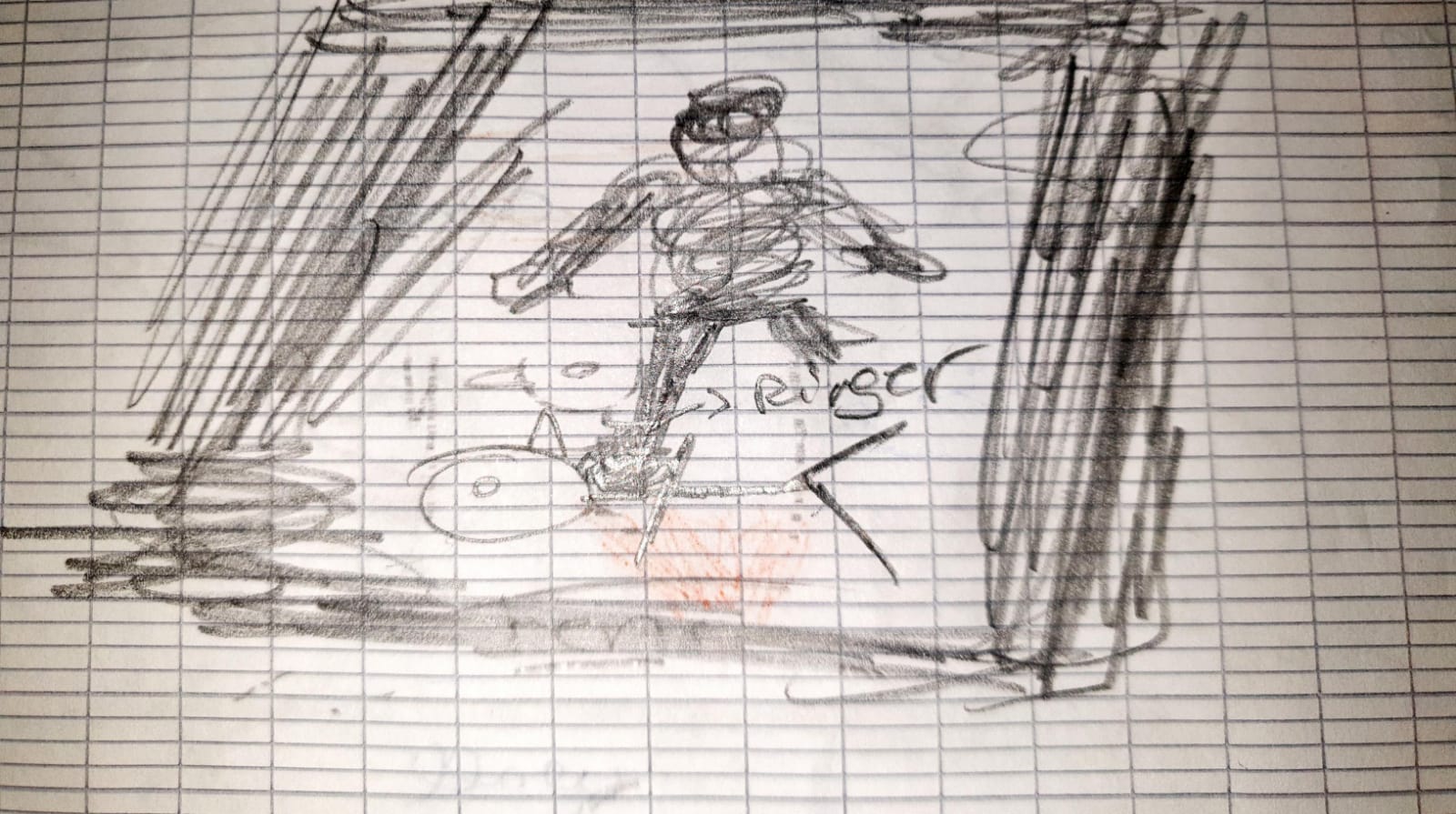
The metaphor was very simple: he was in a completely dark room, couldn’t see the walls but knew they were there. He was laying on his back on the floor with a soldier-like character having his left foot on his chest. He knew it was a soldier-like character because he could only see the shoe, which is called “Ringer” here in Lebanon. He could see nothing else from the character.
The digital nature of the metaphor made working with him very simple, given that he could neither stand up for himself nor be completely connected to the grounds of the situation, lying down completely. I got him to grow up, and he was able to create some movement, but the lightening up part was a bit of a challenge, as in Arabic it does not have the same linguistic ambiguity effect it has in English, and I am still playing around with words to see what else can be used. He then mentions that he has specific memories of being around his dad making these sounds around him when he was a kid and had to keep his mouth shut as it was his father. This was in a 30-minute conversation. We set a session for the following month to do some memory-based work on the memories that have a high emotional response related to them.
Two weeks later, I reached out to check on how he was doing, he replied: “Would you believe me if I told you that I feel better? I have no idea how, but I just am not noticing the sounds as much as I did before.” Because he experienced these triggers regularly at home, this suggested that some progress had occurred.
Metaphors of Movement can reduce some of the guesswork in changework, as uncovering the actual structure of a certain problem makes dealing with it much more straightforward and connected with the client’s experience.
“Are metaphors just beliefs that a person has regarding a context they came to seek guidance about with a therapist or not? Do metaphors equal a limiting story a person has about themselves, the world, or their life?”
It’s not an easy one to answer, primarily because of that word “Metaphor”. It is a word I have come to love and loathe in equal measure. Love, because it has opened up a whole new world of exploration and possibilities for me, and loathe because it is a crap word semantically loaded with so many different meanings to different people.
For example, in the context of therapy, “metaphor” might simply be a story that the therapist tells the client that has a message attached to it. You know, like in that terrible story of the ugly duckling. Only the dimmest of children don’t realise that this is allegorical and has a message for children about being the odd one out. It says, “Hang in there, kids, because one day you will grow up, and be beautiful and better than all those that laughed at you.” It’s a worrying message for sure, and I’m not entirely sure that it instils the right values for children in these modern times.
Many therapists, especially hypnotherapists, love this kind of “metaphor.” I wish they didn’t, of course, because too much of the time they simply come across to their clients as patronising halfwits.
But of course, we can add “technology” to this metaphor. We can make it isomorphic or polymorphic. Basically, this means that we substitute elements of the person’s life for characters in the story (there’s a one-to-one relationship, i.e., the bullied child becomes the ugly duckling, the other kids become those bastard ducks) and the story is parallel to the events as told by the client. Of course, the therapist tries to change the ending or something, you know, just to make it more fun or something. They can begin to add in embedded commands and suggestions, utilise characters in the story to introduce suggestions through “quotes”, and so on.
Or, they can get clever and make the story less obvious. Here’s an example: Tell the story of Jesus to the horribly depressed man. The story of Jesus is built around honesty, faith, horror, suffering, brutality, unfairness, horror, torture, and so on, yet overall, this story seems to inspire hope in people. (Truly, I don’t really understand why or how; it’s just horrible, but well, that’s religion for you).
Often utilising NLP’s “nested loops” and “state chaining”, these homomorphic metaphors can match, pace, and lead the differing states of experience of the client, and there may be many different elements in the story to each of the elements in the person’s real life in order to convey this. This pattern of “therapy” has been happening for tens of thousands of years, and the stories are told in narrative, in song, and/or in ritual (i.e., the grand ritual of Christmas) and passed from generation to generation. These stories evolve and change according to the customs of the time, political pressures, and commercial pressures. To stick with the Christmas example, a long time ago, political pressure added the Jesus narrative to an already established winter ritual. In more recent times, commercial pressures and influences have introduced multiple characters into the ritual drama, such as a Norwegian Santa Claus, a facially deformed reindeer, and, if you are American, The Grinch. This story is always evolving, much to the horror of Christians who want it to be about an uncircumcised baby.
Human experience is rather complex; our emotional range is varied and our social politics are so seriously complex that it can be very hard to communicate our experience verbally in a linear fashion. One key problem is that in order to convey our experience, we need to have someone prepared to listen, and people make quite terrible listeners. They interrupt, change the subject, make it about themselves, have emotional reactions to us and so on. Also, the message we attempt to deliver is filtered through the availability of words, and of course, through distortion, deletion, and generalisation.
Thus, the “metaphor” that MoM concerns itself with are those homomorphic metaphors of the client’s own experience. Inside this metaphor, there will be multiple characters, narratives, and events all happening simultaneously. It is a highly information-dense, complex experience that simply cannot be conveyed adequately in language, and so reveals itself in linguistic fragments as “idioms.” The idioms act as little hints to the complex metaphor that is being alluded to, and the MoM training is designed to enable the practitioner to be able to know what they are hearing and to have a methodology for working with the underlying experience of the client.
So, back to the first part of the question: “Are metaphors just beliefs that a person has regarding a context they came to seek guidance about with a therapist or not?”
I simply don’t know the answer to this. I often wonder if metaphor is contextual to time and location. For example, if we were to interview the client on a different day about the same problem, would they give a different metaphor? I suspect not, but I really don’t know.
One observation about metaphors is that they are remarkably stable and resistant to suggestion and influence, unlike memory and other forms of mental representation. The other observation is that metaphors tend to be timeless and lacking time predication. So my best guess is that the client’s metaphor is likely to exist across context, but…
… while the metaphor’s structure is stable, the imagery can change and morph over time. For example, being stuck is the same thing whether you are stuck in treacle/molasses or mud, stuck in a rut, or in a trap. The effect upon the person is fairly similar in that they cannot move forwards (or wherever). But the quality of the stuckness may differ according to context. So, the person is always stuck, but in place A it is like they have fallen into a trap, and in place B it is like they are glued to the spot, and so on. The effect may be the same, but the taxonomy and symbolism of the metaphor are different.
Now, regarding the issue of metaphors being beliefs. Again, I don’t know. My difficulty here is with the definition of “metaphor” and the definition of “beliefs.” In fact, I’m not entirely sure I even know what constitutes a belief any more. I’ll need to come back to this one later when I have more time to explain.
The next part of the question is: “Do metaphors equal a limiting story a person has about themselves, the world, or their life?”
The answer to this is simply yes. This is exactly what it is. But the problems arise with issues such as, (i) is there a better alternative to this story? (ii) not all limitations are bad or negative.
Metaphors as experienced by people are interesting in that they extend infinitely in all directions. They are the person’s world and their life, so how could they be any different?
Anyway, more on this in later blog entries. I’d be delighted to read any comments or observations people might have on this in the comments section below.
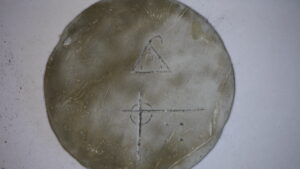
This Divinae Motum Orbis (denoted “la”) is believed to have been created around 1902 by Edith Van Dyne. According to her diaries, the Sensus Autem Huius Partis was added some 27 years later. The material for the Orbis was collected during a visit to her great uncle, Capt. Hugh Fitzgerald.
The reverse of the Orbis is notable in that the triangle is hooked, a detail on which Van Dyne declined to offer comment.
This is only a brief clip and is far from complete, so I am unable to comment on the outcome, but I thought it might be interesting to analyse the exchange a little.
Coach: “So Bex, given that we only have about 5 minutes to do this, is there some area that you feel you’d like to look at in terms of what you are feeling and what you are wanting?“
Client: “Umm… yeah, right now… umm… what is popping into my head is umm, my relationship with my mum at the moment.“
Client gives an example of the problem. Specifically, this is about the relationship with her mother. Within the realms of MoM we can expect the metaphor to take several possible forms. Classically, it may manifest as “The Hurts”, or if the relationship is about responsibilities, it may manifest as “The Burdens” and so on. At this stage, it is difficult to predict accurately. Being family related, there may well be “Containers” too. We simply don’t know yet.
The classic response to this statement might be, “What is this relationship with your mum like?” and to begin pushing for metaphor by shutting down The 4 Left Brain Responses of:
“How I feel about the relationship with my mum.”
“The consequences this relationship with my mum has upon my life.”
“Examples of this relationship.”
“My diagnosis of this relationship and the reason why it is the way that it is.”
Coach: “Perfect, trust that, trust that, so given your relationship with your mother, what are you feeling right now?”
This is an interesting response from the coach. He says to her that the information she has given him is “perfect” and that she should “trust that” information. This is interesting primarily because of what comes a few sentences later.
In MoM, we rarely ask for a feeling, unless we are seeking to ask for that feeling to be subsequently expressed in metaphor.
Client: “I feel that umm… she… umm… kind of works, work too hard, and she’s become negative and, you know, she is finding life really difficult at the moment, sort of working herself into an early grave.”
To use a bunch of words I don’t much like, the client is expressing a kinaesthetic that is a meta-report of the events. To put this simply, when it comes to bad stuff happening in our lives, there are several ways of feeling. To wit…
How we feel about the events that are happening (meta-position).
How the events happening make us feel (cause and effect).
How we feel at the time of the events (experiential).
How we remember feeling at the time of the events (recalled kinaesthetic).
Of course, there are more.
But my observation with therapists is that the vast majority never give this any consideration when working with clients, or even appear to have any awareness of these differences. For too many therapists, a feeling is just a feeling.
The question, “What are you feeling right now?” is quite ambiguous and has a huge assumption behind it. It reminds me of the question taught by some NLP schools when eliciting states. The client is asked, “Can you remember a time when you felt this feeling?” Before instructing the client to step into that time, feeling what they felt, seeing what they saw, and so on. When in reality, for some instances, “Can you remember a time when you felt this feeling?” The client may well answer yes, but have no kinaesthetic recall attached to it whatsoever.
“What are you feeling right now?”; feeling about what, specifically?
Coach: “Great, great, great, great, now notice when I asked you what is it that you are feeling you responded with what you are thinking, you shared thoughts, my mum is a worrier, etc, etc, etc. That is a very common thing that we do. We do not share what is really going on. We share what we are thinking. We stay in our heads. So just give yourself a moment to drop down, and see what is beneath the thoughts. In other words, what are you feeling when you have these thoughts running through your mind?”
Again, the coaches’ responses are interesting. Now obviously, he doesn’t think it is great, great, great, great that the client thinks her mum is going to an early death. He is congratulating her on giving him the responses that he wants. Worryingly, he is inadvertently coaching her on what responses to give him. The problem here is that previously he congratulated her on her “perfect” response, but now he is telling her that her responses and reported experiences were not actually valid. The indirect message here is that her trust was misplaced.
Now, there may be some validity here. After all, it is the daughter of the mum that is sat in front of the coach, not the mum herself. So the client can report as much of the behaviour of her mum as she likes, but the coach simply can’t do anything about that, so listing ever more of the mother’s behaviour would be pointless with regards to any change work.
But the client is asked to close her eyes and drop down to beneath the thoughts. So we are now in the analytical territory, the archaeological dig of the Freudians, who dig down deep into the subconscious to find what mysteries lurk deep within in order to bring them to the surface. A deeply faulted model of therapy that inevitably led to the excess of Recovered Memory Therapy, the Survivor Movement, and devastated lives and families worldwide. (As an aside, I note that in the past couple of years, there seems to have been a resurgence of this recovered memory nonsense, and the outcomes from this do not look at all good).
So, the feeling that the coach is seeking is quite specific. “… what are you feeling when you have these thoughts running through your mind?”
What he is asking for is number five to the above list:
5. How we notice ourselves feeling when we think about the events (a meta-meta kinaesthetic).
We can expect people to be able to report the most extreme states quite comfortably from this position. You’ve probably met phobics who can do this by talking about their phobic reactions in quite glorious funny terms, and they boast about how extreme they feel, and how people have to hold them down and so on. They can do this without showing the slightest hint of phobic response or fear.
Client: “I feel a lot of anxiety and worry.”
MoM trainees should be able to notice the use of “a lot” and now be aware of the emotional exchanges between her and her mother (hint: “The Fulfilments”).
Coach: “Great, great, great, now perfect, now when we connect to anxiety and worry, or when you just did, do you feel that is really the meat of the feeling is that… it? Or does it feel a bit flat?””
The connection metaphor is a common one with coaches and therapists. There is a sizeable amount of dissociation required to live this metaphor, and I have found it to be especially common in psychiatry. In simple terms, it looks like this.
A person exists as an independent entity.
A diagnosis or a bad feeling exists as an independent entity.
The person connects with this latter entity and now they “have it.”
The easiest example is that of “anorexia.” A person refuses food and does all that stuff that anorexics do. That person now “has” anorexia. The behavioural process is stripped out of the whole thing and the presenting problem now has the metaphoric structure of a non-contagious infectious disease (sic).
Many coaches and therapists of all disciplines learn to “distance themselves” from negative feelings as a coping strategy. From experience and observation, the long-term personal cost is high as the short-term gain is given higher priority at the cost of long-term well-being.
Additionally, he is also putting her into a simple bind between two alternatives. This should be immediately obvious to anyone familiar with Ericksonian hypnosis and NLP modelling thereof. Is it “flat”, or is it “meaty”?
The problem is that neither of the alternatives is particularly good or useful for the client. The client isn’t being asked about the quality of their experience, instead they are simply expected to shoehorn their experience into one of the two structures decided by the coach. But for what purpose? Let’s see…
Client: “It feels a bit flat.“
Coach: “Yeah, yeah, and the reason why is because often when we connect, the first thing that we feel is usually a cover emotion, things like boredom, impatience, confusion, doubt, worry, so if anxiety and worry really aren’t it. Close your eyes for a moment and drop, allow yourself to tune in and feel beneath the anxiety and worry. What’s actually there? Just give yourself a moment and see if you can feel… “
What we have here is simply inexcusable, and this is dangerous logic. To give an example that immediately springs to mind, back in the 80s and ’90s, lots of people were getting abducted by aliens all over the United States. What most of them had in common is that they had no idea that they had been abducted by aliens until they saw hypnotists or recovered memory therapists, and there were several high-profile hypnotists with best-selling books on alien abductions who, of course, were attractive to potential abductees.
Initially, “missing time” was an essential part of the abduction narrative. The hypnosis would then attempt to fill in the blanks and, hey presto, previously suppressed memories of aliens would emerge.
But not everyone reported missing time, so a new addition was required for the narrative.
“Screen memories” were added alongside “missing time”; the aliens would block the abduction memory by inserting innocuous memories of routine things or bunny rabbits in order to hide the abduction experience. Clever chaps, these aliens.
Along with the excesses that went with the recovered memory movement (alien abduction, satanic ritual abuse complete with the essential brood mares), more and more details were added to the narrative. “Screen emotions” became another, so did “multiple personality disorder” (MPD/DID), complete with “massive repression,” the spontaneous repression of traumatic memories and feelings. The trauma was so bad, that the brain blocked it. Aliens were thus rendered unnecessary to the process, and obscure and bogus psychological mechanisms took their place. Aliens were no longer sticking things up the bottoms of the abducted; Satanists were doing it instead. These days it’s those pesky Illuminati chaps that are doing it in the name of the New World Order.
So what’s happening in this session so far? Having been told that her responses were perfect and that she was to trust in that, coupled with a somewhat hypnotic sequence, she is now being told that her trust in her own feelings is misplaced. Her feelings are not her real feelings. The real feelings are yet to be discovered.
Remember, the presenting problem here is the concern the client has about the relationship with her mother (“mum “), who is basically working too hard and sounds like she might be a bit tired and irritable.
Client: crying “I feel a lot of guilt and a lot of fear…“
Now the client is emotional and feeling bad. In fact, she clearly is feeling a lot worse than she did right at the beginning. So, here is my question to the reader: without any intervention whatsoever, if the session ended right there and the coach simply got up and left, how long do you think this feeling would last for ? A minute or two? I doubt it would be for much longer.
How would she feel after these tears? A bit of relief, even if only temporary? I suspect so.
Coach: gesturing to self “I can feel that, yeah, that’s really powerful… now that feels a lot more meaty, right, you can feel that, I can see it.”
There’s empathy, there’s rapport, and then there is this. I’ll leave it to the reader to decide exactly what this is.
Again, he has made her initial experience invalid and reinforced his own “screen emotion” metaphor.
Client: “Yeah.”
Coach: “So you have identified it perfectly. Step one, complete. What is it that you want now in order to feel better?“
Any observations to add to this, or to my analysis? Please use the comments section below.
On The Correct Construction of Le Divinae Motum Orbis
The traveller is to construct a clay disc of between 10 to 25 cm in diameter (15 cm is best) and between 1 to 3 cm in thickness (1.5 cm is best).
The best clay is that which the traveller has dug himself and brought back from a foreign land (“ut quæ tibi domum“; literally: “That which we bring home”).
About the perimeter of the circle is inscribed: 666; hic manebimus optime; <triangle with a centre dot and a line with a side dot>; 777; Omne initium difficile; <square with centre dot and circle with centre dot>
The compass is to be situated off centre in the middle of the Orbis. The correct ratio of the Compass arms are:
Upward arm: 3
Downward arm: 2
Left and right arms: 1
About these arms are inscribed the letters: M M and A and Omega.
Outside of the Compass is to be an octagon. Outside each side of the octagon is to be inscribed the Sensus Autem Huius Partis(Literally, “The Sense of This Part”).
Outside, the lowest side is to be inscribed: 23 23/23.
The reverse of the Orbis is to be inscribed with an imperfect cross with the arms off centre, within which is an imperfect circle positioned off centre however the traveller chooses. Four points are to be inscribed within the realm of this cross, positioned however the traveller sees fit.
Above this cross is a triangle within which is an eye on its side and five dots, again placed according to the wishes of the traveller.
The clay is then to be sealed by heating with a mixture of one part olive oil and one part beeswax. The best olive oil is that which has been extracted by the traveller and the beeswax that is procured without harming a single bee.
Private instructions for consecration can then be given once the traveller has understood the meaning of this symbol.
I thought a quick analysis of this imagined exchange from a MoM perspective might be an interesting exercise:
Coach: “What would you like to have happen?
This is a nice ambiguous question and is something that can be either an outcome or a process.
Client: “I feel trapped.”
However, the client states a feeling that is expressed in metaphor/idiom, which is not a reply to the question. The client has answered the question, “What’s the problem?” but the referential index is missing. Trapped by the exchange with the therapist? Trapped by the soggy seat facing away from the door? And so on. But we can assume that the client is probably referring to their presenting problem, but this may not always be the case, of course.
Coach: “When you feel trapped, what would you like to have happen?”
Coach refers back to the outcome/process, incorporating the feeling of trapped.
Client: “I feel I’ve hit a brick wall, I want to get over the wall.”
Classically, the client experiences the wall as the presenting problem and not his coping behaviour. Getting over the wall is only one of many possibilities. MoM trainees will be aware of the other possibilities, including avoiding the wall, going through the wall, going around the wall, and so on.
We also know that the client’s current direction and momentum has led him to “hit” the wall. Thus, we have either “hit” as in he has punched it, or “hit” as in he has run into it. There are probably other less likely possibilities.
In the first scenario, he is punching it: we’d need to consider why exactly this man has violent tendencies to metaphoric walls (for example, he may have been taught to break down things that get in his way, or attended workshops that told him he was to be unstoppable). We also need to consider what this man hopes to achieve through this action.
In the second scenario, the man has been unstoppable… right up until something got in his way. He didn’t see it. This is someone who doesn’t pay much attention to where he is going and what is in front of him. This is someone who ignores outcomes, which is congruent with his responses to the first two questions.
Coach: “Is there anything else about getting over the wall?”
This reinforces the client’s failed solution to his situation, negates the problem of hitting walls and ignores the other possibilities that the client currently appears to be unaware of.
Client: “My friends are over the other side and I can’t get over the wall.”
There’s an obvious question here of how does he know they are the other side. Let’s assume they probably are both metaphorically and literally. This is his destination and the outcome is now defined. But we know from MoM that walls and related obstructions tend to reflect real-world obstacles, usually in the form of a primary negative injunctive (a rule that says “no”). The height of the obstruction, in this case, a wall, gives a clue as to the status level of that injunctive, and its location and orientation give an idea of its time frame (i.e., its place in time, i.e., behind: historical).
This is a wall in front. Presumably high enough that he can’t get over it. In order to get over this, he needs to raise/elevate himself (i.e., status increase), at least temporarily, in order to transcend this rule that currently gets in his way. We have to ask ourselves if this is a good thing or not.
At least he isn’t “breaking through” the wall, i.e. breaking the rule.
Coach: “What kind of wall?”
Symbolically, this is an important question, although I think that the import is lost in this instance. A solid wall of concrete is a single piece. Brick walls are made up of lots of small pieces. A clue: Think about how primary negative injunctives are formed…
Client: “Well, it’s got bricks and it is also surrounded by a small wall.”
There is a smaller, secondary injunctive.
Coach: “Is there anything else about the small wall?”
Client: “Well, it adds to the feeling of being trapped, but it’s made up of small bricks that I can break up and use, but that doesn’t help me though.”
At this point, it is worth mentioning the issue of “trapped” and “wall”. Go and stand behind a single wall, and see if you feel trapped. So we have a significant incongruency. In an MoM exchange, we’d have asked what was left, right, etc., and either this would have revealed itself, or would have presented as one of the 19 Boundary Violations.
The client’s strategy continues to fail, in that he thinks that he can change the metaphor by breaking up the smaller wall (presumably in the real world, he thinks that this injunctive can be broken down and used to his advantage). In the early levels of MoM, we leave the metaphor intact and don’t seek to change any aspect of it. We change the person’s coping behaviour, not the representation of their problem. In the higher levels, we begin to change the identity within the metaphor as well to something more congruent.
Coach: “When there are small bricks that you can break up and use, what happens to the big wall?”
The client’s flawed strategy for changing the metaphor is now reinforced by the coach.
Client: “Ah, there is an opening over there.”
Is the opening to the left or the right? This would be significant in terms of whether this is the right way forward or not. It might be something that is best left.
Coach: “When there is an opening over there, what happens next?”
Client: “I can see if I can use the bricks to get through.”
The client has switched strategy from trying to get over the wall to trying to go through the wall. Quite how they can do this by using smaller bricks isn’t revealed, but essentially not much has changed for this client. His strategy for dealing with rules that get in the way of his social life will remain as “The rules [primary negative injunctives] don’t apply to me.”
We can predict that such a client will leave the session feeling immediately empowered and with raised confidence. “I can do it!” will be his motto.
I shall leave it to the reader to ponder the implications of this.