Experience · Relationship · Agency
Metaphors of Movement
A framework for exploring the organisation of human experience through the elicitation of autogenic metaphor.
Definition · Framework drawing · Elicitation · Eight lenses · The Compass · Practical logic · Relationships · Worked example · Human potential · Related perspectives
The central proposition
Metaphors of Movement is an experiential framework for exploring how a person organises themselves in relation to their situation, other people and their world. Through the elicitation and precise articulation of autogenic metaphor, it makes patterns of position, constraint, relationship and possible action available for conscious examination.
The purpose is to help the person recognise more of the organisation of their own experience. That recognition may enable different responses, relationships and ways of participating in life. Its value ultimately concerns what becomes understandable and possible for the person, including what they subsequently do.
MoM concerns human potential and experiential understanding. Its therapeutic applications belong within that broader purpose: helping a person recognise how they experience their circumstances, how they participate in them, and what might become possible through a different relationship to them.
The most useful unit of attention is therefore the person in relation to a world. A wall, a weight or a pedestal only becomes informative through the person’s position, the qualities of that structure, their relation to it, and what they can or cannot do. “A wall means resistance” discards those distinctions. “This person is facing a wall, repeatedly pressing against it, and treating forward movement as the only acceptable progress” retains a configuration that can be examined.
The organising question: how is this person situated and participating, such that this experience and these responses make sense?
The organisation of experience
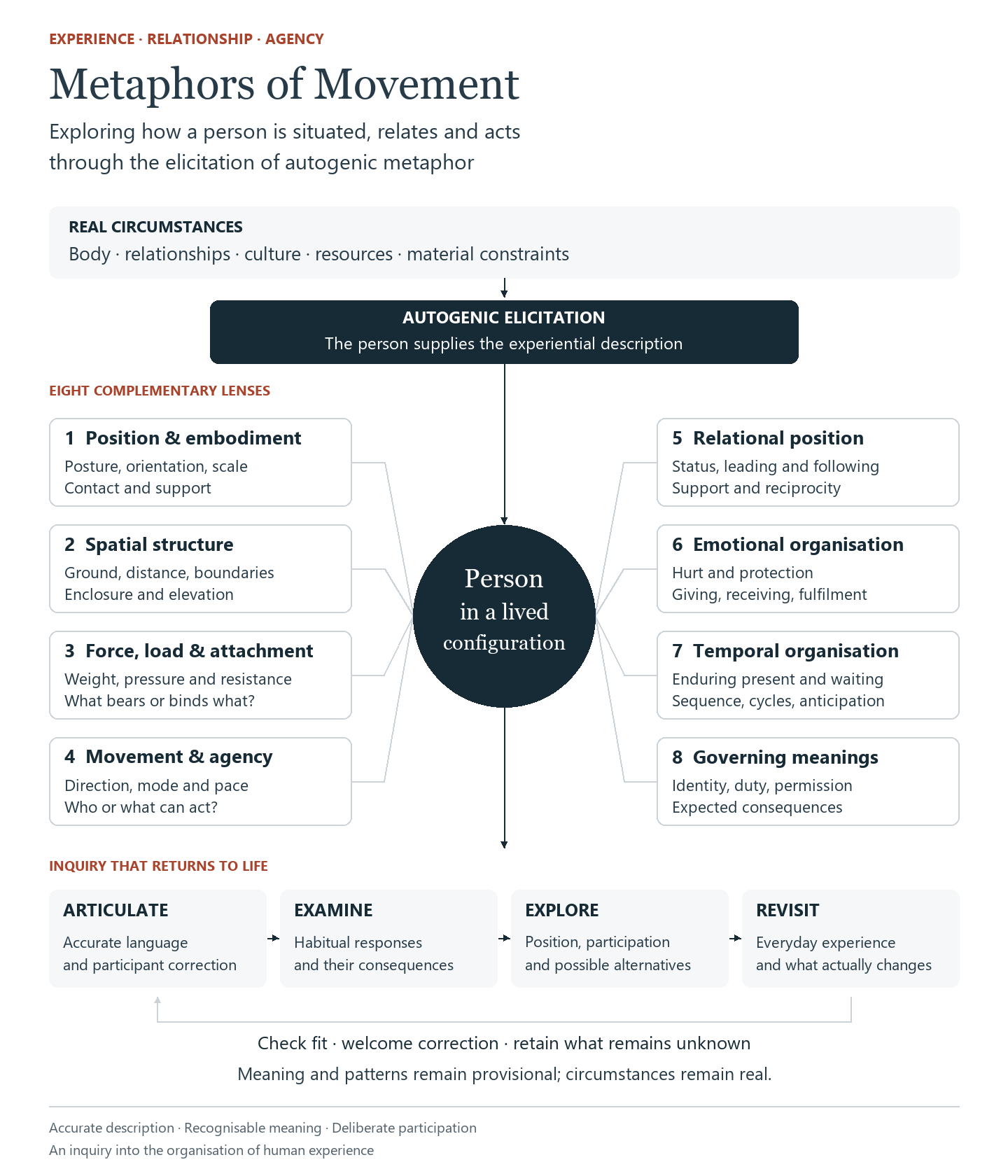
Inquiry begins with the person’s situation and the experiential description that emerges through elicitation. The relationships within that account become available for articulation, examination and further exploration. Understanding develops through the person’s recognition and correction, and through attention to what happens in everyday life.
The external situation remains part of the framework throughout. Material conditions, illness, power, duties, finances, discrimination and other people’s actual behaviour cannot be reduced to the way someone describes them. A person’s metaphor offers access to how those conditions are experienced; it does not replace investigation of the conditions themselves.
What makes the metaphor autogenic?
Autogenic means generated by the person. In MoM, this has a particular experiential emphasis: the person describes a configuration they find themselves in. Such an account differs from selecting an analogy to communicate an idea. The distinction concerns an experience being reported and a concept being proposed.
Three levels need to be kept distinct:
| Level | Example | What it establishes |
|---|---|---|
| Everyday expression | “I’m stuck.” | A possible entry into exploration. It does not yet establish how stuckness is organised. |
| Experiential configuration | “There is a slab above me. My shoulders are against it. I’m holding it up.” | A particular relationship between body, object, force and activity, to be checked with the person. |
| Conceptual comparison | “We could think of our business as an orchestra.” | An analogy for reasoning or communication. Useful, but it does not demonstrate that someone experiences themselves within that configuration. |
A person may use familiar words to report a highly particular experience. Ownership rests in the source and fit of the description. A culturally familiar metaphor can be personally experienced; an original image can be someone else’s invention. Client-generated metaphor also occupies a central place in Symbolic Modelling. See: Lawley and Tompkins, Symbolic Modelling Lite (link opens in new window).
Elicitation is an attentional discipline
Elicitation begins with an experience the person wants to explore. Attention moves from a general verdict about oneself towards how that experience is organised. An emotion, a diagnostic description, a remembered explanation and a present configuration may each matter, but they provide different kinds of information.
Once an experiential description emerges, the task is to establish its relative arrangement accurately: what is present, where it is in relation to the person, and which qualities matter to that relation. Enough detail to preserve a consequential distinction is useful. Endless detail to satisfy the facilitator’s curiosity can obscure the structure. A wall just ahead, a weight resting on the body and a binding attached to a limb create different constraints.
Many experiences of stuckness have the quality of an enduring present: a predicament that remains recognisably the same despite time passing. Establishing that configuration requires attention to what is experienced now. A story about how it began, or an imagined account of how it will end, may obscure the relationships that currently define it.
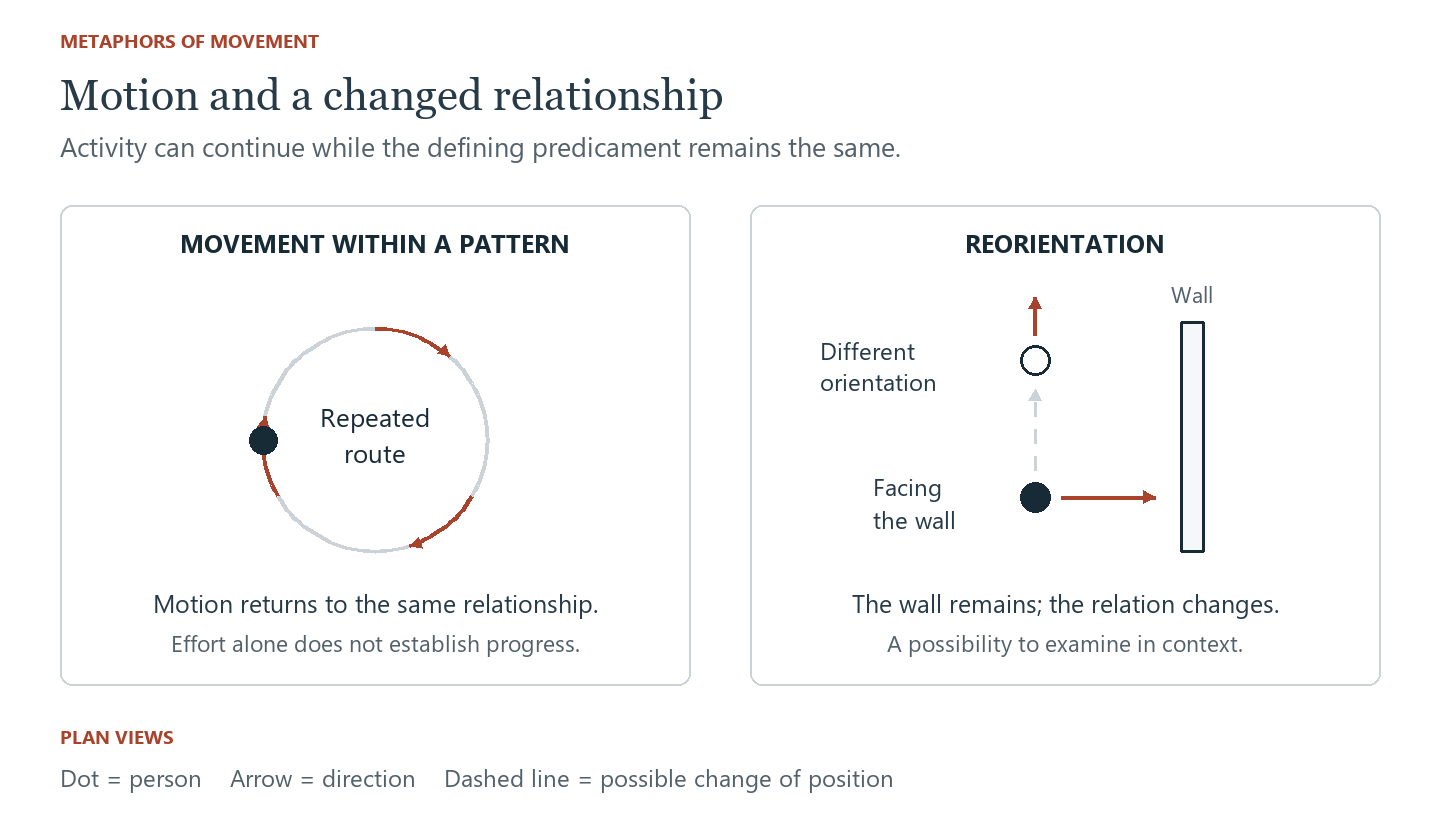
An enduring present can contain movement. Running on a treadmill or continually sinking involves activity while preserving the defining predicament. Motion within a repeated configuration differs from a change in the person’s relationship to that configuration. Effort, motion and progress need to be distinguished.
Visual vividness is not the criterion of accuracy. Position, weight, contact, direction, pressure, and a felt sense of arrangement may be available without a detailed inner picture. A published account of MoM with an aphantasic participant describes the use of posture, the participant’s own drawing, and physical action. See: Bennett, Working with Aphantasia (link opens in new window).
Autogenic content does not mean an uninfluenced conversation
The facilitator selects questions, directs attention, and chooses when to speak. These actions influence what becomes available for description. MoM can involve active, humorous and provocative facilitation, including formulations that the person corrects. The distinction between the person’s experience and the facilitator’s contribution remains essential throughout.
What the person volunteers, what emerges through inquiry, what the facilitator suggests, and what the person subsequently confirms or corrects have different origins. Preserving those distinctions protects the accuracy of the account. Rejection can reveal precision; agreement alone cannot establish that a suggestion uncovered something already present.
Eight lenses on one lived configuration
Experience can be examined through eight complementary lenses. They overlap because a situation is experienced as a whole: position affects movement, movement affects relationships, and expectations give those relationships significance. Each lens directs attention to a different aspect of the same configuration.
| Lens | What to preserve | What it can help explore |
|---|---|---|
| 1. Position and embodiment | Bodily orientation, posture, scale, contact, support and the point from which experience is described. | How the person is situated; what is immediately available, effortful, exposed or stable from there. |
| 2. Spatial structure | Ground, distance, direction, elevations, edges, enclosures, boundaries and openings. | The organisation of access and separation. An opening is not yet evidence that leaving is possible, desirable or safe. |
| 3. Force, load and attachment | Weight, pressure, resistance, carrying, binding, holding and the physical qualities attributed to objects. | What is exerting a force, what bears it, and what depends on the current arrangement. |
| 4. Movement and agency | Available movement, direction, distance, mode, pace and who or what initiates or controls it. | Distinctions between movement, effort and progress; between action, waiting, coping and being acted upon. |
| 5. Relational position | Relative locations, facing, leadership, following, support, status, belonging and reciprocal positions. | How a way of relating places both parties, including the facilitator; how a helpful role may acquire costs. |
| 6. Emotional organisation | The person’s experience of injury, protection, emptiness, fullness, giving, receiving and unmet expectation. | How hurt and fulfilment are structured, and how different people’s requirements or offered exchanges may fail to match. |
| 7. Temporal organisation | Enduring present, anticipated movement, waiting, repetition, sequence, and orientation towards what has been or is to come. | What is expected to change first: whether the passage of time is being treated as equivalent to the person’s situation changing. |
| 8. Meaning and governing expectations | The person’s own implications concerning duty, correctness, identity, permission and what would happen if they acted differently. | Why one response feels necessary or another feels unacceptable; the rules sustaining a position. |
How the established metaphor families fit
Recurring configurations include containers and partial containers, obstructions, burdens, elevations, hurts and fulfilments, alongside structures such as treadmills or immersion. Their differences matter. A backpack can carry a load while its straps restrict movement; a single configuration can contain several kinds of constraint.
The distinctions concern properties and relations. A boundary marks an inside and outside. An obstruction impedes a particular movement. A burden is carried or borne. An elevation changes position relative to a reference. A hurt involves experienced injury. Fulfilment concerns what is wanted, given, received or retained.
The same arrangement can constrain and protect. High status can bring recognition while making a misstep consequential. Support can provide stability while limiting the supporting person’s freedom. The purpose of classification is to preserve these differences long enough to investigate them.

The Compass as a reference system
The Compass directs attention to orientation and directional idioms: forward, behind, left, right and vertical relationships. The meaning of a direction depends on its place in the person’s account and on the language being used. An idiomatic association is a possibility to examine, rather than evidence of a particular personality or history. The Compass.

Forward can concern what is anticipated; behind, what lies in the background. Left draws attention to what remains or is unexplored, while right can concern what is considered correct or conventional. The diagonals combine these relationships. These meanings arise through the person’s idioms and circumstances. Above and below add a separate dimension of relative height, status and rank.
From configuration to practical logic
Embodied practical logic describes the relationship between how a person experiences themselves as situated and the responses that seem available, necessary, futile or dangerous. An action that appears unhelpful from outside may be intelligible within the person’s experienced arrangement.
Its simplest form is: a person reports a configuration; that configuration has implications for action; their habitual responses can be examined in relation to those implications; and the consequences of those responses can be checked in life. Each connection remains open to correction. A metaphor does not mechanically determine behaviour.
Consider someone who experiences themselves as holding up something important. Continuing to hold it may make sense within that arrangement. Advice to relax or be more positive may fail to address the perceived consequence of releasing it. The useful inquiry concerns what holding accomplishes, what it costs, and what the person expects would happen if the relation changed. It also concerns whether, in ordinary life, there are real responsibilities or dangers that require practical action.
The focus is the person operating within the metaphor. A metaphorical wall may organise the person’s experience as though it were physically present. Exploring their orientation, expectations and activity makes their relationship to that wall examinable. Altering the appearance of an inner image, by itself, establishes little about how the person participates in life.
Accurate articulation makes the structure discussable
Idiomatic articulation renders a supplied configuration in language that preserves its relationships. Precision matters: “on the moon” does not establish “on a pedestal,” because the second expression introduces a structure absent from the first. A compelling interpretation can still misrepresent the experience.
Accurate articulation depends on structural accuracy, recognisable fit and practical relevance. Structural accuracy preserves the reported arrangement. Recognisable fit allows the person to confirm or correct it. Practical relevance concerns whether the articulation clarifies something consequential about their experience.
A phrase can fit the geometry of a drawing while making an unsupported claim about agency or identity. “Held back,” for example, supplies an agent or force holding someone. “Not moving” does not establish that relationship. The wording needs to preserve what is known and leave room for what remains unspecified.
Exploration precedes prescription
A desired future establishes what matters to a person, but does not fully describe their present situation. Direction, distance, mode and pace all affect how movement is experienced. Knowing where someone wants to arrive is different from understanding what currently makes movement possible, costly or unavailable.
Similarly, a coping response can have a real protective or regulating function while leaving a situation unchanged. The distinction to explore is between what a response helps the person endure and what it changes in the situation. Recognising participation is not the same as assigning blame for the circumstances.
Possible reorientation can involve changed position, different participation, communicating an expectation, obtaining resources, adjusting a relationship, accepting a real limit or deciding what to stop doing. Forward motion is one possibility among others. What matters is whether the alternative fits the person’s circumstances and purposes.
Relationships, time and exchange complete the picture
A relational position affords positions for other people: supporting and relying, leading and following, including and belonging. The facilitator is another participant in that social field. Repeated rescuing, directing, or reassuring can occupy a role already central to the person’s experience. The relationship enacted in the conversation is itself part of what needs to be understood.

Fulfillment introduces questions of exchange: what is offered, what is wanted, what is received, and which expectations accompany the offer? Giving more does not ensure that another person receives what they need. An offer can carry a condition its recipient never accepted. Making those expectations explicit can clarify a persistent mismatch between intention and experience.
Time adds the conditions under which change is expected. Waiting can be appropriate where another event must occur first. It becomes a useful focus when someone anticipates that time itself will do work requiring action or resources. A recurring cycle, a countdown, and an indefinite wait can sustain different expectations even when the surrounding facts are similar. The person’s account determines which temporal relationships are actually present.
A worked example: why “I’m stuck” is insufficient
A hypothetical example
A person discussing their work says, “I’m stuck.” As their own description is clarified, they report standing on firm ground, facing a high wall, with both palms pressed against it. The wall is in front of them; its extent to either side has not been described.
The description establishes ground, orientation, contact and an obstruction in the direction faced. It leaves other matters unknown: whether the person is enclosed, whether sideways movement is available, who built the wall, and why the person is pressing. An accurate drawing would retain those unknowns.
In ordinary-life discussion, suppose the person says they repeatedly make the same request to a manager, meet the same refusal, and conclude they must explain it more persuasively. The correspondence between repeated pressure in the account and repeated persuasion in life is now an exploratory connection. It still needs the person’s judgement. Neither the wall nor the practitioner proves that the manager is unreasonable, that the person is stubborn, or that leaving the job is the correct response.
The useful questions become: what does the repeated approach accomplish? What would count as enough evidence about its prospects? Which constraints are real and verifiable? What alternative activity is actually available? The person might decide to obtain information about the decision criteria, make a different request, accept a limit, or explore another position. None follows automatically from the shape of the drawing.
A useful recognition might be that persuasion had become the only response the person was considering. That recognition creates room for a deliberate choice. Its significance becomes clearer through the person’s subsequent conduct and experience.
| Same opening phrase | Different supplied configuration | Distinct issue to investigate |
|---|---|---|
| “I’m stuck.” | A wall ahead. | A restriction in a particular direction. |
| “I’m stuck.” | An enclosing structure around the person. | Inside/outside, access, containment and the person’s relation to the enclosure. |
| “I’m stuck.” | A load being carried. | Weight, attachment, responsibility and the activity of bearing it. |
| “I’m stuck.” | A narrow elevated surface. | Position, exposure, stability and the anticipated consequences of moving. |
The same opening phrase can therefore lead to substantially different accounts. The relevant distinctions emerge through the person’s description. Offering a ready-made selection of metaphors would risk supplying the experience that the inquiry is intended to elicit.
Exploring experience beyond difficulty
Human potential includes the organisation of belonging, commitment, fulfilment and purposeful action. Relational positioning, time and exchange can also be explored where a person wants to understand what is satisfying, sustainable or worth preserving.
Consider a person who describes being alongside someone on firm ground. Companionship, shared orientation and mutual support are possible meanings, but they require the person’s recognition. The same spatial arrangement might be experienced as surveillance or unwanted obligation. An attractive image is no more self-interpreting than a difficult one.
Such inquiry may clarify what a person wants to preserve, what makes a commitment workable, or what changes when a valued relationship becomes demanding. It can address tensions between desirable experiences: autonomy and belonging, stability and exploration, generosity and sustainable limits.
The framework need not encompass every aspect of human experience to be useful. If no stable experiential metaphor emerges, retain the person’s available description rather than press them into producing one. Practical facts, direct conversation and other forms of inquiry may better answer the question at hand.
Precision in experiential inquiry
1. Keep observation, formulation and explanation separate
“The person reports darkness behind them” is a description. “Darkness may recur across this person’s experiences” is a formulation to investigate. “Darkness establishes a particular personality or biological origin” is a stronger explanatory claim requiring independent evidence. The distinctions between report, pattern and explanation are fundamental.
A recurring association can direct attention without establishing a childhood history, a diagnosis or another person’s conduct. Alternative interpretations, counterexamples and uncertainty remain part of a disciplined account.
2. Treat correction as information
The person must be able to say that the description is wrong, partial or irrelevant. Their correction may reveal a consequential distinction. Practitioners also need a way to abandon a favoured interpretation when it fails. If agreement confirms the model and disagreement is automatically treated as confirmation through “resistance,” the model has ceased to be testable.
3. Preserve functional detail and tolerate the unknown
Record the detail that changes the relation: weight resting versus strapped; an opening visible versus absent; a path available versus assumed. Do not fill blank areas of a drawing to make it look complete. Distinguish “not yet reported” from “reported as absent.” A person’s correction to the diagram is part of the inquiry, not an aesthetic problem.
4. Separate agency from culpability
The possibility of a different response does not imply responsibility for having been harmed. Interpersonal expectations and felt permissions do not establish consent to mistreatment. Similarly, a money metaphor may reveal how resources are anticipated or approached without explaining the material causes of poverty.
5. Make the facilitator visible within the method
Humour can articulate a contradiction and make something recognisable. It can also recruit agreement, embarrass or impose a status relationship. The relevant standard is whether it improves the person’s ability to inspect their experience and disagree freely. Wit is a delivery style; accuracy and relational judgement are the transferable disciplines.
6. Define what would count as useful learning
A person may leave with a more accurate account, a newly explicit expectation, recognition of a repeated response, a different available choice or a better understanding of a limit. Those are legitimate exploratory gains. When a claim of beneficial change is made, specify the actual change and check its persistence and consequences. Immediate emotional relief is useful information, but not sufficient evidence of durable benefit.
Nor should discomfort be promoted into evidence of effectiveness. Absence of improvement, unwanted effects and the person’s decision to stop are also data. The framework should accommodate no change without requiring that the participant or practitioner be declared defective.
Related perspectives on language and experience
Clean Language and Symbolic Modelling share an interest in client-generated metaphor and close attention to a person’s expressions. MoM gives particular weight to idiomatic articulation, recurring configurations, relational position and the examination of habitual responses. Questions inevitably direct attention; precision includes recognising their influence. Lawley and Tompkins, Clean Language Revisited.
Situated cognition offers a relevant perspective on how representations of situations involve perceptual, motor and introspective processes. Such representations can be partial and biased. This provides a conceptual connection with embodied experience, while leaving the mechanisms and effectiveness of particular MoM practices as separate empirical questions. Barsalou, Simulation, situated conceptualization, and prediction.
Research on psychotherapy discourse has found differences between therapists’ and clients’ patterns of movement language. The finding makes the ownership of metaphor a consequential issue: the practitioner’s preferred direction of “progress” may differ from the person’s experience. This discourse research concerns movement metaphors in conversation, rather than an evaluation of MoM. Tay, Metaphors of movement in psychotherapy talk.
Several processes may contribute to useful exploration: more precise attention, a description that makes relationships easier to inspect, recognition through accurate articulation, and examination of familiar responses. Understanding which processes contribute to lasting benefits requires evidence beyond the coherence of an explanation or the vividness of an experience.
