
“I’m carrying the business.” “I need to get on top of things.” “I’m trying to move it forward.” A conversation about work can contain several descriptions like these before anybody notices that they describe quite different relationships.
In one, the person supports a weight. In another, they want a position above something. In the third, they want movement. It is possible to respond to all three with the same advice about priorities, confidence or motivation. It is also possible to pause and ask what the person is actually describing.
This attention to relationship and position is one of the themes Andrew T. Austin develops in Metaphors of Business and Money.
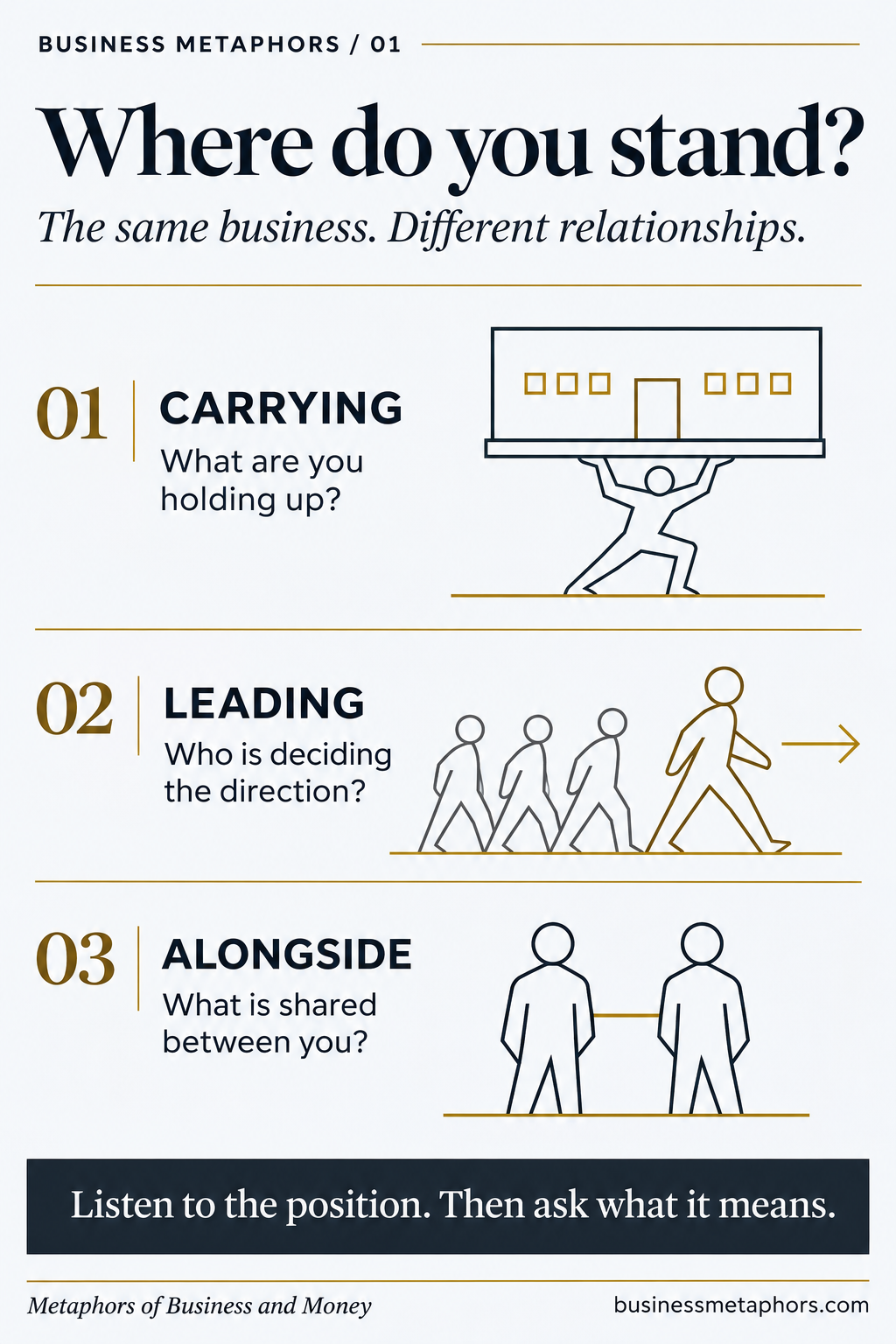
Read the infographic as text
The same business. Different relationships.
- Carrying: What are you holding up?
- Leading: Who is deciding the direction?
- Alongside: What is shared between you?
Listen to the position. Then ask what it means.
The business and the person are not always in the same position
Consider a hypothetical owner who says that the business depends entirely on them. They hold it up, keep it together and carry the responsibility. A colleague suggests that they should take the lead. Both descriptions sound positive in ordinary business language, but carrying something and leading it involve different arrangements.
That difference is a starting point for conversation. What does the owner mean by carrying the business? Which responsibilities are involved? What, in practical terms, would change if other people took responsibility for part of the work?
The expression does not establish the answer. It helps identify a question that a general encouragement to “be more of a leader” might overlook.
A useful position in one relationship may not suit another
A person can lead a project, work alongside a colleague and ask a specialist to take responsibility for a separate task. There is no requirement for the same arrangement to apply everywhere.
Problems become easier to discuss when these relationships are distinguished. An owner may be comfortable making decisions for the business but uncomfortable letting an expert lead a technical project. A customer may want a task completed independently while the provider keeps offering guidance. The difficulty may involve the arrangement between the people as well as the quality of the work.
Andrew’s teaching on situational relational positioning examines this territory in greater depth. For a first observation, it is enough to notice the position implied by the language and check it against the work being discussed.
Listen before drawing a conclusion
An isolated idiom is not a personality assessment. Someone can say they are “on top of the paperwork” without making a statement about every relationship in their organisation. Context matters, as does the person’s own explanation.
In your next business conversation, notice one expression about position. What is the person in relation to: the business, the task, the customer or another individual? Does the position stay the same as they describe different parts of the situation?
The aim is a more precise conversation. It begins with hearing a distinction that familiar language can make easy to miss.