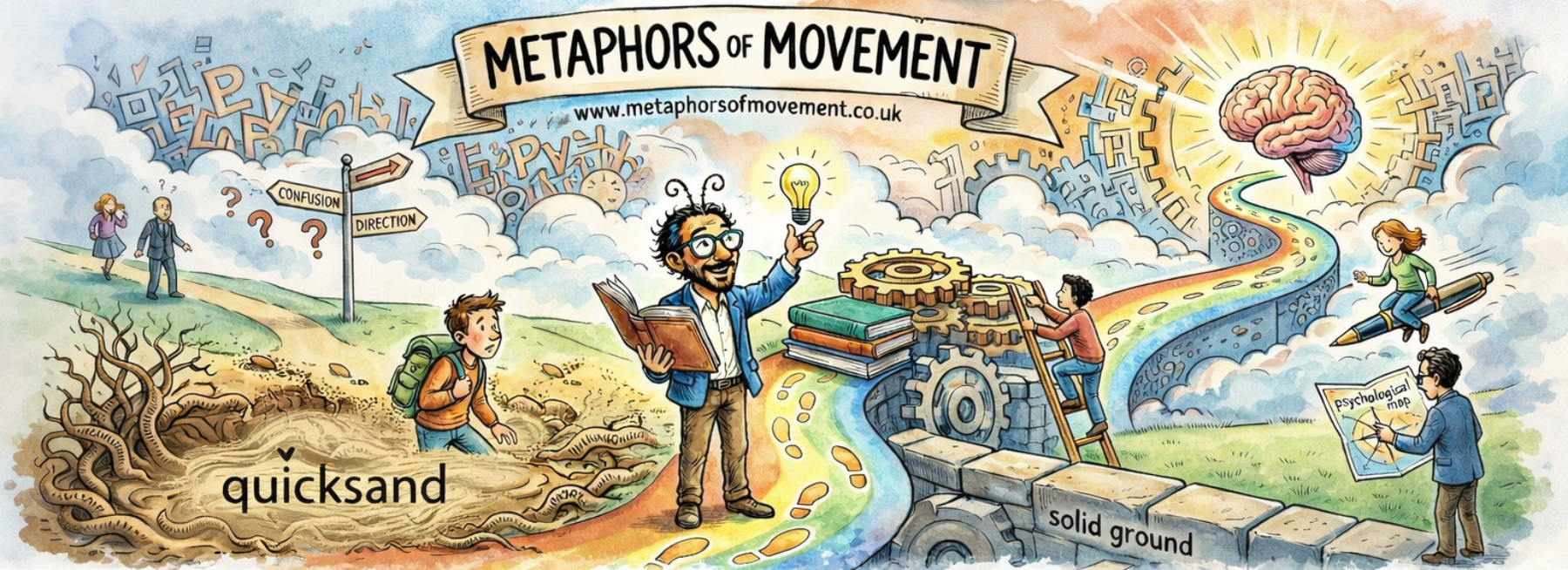
“I’m stuck” can describe an obstacle, an enclosure, a load, an obligation or a lack of somewhere to go. Treating all of these as a shortage of motivation loses the distinctions that might explain the difficulty.
In this article
Three people describe their work as exhausting and say they cannot move forward. One is waiting for permission that never arrives. Another can see several possibilities but would have to give up the security of a familiar role to pursue them. The third has enough responsibilities to occupy every available hour.
They share a phrase. They do not necessarily share a problem.
Advice offered at the level of the phrase is likely to be equally broad: believe in yourself, take action, overcome your blocks. Such advice can be encouraging while leaving the actual difficulty untouched. Permission, security and responsibility are not interchangeable. Neither are the consequences of acting without them.
Metaphors of Movement pays attention to differences that ordinary summaries compress. The interest begins with the specific organisation of someone’s experience: what makes this particular situation difficult, and how that difficulty is being lived.
One word can hide several kinds of restriction
In everyday language, “stuck” does an enormous amount of work. A drawer can be stuck because something obstructs it. A vehicle can be stuck because the ground will not support its movement. A traveller can be stuck because the available routes have closed. A person can be stuck with a task because nobody else will take it.
These are ordinary examples, yet each suggests different circumstances. More force might damage the drawer. More effort might leave the vehicle deeper in the mud. Faster travel cannot open a closed route. Working harder may make somebody even more dependable as the person who always absorbs the unwanted task.
The word identifies a difficulty without specifying its structure. This is why repeating it more emphatically does not necessarily clarify anything. Feeling very stuck is a useful report of intensity, but it still leaves the nature of the restriction unresolved.
Within MoM, distinctions between such things as obstructions, containers and burdens help organise attention. Their value lies in preserving differences. Used carelessly, the same terms could become another collection of labels applied too quickly.
Some obstacles have consequences beyond the imagination
A familiar response to an obstacle is to describe it as a limiting belief. That may occasionally identify something relevant. It can also obscure the existence of a real rule, dependency or consequence.
An employee who requires approval to spend a budget is operating within an organisational arrangement. A person with caring responsibilities cannot necessarily become available by thinking more positively about freedom. Someone whose income depends on a difficult customer may be making an uncomfortable calculation rather than failing to recognise their own worth.
The fact that a restriction is experienced metaphorically does not establish that it is imaginary. Nor does the fact that it seems unreasonable to an observer make its consequences irrelevant to the person who must live with them.
This point matters because confident encouragement can be remarkably dismissive. “Just do it” is easy to say when somebody else bears the cost. The observer enjoys the excitement of bold action; the person taking the action retains the aftermath.
An account of agency that ignores circumstances is incomplete. Equally, circumstances do not explain every aspect of someone’s position. The useful work is in the relationship between them, where choices, expectations and consequences meet.
A familiar place can be restrictive and valuable
It is tempting to assume that an uncomfortable situation has nothing to recommend it. Yet arrangements that restrict someone can also provide predictability, belonging, identity or protection. A long-established role may be resented and relied upon at the same time.
Consider a family business in which one person has always handled the difficult customers. They dislike the work, but the role also gives them a recognised place in the family. Leaving it could involve practical changes and a less obvious question about who they would be within that group.
The reluctance to leave cannot be understood simply by listing the unpleasant features of staying. Something about the current arrangement continues to matter. That does not mean the arrangement is healthy or should remain. It means an observer’s preferred alternative may leave part of the situation unaccounted for.
Freedom itself is often described as though it has only one consequence. In practice, greater freedom may arrive with unfamiliar decisions, exposure to uncertainty and fewer ready-made explanations. A person can want more room in their life while finding the implications of that room difficult.
Why “put it down” can miss the point
Burden language makes the temptation to offer a simple solution particularly strong. If someone describes carrying too much, surely the obvious answer is to put some of it down.
That answer can overlook the reason the carrying continues. A responsibility may have become associated with being decent, loyal, competent or indispensable. To an observer, stopping looks like relief. To the person, it may look like becoming someone they have spent their life trying not to be.
A colleague repeatedly takes on unfinished work because they cannot tolerate seeing it neglected. Over time, everyone comes to expect this. Their complaint about the workload is sincere. So is their discomfort when someone suggests leaving a task incomplete. The difficulty concerns more than the quantity of work.
There may also be a practical obligation which cannot simply be abandoned. Some responsibilities are freely chosen, some negotiated, some inherited and some imposed. Grouping them all under “baggage” can erase those differences and turn a serious question into a slogan.
Relief can be easy to imagine while the meaning of relinquishing a responsibility remains difficult to face.
The cost of carrying can become invisible
Responsibilities that persist for years can become part of the background of a life. The person notices the effort but may stop noticing how much else is organised around it. Availability, relationships, work and future plans all accommodate what is being carried.
This is one reason a complaint can remain remarkably stable while circumstances change. A person moves house, changes employment or begins another relationship, yet the familiar experience reappears. The settings differ; an established way of taking responsibility travels with them.
That observation does not prove that the person caused every difficulty they encountered. It draws attention to continuity. There is a difference between acknowledging a recurring contribution and assigning total blame. Confusing those positions makes honest examination much harder.
It also matters that the cost of carrying may be easier to describe than the cost of stopping. The former is familiar and has evidence behind it. The latter may be a mixture of realistic concerns, inherited expectations and events that have never actually occurred. They can nevertheless feel equally certain.
The opposite of a problem is not automatically a workable life
Once a difficulty is described clearly, its opposite can seem to supply the answer. Restriction suggests unrestricted freedom. Responsibility suggests having no obligations. Being overlooked suggests being permanently at the centre of attention.
Those opposites may provide appealing fantasies while offering poor accounts of everyday life. Someone who wants relief from impossible expectations may still value dependability. Someone who wants more autonomy may also want cooperation and commitment. Discarding everything associated with the problem can discard things the person wishes to retain.
A desired change therefore deserves more consideration than simply reversing an unpleasant state. There is a difference between escaping a description and developing a viable way of living. The first can happen in a sentence. The second has to accommodate other people, ordinary demands and the passage of time.
The site’s discussion of well-formed outcomes explores the related difficulty of confusing an attractive imagined future with changes that become evident in behaviour.
Specificity changes the conversation
The importance of distinguishing different kinds of stuckness is not that every description can be assigned a neat explanation. It is that premature generalisation makes useful information disappear.
A person negotiating a consequential rule, a person maintaining a familiar place and a person carrying an unwanted responsibility may all need something different from a conversation. The same motivational response is unlikely to do justice to each.
Precision also changes how we understand effort. Someone can be working extremely hard to maintain an arrangement they dislike. Their problem may involve the direction and consequences of that effort rather than an absence of it. Telling them to try harder can reinforce the very pattern they are describing.
“I’m stuck” is therefore a beginning worth taking seriously. Its usefulness grows when the differences inside that statement remain visible. The moment everything becomes a block to be smashed, a belief to be changed or a burden to be dropped, the person can disappear behind the proposed solution.
The Metaphors of Movement training develops these distinctions through practical study. The public idea is straightforward: understanding the nature of a restriction matters before enthusiasm for removing it takes over.
