A practitioner can sound perceptive, compassionate and impressively fluent while describing an experience the client never reported. In metaphor work, a good turn of phrase is only useful when it fits.
In this article
Someone describes being caught in a crowded doorway. Before they have finished speaking, their listener announces that they are afraid of taking the next step. It sounds plausible. Doorways, transitions, new beginnings: the associations arrive almost automatically. The conversation now has a direction, and the listener feels they have understood something.
But the person did not mention fear. They did not say they were entering somewhere new. They may have been trying to leave. They may have been holding the door for everyone else. The explanation has arrived before the experience has been understood.
This is an ordinary listening error with considerable consequences. Once a convincing interpretation enters a conversation, subsequent details can be recruited to support it. The original description gradually disappears beneath a better organised account supplied by somebody else.
The attraction of sounding insightful
Metaphorical language is particularly vulnerable to this problem because it offers so many opportunities for cleverness. A wall suggests boundaries, resistance, protection, division and imprisonment. A journey suggests progress, purpose, uncertainty and discovery. A practitioner with a large vocabulary can generate an impressive amount of commentary from very little information.
That fluency can conceal a shortage of accuracy. Being able to say five interesting things about walls does not establish that any of them describes this person’s wall. A compelling association remains an association until the details support it.
There is also a social reward for getting there quickly. In everyday conversation, we often signal understanding by finishing someone’s sentence or supplying a familiar expression. In professional work, speed can look like expertise. The person who pauses to notice a discrepancy may appear less assured than the person who confidently explains everything.
The confidence is easy to admire. The discrepancy is more useful.
Accuracy lives in the relationships between details
Consider the difference between carrying something, being followed by it and being prevented from reaching it. All three descriptions might involve the same object. They nevertheless describe different relationships with that object.
A suitcase being carried through an airport has a different role from a suitcase abandoned on a platform. One is being transported; the other has been left. Calling both examples “emotional baggage” may sound psychologically sophisticated, but it removes much of the information that made the descriptions different.
This is one reason metaphor work requires more than recognising a topic. The relationship between a person and what they describe matters. So do the actions taking place, the restrictions involved and the details that are conspicuously absent. An expression can be appropriate to the general subject while being wrong about the particular experience.
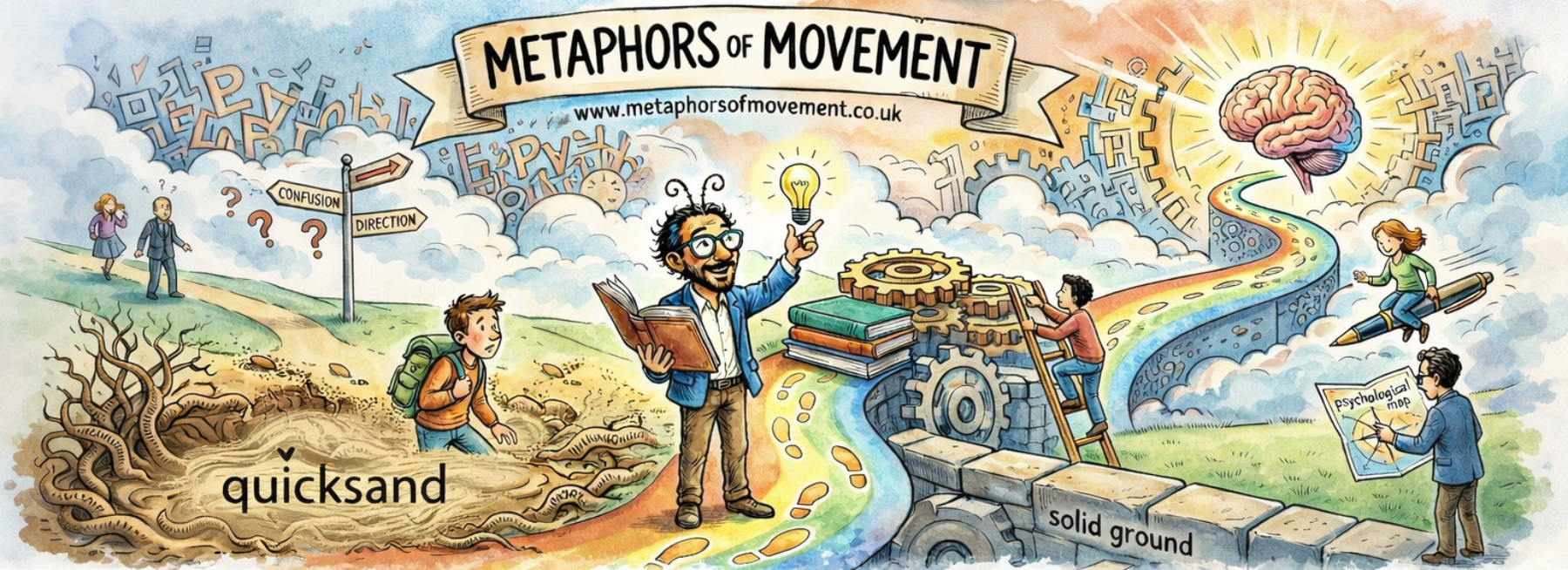
In Metaphors of Movement, the discipline of accuracy keeps the language connected to what is actually being represented. Without that discipline, the work can become a display of the practitioner’s imagination.
An interpretation can be elegant and still belong entirely to the person who supplied it.
The problem with the helpful addition
Often the error enters through an apparently helpful addition. The listener supplies a motive, an emotion, a missing character or a possible escape. Each addition makes the account more familiar and easier to explain. It can also move the conversation further from the original experience.
Suppose someone says they are standing outside a gathering, watching other people through a window. A listener might immediately talk about rejection. Yet being outside does not, by itself, establish that anyone has rejected them. Nor does observing a gathering establish that they want to join it. Curiosity, caution, exclusion and deliberate distance remain different possibilities.
The difficulty is not that rejection could never be relevant. It is that relevance has been assumed. The practitioner has converted a description into a conclusion and may then respond to that conclusion as though the client had supplied it.
This is how an apparently empathic conversation can become strangely inaccurate. The person receives sympathy for an experience they do not quite recognise. Correcting the listener may feel awkward, particularly when that listener is being very kind.
When the metaphor becomes a rescue mission
A second temptation follows closely behind interpretation: the urge to repair the scene. A person is enclosed, so the listener starts looking for an exit. Something is heavy, so it should be removed. There is an obstacle, so somebody must find a way around it.
The wish to help is understandable. The difficulty is that an imagined improvement in the scene can become a substitute for understanding the person’s experience. A satisfying ending has been produced, but the relationship between that ending and everyday behaviour may remain unexplored.
We see a similar habit outside therapy. Tell someone about an unsatisfactory job and they may immediately suggest resigning. Describe a difficult friendship and they may advise cutting the person off. Sometimes those possibilities deserve consideration. They are still premature when the listener has not understood the circumstances, commitments and consequences involved.
With metaphor, the premature solution can be especially seductive because it is easy to imagine. Producing a ladder takes no account of whether climbing is relevant to the experience being described. It simply satisfies the observer’s wish to see the person somewhere else.
The training repeatedly returns to this distinction. Understanding an experience and inventing its resolution are different activities. The second can prevent the first.
Agreement is not a reliable shortcut
It would be convenient if an inaccurate interpretation always produced an immediate correction. Human interaction is less obliging. A person may agree because part of the statement sounds familiar, because they assume the practitioner knows something they do not, or because disagreement would complicate the encounter.
Agreement can also be broad. “Yes, I suppose so” might mean that a phrase is generally applicable to life. It does not necessarily mean that it accurately expresses the experience under discussion. Many observations about feeling overlooked, wanting freedom or carrying too much are easy to recognise without being particularly precise.
The reverse requires equal care. Disagreement does not automatically demonstrate that an intervention has reached an uncomfortable truth. Sometimes the listener has simply got it wrong. Treating every correction as resistance creates a conversation in which the practitioner can never be mistaken.
That is a very comfortable arrangement for the practitioner. It is a poor arrangement for learning anything about the other person.
Vocabulary matters, but restraint matters too
Learning more idioms broadens what a practitioner can hear and articulate. It can reveal distinctions that an overused vocabulary obscures. However, a larger collection of expressions also creates more opportunities to impose something attractive but inaccurate.
The useful skill involves discrimination. It includes recognising when a phrase adds information that was never present, when it changes who is doing what, and when it converts a possibility into an assertion. Knowing an expression and knowing whether it belongs in this conversation are separate achievements.
Context matters as well. Familiarity with an idiom varies between people, generations and communities. An expression that is immediately intelligible to one listener may require explanation for another. A phrase does not become suitable merely because it appears in a dictionary or is familiar to the practitioner.
Good practice therefore involves tolerating the moment before the clever response. That moment makes room for the possibility that the detail which does not fit is the most informative detail in the account.
The value of a less impressive conversation
The ordinary measure of an impressive conversation is often how much the expert appears to know. Metaphor work presents a different demand: how faithfully can the practitioner attend to an experience without replacing it with something easier to understand?
This does not require pretending to know nothing or avoiding all challenge. It requires keeping distinctions clear. What was described, what has been inferred and what remains unknown should not collapse into one confident explanation.
The difference becomes especially important when the conversation acquires emotional force. An evocative phrase can produce recognition, amusement, irritation or surprise. Those responses deserve attention, but intensity alone does not settle the question of accuracy. A person can be strongly affected by something that has been misunderstood.
The most useful practitioner is therefore not necessarily the person with the quickest metaphor or the most striking interpretation. It is the person whose language continues to fit when the details are examined. That discipline is less theatrical than a moment of apparent revelation. It is also much harder to fake.
For readers interested in developing that discipline, the Metaphors of Movement training pathway provides the practical context, demonstrations and feedback through which these distinctions become skills.