Helping is a relationship as well as an activity. The assistance may be useful while the position it creates between two people becomes increasingly difficult.
In this article
A capable employee becomes the person everyone consults before making a decision. At first, this is flattering. Their judgement is respected, their contribution is visible and colleagues are grateful. Eventually, ordinary work cannot proceed without them.
They begin to complain that nobody takes responsibility. Their colleagues complain that decisions are always referred upwards. Both descriptions have some truth, and both are being produced within an arrangement that developed through apparently helpful interactions.
It would be easy to search for the guilty personality: the controlling expert or the helpless team. More becomes available for examination when attention includes the relationship between them. The expert has acquired a position. Other people have organised themselves around it. Changing the arrangement may feel uncomfortable on both sides.
Everyday language already describes positions
We say that someone backs us up, stands beside us, gets ahead of us, looks down on us or leaves us behind. These expressions do more than announce that a relationship exists. They describe different kinds of involvement within it.
Being backed by someone can be welcome. Having someone constantly behind us can also feel like pressure or surveillance. Looking up to another person can involve admiration, while being required to remain beneath them may become humiliating. The surrounding circumstances matter.
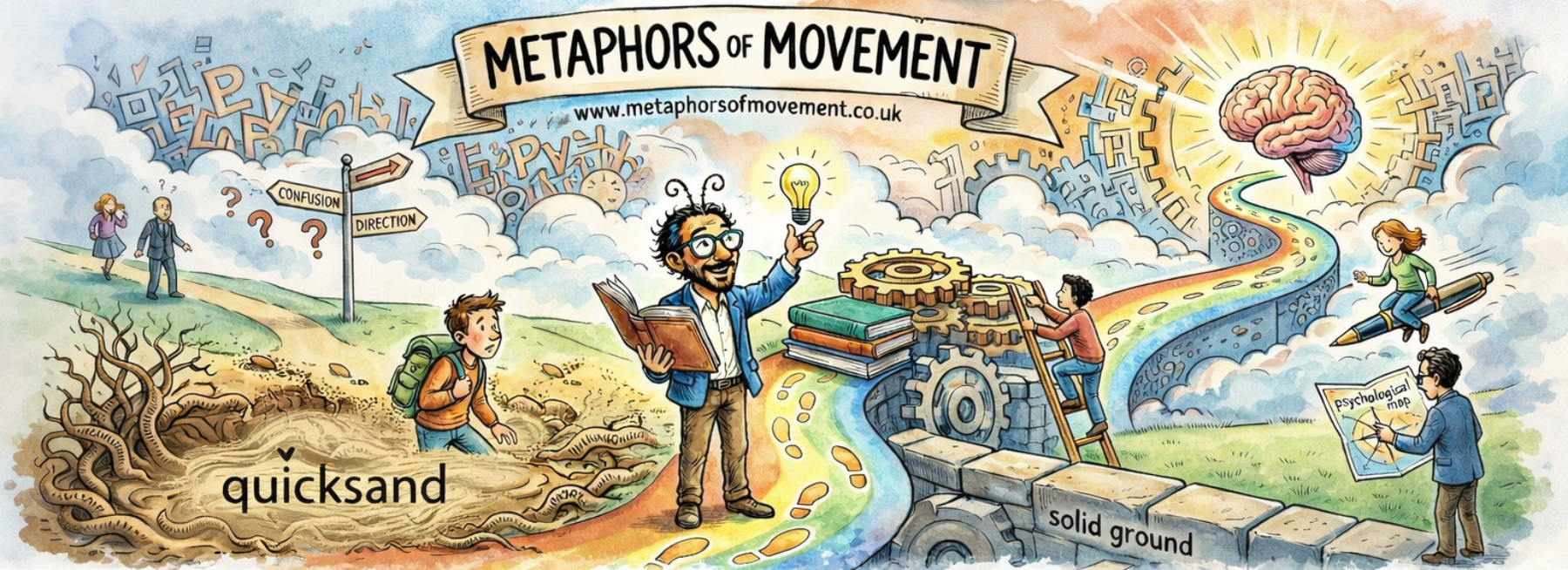
Metaphors of Movement takes this relational language seriously. It invites attention to the way people experience themselves in relation to others, including the roles and expectations that follow from those positions.
This does not mean every casual phrase reveals a complete psychological account. An expression provides something to understand in context. Turning it immediately into a judgement about someone’s character would lose the relational complexity it might have helped reveal.
Good intentions do not settle the relationship
Someone can intend to support another person and still establish an arrangement the other finds constraining. A parent who repeatedly intervenes may experience themselves as protective. Their adult child may experience the same involvement as a refusal to recognise their competence.
Likewise, a manager who provides detailed guidance may believe they are making the task easier. The employee may hear that their judgement cannot be trusted. Neither intention nor reception alone explains the whole encounter.
The relationship also develops over time. Help that was appropriate during a crisis can become intrusive when the crisis has passed. An arrangement that worked when somebody was inexperienced may continue after their capabilities have changed. The actions remain familiar while their meaning alters.
This is why “I was only trying to help” rarely resolves a disagreement. It describes an intention. The disagreement may concern authority, autonomy, recognition or the expectation that one person will remain in need of the other’s involvement.
Good intentions matter. They do not remove the need to understand the position from which help is being offered and the position in which it places its recipient.
The role can become more durable than the original problem
Imagine two friends, one of whom gives extensive support during the other’s difficult separation. For a while, the relationship centres on reassurance, practical assistance and discussion of the crisis. Later, the circumstances improve, but the familiar pattern continues.
The friend who helped may still expect to be consulted. The friend who received help may feel obliged to keep reporting difficulties. A relationship organised around one person’s vulnerability can find an improvement unexpectedly disruptive.
There need be no conscious desire to keep anyone struggling. The established arrangement supplies both people with something familiar: a recognised role, a reason for contact and a predictable form of closeness. A change in circumstances may require a change in the relationship which neither anticipated.
This is an illustrative example, not a claim that support inevitably produces dependency. Many supportive relationships adapt comfortably. The point is that assistance has a relational history. Its meaning cannot always be understood by looking at a single helpful act.
The helper’s investment deserves attention
It is relatively easy to discuss what a person receives from being helped. There is often less enthusiasm for examining what the helper receives.
Being useful can provide satisfaction, connection, status and a sense of purpose. None of those is inherently suspect. Difficulties can emerge when the role becomes essential to the helper’s identity, so that a reduction in need feels like rejection or loss of value.
The expert who complains about being consulted over every detail may also feel excluded when colleagues make decisions independently. The friend who wants someone to become more confident may feel unsettled when that confidence includes disagreeing with their advice.
These apparent contradictions become more intelligible when the helper’s place in the relationship is included. A person can sincerely want another to change and still dislike some of the consequences of that change.
Becoming less necessary can be an uncomfortable outcome for someone whose identity rests on being indispensable.
Professional expertise introduces its own positions
Therapy, coaching and training involve differences in knowledge and responsibility. Acknowledging those differences is part of doing the work properly. Pretending that expertise creates no asymmetry would be unrealistic.
The difficulty arises when professional authority expands into an assumption of personal superiority. Knowing a method does not confer complete knowledge of another person’s life. Being able to identify a pattern does not establish that every interpretation of that pattern is correct.
A practitioner may be invited to become the person who knows, decides, approves or rescues. Those invitations can be rewarding. They can also reproduce a familiar arrangement in which the client has little room to exercise judgement, disagree or discover that the expert has misunderstood something.
There is an opposite temptation as well: to avoid using expertise because taking a clear position might disturb the relationship. Agreement can become a way of preserving the practitioner’s comfort. Warmth and rapport then coexist with a reluctance to address anything difficult.
These are questions of judgement within a relationship. Neither permanent authority nor permanent agreement supplies an adequate answer.
There is no universally ideal position
It would be convenient to conclude that standing alongside someone is always preferable to leading, following or supporting them. Everyday life quickly complicates that conclusion.
A person learning an unfamiliar skill may welcome leadership. An experienced colleague may value someone willing to support a decision they have already made. A person facing an urgent problem may need direct assistance. A friend sharing a disappointment may want company without a proposed plan.
The question is therefore larger than which position sounds most egalitarian or caring. Suitability depends on the task, the relationship, the capabilities involved and the current circumstances. A position that was helpful yesterday may be a poor fit today.
Flexibility becomes important because people can develop preferred roles. Some readily take charge. Others wait to be directed, become the dependable supporter or maintain distance. A familiar role can be useful across many settings without being suitable for all of them.
Turning a preference into a virtue makes it harder to recognise its limits. The person who is “always there for everyone” may eventually discover that being elsewhere has become surprisingly difficult.
Understanding contribution is different from assigning blame
Attention to relational position can be misused if every difficulty is converted into a claim that the person created their own treatment. Other people’s decisions and conduct remain their responsibility. An unequal or harmful arrangement does not become acceptable because its pattern can be described.
There is nevertheless value in distinguishing what a person controls, what they influence and what lies beyond their authority. A relationship can involve contributions from several people without those contributions being equal in power or consequence.
For example, a junior employee may participate in a pattern of seeking constant approval while also working for a manager who punishes independent decisions. Describing only the employee’s dependence would omit the arrangement that reinforces it. Describing only the manager’s behaviour might leave the employee’s available choices unexplored.
A useful account has room for both. It can acknowledge constraints while remaining interested in possibilities, without converting that interest into a moral accusation.
When the relationship can move
At the beginning of this article, the capable employee had become a permanent point of referral. A change in workload alone might bring temporary relief. The deeper organisational question concerns how judgement, responsibility and recognition have been distributed around that person.
The same distinction matters in families, friendships and professional encounters. A practical act can help with an immediate difficulty while leaving an established relationship unchanged. Sometimes that continuity is appropriate. Sometimes it explains why the same difficulty returns in a different form.
Recognising position makes it possible to think more carefully about what helping involves. The value of assistance includes its effect on the other person’s room to participate, develop and disagree. It also includes whether the relationship can adapt when the original need changes.
The Metaphors of Movement training examines situational and relational positioning in depth. Its relevance extends beyond professional work to a familiar human challenge: helping someone while allowing the relationship to become something neither person has occupied before.