Category: Metaphor Video

The History of Metaphors of Movement with Andrew T Austin

The Origins of Metaphors of Movement: An Interview with Andrew T. Austin

Andrew T. Austin, the creator of Metaphors of Movement and Integral Eye Movement Therapy (IEMT), recently shared insights into the development of his innovative therapeutic approach. Here are the key takeaways from the interview:


The Catalyst: Charles Faulkner

Austin credits Charles Faulkner as a significant catalyst for the development of Metaphors of Movement. After attending Faulkner’s presentations, Austin found himself “completely bamboozled” but intrigued, which sparked an inward journey of reflection.

A Convergence of Influences

The development of Metaphors of Movement was influenced by several factors:

  • Austin’s work with IEMT and identity work
  • Exposure to Clean Language techniques
  • Experience with challenging clients in mental health

A New Way of Listening

Austin began to hear people’s expressions differently, focusing on the literal meaning of idiomatic phrases rather than interpreting them. This shift allowed him to uncover the underlying structures in people’s representations of their experiences.

The Richness of Autogenic Metaphors

Austin emphasises the extraordinary data density found in autogenic metaphors, believing that we’ve only scratched the surface of their potential. He suggests that future practitioners may uncover even more applications and insights.

A Response to Traditional Therapeutic Models

Metaphors of Movement was developed partly as a response to the limitations Austin observed in traditional therapeutic approaches, including:

  • The need for clients to “play along” in hypnosis or NLP
  • The challenge of working with resistant or non-compliant clients
  • The disconnect between increasing numbers of therapists and declining global mental health

The Future of Metaphors of Movement

Austin views his work as an ongoing exploration, focused on codifying and teaching the skill set to others. He emphasises the importance of honesty in therapy and a realistic approach to expectations and outcomes.

For those interested in learning more about this unique therapeutic approach, both Andrew T. Austin and the interviewer offer training in Metaphors of Movement.

A Conversation with Andrew T. Austin About Human Behaviour and Psychology

About This Conversation

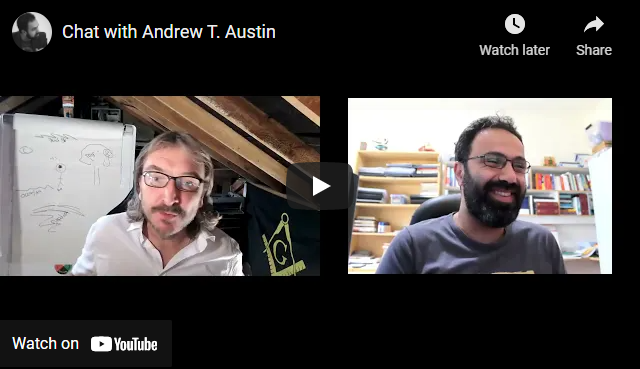
In this video, I have a conversation with Andrew T. Austin about human behaviour and psychology. We explore several interesting topics.

We discuss how people approach planning and problem-solving differently, using an example from my relationship. Andrew explains the concepts of feeding forward and feeding back in human responses.

We explore childhood experiences and their impact on adult behaviour, touching on topics such as parental anger and over-regulation. Andrew shares perspectives on how these experiences shape our emotional responses and coping mechanisms.

The conversation also covers self-awareness and the challenges of truly understanding our behaviours. We discuss baseline emotional states and how difficult they can be to recognise in ourselves.

Andrew offers perspectives on modern education and therapy approaches, questioning the trend towards pathologising normal behaviours.

Throughout the conversation, we reflect on the complexity of human behaviour and the importance of nuance in understanding ourselves and others.

It is a wide-ranging discussion that touches on psychology, personal development and social dynamics.

Key Topics

  • Proactive versus reactive behaviour in relationships
  • The intricacies of emotional responses and their origins
  • The impact of parenting styles on child development
  • The challenges of self-awareness and self-remembering
  • Critique of modern education and therapy approaches
  • The importance of intellectual curiosity and lifelong learning

Whether you are a psychology enthusiast, a mental health professional or simply curious about human behaviour, this conversation offers perspectives on understanding ourselves and others.


Roni Matar is based in Beirut, Lebanon. You can find his coaching and training website at www.ronimatar.com.


Timestamps

  • 0:00 Introduction and discussion of time elements in metaphors
  • 3:01 Proactive versus reactive planning
  • 6:23 Blame versus shame
  • 11:18 Self-awareness and baseline emotional states
  • 16:41 Pathologising normal experiences
  • 21:10 Nuclear family and community impact on mental health
  • 27:43 Childhood experiences and their long-term effects
  • 33:40 Feedback loops and memory
  • 38:20 Complexity of human behaviour and limitations of diagnostic frames
  • 43:18 Education system’s impact on intellectual curiosity
  • 49:22 The challenge of self-awareness and insight
  • 54:25 The importance of community in child-rearing
  • 59:23 Intellectual laziness and the value of lifelong learning

Metaphors of Movement Q&A with Andy: MoM Practice Group

In the 6 June 2024 practice group, we held a Q&A with Andrew T. Austin about several topics. Here is the summary.

Understanding Boundary Violations

One significant challenge in metaphor work is handling boundary violations. These occur when clients introduce elements that are not part of the metaphor, such as unrelated conversations or distractions. Andy emphasised the importance of recognising these violations, which can be understood within the model as indicating a dominance of left-hemispheric thinking. By identifying and addressing these violations, practitioners can guide clients back towards more direct engagement with their metaphors.

Encouraging Right-Hemisphere Modes of Processing

To counterbalance left-hemispheric dominance, Andy recommends using techniques that promote right-hemispheric modes of processing. These include incorporating visual stimuli, varying vocal tones and expressing emotions freely. By creating an environment rich in sensory and emotional cues, practitioners can support deeper engagement with metaphors.

Managing Boundary Violations of Dissociated Identity

Clients sometimes present metaphors in a dissociative manner, such as saying, “I see myself in a bubble.” Andy advises practitioners to shift the client’s perspective from observer to participant. Asking questions about their position and surroundings within the metaphor helps anchor them in the experience, allowing for a more detailed exploration of their metaphorical landscape.

Social Functions and Pain Avoidance

Boundary violations can serve as mechanisms for clients to avoid discomfort or social pain. These behaviours may manifest as conversational distractions or changes of subject. Recognising the possible motivations behind these actions can help practitioners navigate and address them.

Identity Changes and Internal Metaphors

Within the model, internal metaphors, such as those involving the loss of body parts, may be associated with significant identity changes. These metaphors can highlight issues related to support, understanding and personal growth. Practitioners need to assess whether clients are open to engaging in a process of healing and growth or are seeking immediate symptomatic relief. This distinction helps guide the therapeutic approach.

Practical Application: Eliciting and Idiomising Metaphors

Developing skills in metaphor work requires practice. Practitioners are encouraged to elicit and idiomise as many metaphors as possible. Engaging with peers for feedback and participating in practice sessions can improve proficiency. Understanding idioms and how they relate to metaphors is an important part of effective metaphor work.


Metaphors of Movement offers a framework for understanding and addressing complex emotional and psychological issues. By recognising boundary violations, using techniques intended to stimulate right-hemisphere modes of processing and exploring the meanings of metaphors, practitioners can support structured therapeutic exploration. Continuous practice and collaboration with peers are important to mastering this approach.

Watch the full discussion below.

Understanding Immersion Metaphors in Metaphors of Movement

Immersion metaphors are an important concept in the therapeutic approach known as Metaphors of Movement. They refer to metaphorical situations where an individual is immersed in a liquid environment, either with defined boundaries, like a swimming pool, or without boundaries, like an infinite ocean. These metaphors may provide insight into a person’s childhood circumstances and the adaptations they made to those circumstances.

Key Principles of Immersion Metaphors

  1. Bounded versus unbounded immersions: A bounded immersion, like being in a swimming pool, may represent growing up in a constrained family environment with limited room to move or escape. The size of the boundaries can provide clues about the degree of limitation. An unbounded immersion, like being in an infinite ocean, may represent circumstances that are so vast they cannot be adapted to.
  2. Anomaly in the environment: In an immersion metaphor, the person is the “anomaly” in the liquid environment: a human cannot survive indefinitely in an ocean or pool. This may represent childhood circumstances that fundamentally conflict with the needs of the developing child. The person must either find a way to “escape” the environment or will be shaped by it in ways that may later prove maladaptive.
  3. Submodalities and content: Immersion metaphors can be understood in terms of their submodalities, such as sensory qualities including temperature, colour and size, and their content, meaning the facts of the metaphor. Submodalities may provide information about the emotional impact of the circumstances, while content may provide information about the logical constraints.
  4. Context within context: An individual’s immediate circumstances exist within a family context, which exists within a societal context and, in turn, within even larger contexts. Where we draw the boundaries between these nested contexts shapes how we understand immersion metaphors.

In Summary

Immersion metaphors in Metaphors of Movement provide a symbolic representation of the shaping influences of a person’s early environment and the adaptations they made to those circumstances. Analysing the boundaries, escape potential and degree of “fit” between person and environment in the metaphor may provide therapeutic insight into the origins of a person’s present-day challenges. Exploring problematic immersion metaphors may point towards fundamental changes that the individual needs to make to move forward in life.


To learn more about immersion metaphors and other key concepts in Metaphors of Movement, sign up for the Metaphors of Movement Level 3 course by visiting www.metaphorstraining.com. This in-depth training will develop your ability to explore and work with the core metaphors shaping your clients’ lives.