Decoding the Symbolic Architecture of The Unconscious Mind
Author: Andrew T. Austin
Andrew T. Austin is the developer of "Integral Eye Movement Therapy (IEMT)" and "Metaphors of Movement". He is an author, therapist and trainer who speaks on a variety of topics related to emotional and mental health. Andrew T. Austin is a well-known critic of the mental health and personal development "industries" and openly criticizes the cult of personality and the high-status games that are so prevalent amongst these so-called "experts". Needless to say, they don't much like him. #NLP #metaphor #archetypes
The metaphor: “I feel like my excess weight is a heavy coat I have to wear. It’s like those old plaid, thick woollen waist-length coats we used to wear in the winter as kids in the midwest USA. It seems to be protective, but at the same time, it’s making it difficult to move. There’s a whole world out there to explore. If I could swim across the ocean, but even if I could get the coat off, there’s something holding me back, like I’m chained to an anchor in the sand.”
If we start with the taxonomy.
Burdens: The coat is a burden and is one he wears well. Burdens are classically “responsibilities”, usually (but not always) responsibilities handed to us as children, and in this instance, is verified by the fact that it is a children’s coat.
However, he might have been an adult who was handed this as though he were a child. In which case, we can start to posit some ideas around that of identity and maturity and how he is viewed and treated by other people.
As MoM trainees will be aware, burdens can be easily grouped into simple categories:
heavy objects such as rocks, sack loads, etc. These can be either carried externally (publicly) or internally (privately).
shields or objects that function as shields. Typically, these are carried over the chest.
garments that are worn, including heavy cloaks and suits of armour.
Each of these has different characteristics and functions, but all have in common the detail that they pertain to responsibilities that usually arise sometime in childhood. They are handed to the child by person/s and/or circumstance, rather than voluntarily assumed and taken up by the child. The latter rarely takes the form of a burden and instead takes on a different construct.
Burdens that are acquired through various means in adulthood often arise in metaphor as anthropomorphications, so we may see it as an elf sat on the shoulder, or the mother-in-law carrying on top of their head and so on.
When a burden is a garment, there is usually a protective function to this, as suggested by the person reporting the metaphor.
In this instance, the burden heavily restricts movement. I’ll leave it to the reader to ponder what the responsibility might be in this case.
In terms of taxonomy, we also have that pesky chain that keeps him attached to the place he cannot move from. There is a detail missing from the metaphor in that we do not know how the chain is attached to the person, so I am not able to comment on that aspect. But we do know that it is attached to an anchor.
This anchor is another burden, one that has been dropped to which there remains a strong attachment. It’s either become a bit of a drag, or will become a bit of a drag should the person be able to get moving.
There’s an additional detail which would require further exploration, and that is the sand on which the anchor is set. An ocean is mentioned, so it would be easy to assume this sand is a beach, but this may not be the case.
The client’s fantasy solution is, of course, in serious error, and we can begin to get an idea of why he may have been burdened in this manner in the first place. He writes, “There’s a whole world out there to explore. If I could swim across the ocean…“
Note: “… if only…“
This is, of course, utterly absurd. It would be foolish to try and swim across an ocean, and so this person’s reality strategy is erroneous. There is a sizeable overestimation of his potential ability, should he simply be able to cast off his burdens and free himself from his attachments. His solution to his problems would probably be more dangerous than his actual presenting weight problem. If this wasn’t spotted by the practitioner who then goes ahead to change the burdens, this is the man who returns to the clinic later, reporting that his problems are getting worse. Remember, burdens are about responsibilities!
But not all responsibilities are burdens.
A lack of creativity and imagination is demonstrated here by the use of those two little words, “if only.” We can safely know he can do more, and there are plenty of alternatives open to him, but there is a reason lurking in there somewhere. I’d want to probe a little bit about that.
This is the Erroneous Law of Opposites in action. The Erroneous Law of Opposites states that the opposite of the problem must be the solution. There’s a good reason why this is called the ERRONEOUS law.
Danny posted a metaphor on the FB page, I thought it might be interesting to play a little with it.
The metaphor:“I’m stood upright in a red velvet lined coffin (no lid), which itself is stood upright in a graveyard. Only my head and shoulders are above ground level. My left wrist is bound with a leather strip tied at the other end to a wooden peg in the ground. The graveyard is on a hillock. There are lots of gravestones behind me in each direction, and beyond the graveyard, countryside. My upright grave has no gravestone. Directly ahead, and down the hillock, is a gravel churchyard and a church. To the left is a towpath, a canal (with a few barges) and countryside. To the right is a stone wall, with an open gateway adjacent to my grave, then a country lane with a couple of walkers, and then countryside.”
Overall, this is a very common metaphor, although it can take many forms. This is the archetypal “living death” metaphor. i.e., “I don’t have a life,” “my life is over,” “I’m as good as dead,” “My life isn’t worth living.”
This is quite common following a major loss event or a series of events. It is also not uncommon with traumatic events when the casualty reports, “My life ended that day,” “I’ve had no life since then,” “I’ve lost everything, I’m lifeless,” and so on.
If we look at the taxonomy of the metaphor, there are a number of categories.
Container Metaphor: The red-lined coffin (red is the only colour mentioned in this metaphor, so it has symbolic significance). So, we know that this isn’t a new problem, but rather one that has existed since childhood. We also know that this is about the client’s family of origin.
If we add this to the element of bodily position, we can say that the client stands up for himself when it comes to his family, but he still doesn’t have much of a life.
Elevations: The coffin and graveyard are elevated on a hillock. This suggests that there is an elevated status [of the family] but not necessarily so for the client within the family.
If we add this to the missing gravestone, we can suggest that he doesn’t have the family name to identify his position.
Attachments: The leather strip bound to the left wrist (which in turn is a container metaphor) and attached to a peg in the ground.
We know that this client is very attached to this place. He’s going to be very reliable because we always know where he stands. This isn’t a man who changes his position readily. This attachment has existed since childhood (as revealed by the container element) and he’s always had a hand in it himself. Being a place for the dead, it could be suggested that this attachment is not at all healthy.
I would be left wondering if this client is haunted by ghosts from his past.
We know that the client looks down on the church, but there is also something about the church he looks forward to.
Now, if the client were to go with what is left for him: assuming he couldn’t get over it (the canal), then this would be something in which he’d need to immerse in order to cross himself.
There’s a degree of inevitability about this, and this is something he’d have to go through in order to cleanse himself of all that he’d have right behind him. He may have to barge past a few things that may get in his way, but if he lets them go with the flow, things will soon be clear to him.
It would almost be like being born again, a different kind of baptism, but the church would have no hand in this. They would regard this as taking the “left hand path,” commonly associated with the antichrist.
Meanwhile, there is an opening that is right for him. The wall is a barrier (The Obstructions = primary negative injunctive), but if he looks at what is right for him, then he can find an easy way through into the country that is right for him.
Eric writes: “I realised that going to the gym and walking from the front door to the locker room while carrying a heavy gym bag felt like pushing my torso through a 10 ft deep wall of jello (or another resistant medium.) That’s why I hate going. It doesn’t bother me if I go in and follow the same path to visit the massage therapist.”
This metaphor is incomplete in that we do not know what is outside of the jello or how far the jello extends, but encoded in here is more than enough information to get us started.
First off, if we start with some idioms that match the metaphor:
you have trouble moving forwards
you aren’t making much progress
you aren’t making the progress you’d like to make
something gets in your way
it’s hard going forwards
it would be easy to get stuck in
it’s all a bit wobbly/shaky
you are getting set to go
everything is set but not much is happening
Suffocation idioms might be an obvious choice here, but because the reference is “my torso,” this suggests his head is clear from the jello. So we know he keeps a clear head even when he has difficulty moving himself forward. It enables him to focus on other things, as his head is elsewhere.
His mind isn’t set on this, and even if it was, it wouldn’t help.
If we explore the taxonomy, we have several overlapping metaphoric structures. First up, we have an obstruction metaphor. It’s a wall of jello (as opposed to a pit or pool of jello), so we have an obstruction, which as you will know generally relates to a rule. Well, to be specific, it’s a primary negative injunctive, and I urge people to study Gregory Bateson’s book, “Steps to an Ecology of Mind,” to learn more about this kind of thing. People tend to say things like, “But I’ve heard that Bateson is too difficult to read.” Stop making excuses and buy the book and study it. Don’t read it. STUDY IT!
Anyway, back to the jello. So we have a rule that gets in the way of the man and where he is trying to get to. His strategy to deal with this rule is not to do what is right, or to seek a different direction, but rather to try and get through this. If he is looking for some kind of breakthrough, then he will be disappointed because jello rarely breaks in this way.
I don’t know if he is normally a pushy guy when it comes to getting what he wants, but it seems that his pushiness may be the very thing that exhausts him before he reaches his destination/goal. He meets too much resistance.
The rule he faces has some flexibility, and it is something that he can get through, but it is there every time waiting for him. He hasn’t found a decent way to get around it yet, so he may want to consider what is left for him and what is right for him, as well as his background and where he has come from.
And here we have a secret. This is about moving away from his background and getting ahead, moving forward in the world, to get to a better place.
And this takes us to another taxonomy: that of contamination. Contamination metaphors are classically, but not exclusively, about shame. It isn’t being in the contaminant that reveals the shame, that actually masks it, but it is when the person is out of the material of contamination. What I mean here is that the person in the shit pit doesn’t feel the shame, but it is when they climb out of it that they experience the shame.
Shame generally requires other people to assist with its creation. Later, of course, this can lead to a division in identity whereby the person sees themselves and is shamed of what they see. Thus, they have learned to be ashamed of themselves.
So, I’d be bold and suggest that this person will experience a degree of shame entering the gym once they have gotten through the jello.
What we have here is an issue of identity. Guilt is about what we do; shame is about who we are.
When he stays in the background (i.e., this side of the jello), there is no shame, but this shame is revealed once he gets through the jello and out the other side.
Novice MoMers might be tempted to think of the jello as a container. It isn’t, and thus, any attempt at getting the client to “grow up” will only add to his difficulties.
And there I shall stop and invite further suggestions as to how we can handle this metaphor in the comments section below. Remember, I’d rather you have a go and get it wrong than not suggest anything at all. That is how we learn.
I’ll give you a clue. I mention Gregory Bateson for a good reason.
Anon writes: “My problem is like a set of padlocks and chains around my groin. Is there anything that MoM would suggest about this?”
Metaphors of this sort are quite common, especially amongst young men. An observation is that bondage-style metaphors tend to be most common amongst 1. the middle to upper class and 2. individuals with no particular predilection towards bondage. As a result, we can see much prevarication around metaphor elicitation, with numerous boundary violations that prevent first access to the metaphoric experience.
I remember one particular individual who, after much difficulty, finally said words to the effect, “Fine, then I’ll tell you!” and blushed bright red as he said his metaphor was like a rope tied around his testicles. At the other end of the rope was his wife, and she was dragging him along a beach. This whole image was quite embarrassing to him and conflicted with the narrative that he had about his relationship and his own masculinity.
For more on the masculine types of guys, That “gimp” scene from the movie “Pulp Fiction” seems to have influenced metaphoric imagery rather a lot.
Anyway, back to Anon’s metaphor. If we begin with idioms and expressions that fit the metaphor:
he is keeping his groin safe.
his groin is safe.
his sexuality is safe.
his sexuality is secure.
he only has safe sex.
he’s cocky (“cock key”).
there are historical links with his groin.
there might be a missing link.
he has too many/insufficient links to his groin.
he lacks sexual freedom.
he can’t get to grips with his genitals.
he isn’t able to take his true nature in hand.
no one else can handle his sexuality.
these padlocks and chains stop him from being a wanker.
he can’t feel himself being a man.
If we explore the structure of the metaphor, there are several overlapping taxonomies:
-There is the burden aspect, the carried object. Typically, burdens denote responsibilities. Usually, these are handed to the person at some point in their history by someone else, “Here kid, take this and carry it forever.” It’s their very own personal cross to bear.
In this case, the responsibility is that of not permitting sexuality. It is a sex that must be kept under tight control, tightly constrained, inhibited, locked away out of sight. Only those with the set of keys (for there is more than one key required) may be granted access. The victim here has been given the locks and chains, but evidently, they lack the keys to reveal themselves.
Presumably, the person who handed over this burden is keeping the keys for themselves.
Historically, sex is sin, and sin is a contamination that must be washed clean. Baptised with [holy] water, cleanliness is next to Godliness, washing away the sin, purification with [holy] water, and so on. In more extreme circumstances, purity can be created with fire, whether the temple is consecrated with smoke (incense), a candle, or the sin is burnt out of the afflicted with fire (i.e., in cases of witchcraft or demonic possession).
The padlocks and chains prevent that contamination from occurring in the first place. It is a restriction against sin, an effective prevention of being dirtied by the unholy fluids of another.
Such burdens are typically carried until death because the carrier knows not that they have a choice. Jesus had no choice but to carry his cross to his death, and when he faltered, he was simply assisted to carry it. Culturally, such powerful imagery forges some interesting beliefs that go unquestioned for generations. Questioning these beliefs can get one punished, banished, or, until relatively recently, imprisoned or killed.
-The other overlapping taxonomy is that of “containers”. The chains form multiple strands of container metaphor, which tells us this is not a new problem; it has been present for all of his adult life and for a significant portion of his childhood. We also know that this was inevitable, which means there was nothing within his ability to have done anything differently. Anything he would have done differently would also have been doomed to failure. This is the nature of container metaphors.
Thus, by the time a person reaches out for help for a problem of the nature of a container metaphor, they will often be faced with a sense of helplessness, hopelessness, and desperation. Self-doubt, self-esteem, and so on may all have been compromised as the person is subjected to repeated failures.
There is nothing they could have done differently.
Other than to grow up.
But the other parties involved in the creation of the container will resist this. To grow up and out of a container metaphor is to reject all that came with it, and not everything was bad or negatively intended.
Containers trap us, but they also protect us.
They hide us, but they also give us identity in the world.
And so on.
As a child, there are many factors that reside outside of our awareness. These factors usually remain hidden until a person “grows up” and out of the container, and not everyone in the individual’s social and family nexus wants this.
Also, with freedom comes responsibility and fear. Freedom for the child now adult comes with apprehension and fear in the parents.
For example, the sexually precocious teenager may not perceive her 30-year-old “boyfriend” in the same way that appropriate adults will view them.
And sex is one of the greatest sources of fear and apprehension for parents when it comes to their [adult] child. It is one possible reason that people appear so comfortable with religious organisations taking control and responsibility for how our populations are supposed to have sex (i.e., our preferred cultural narrative is that no sex should really be allowed before a marriage occurs in a holy place and in front of God and then only occurs to create life. It must never be outrageously fun and outright naughty. Self-pleasure is a sin for which there must be atonement. We are most comfortable with the conservative baseline narrative, even though the actual reality is so very different.)
And herein lies a little secret, not yet taught in the MoM training. Containers also represent familial beliefs intended to protect the contained person from the outside world. For, in this instance, the outside world might demand interaction with his groin, and this outside world isn’t always quite so trustworthy or reliable as a child would like to believe.
The person contained probably thought it was the other way around, though, so he might want to think about that a little.
So, in summary, MoM trainees will know that working with container metaphors can often be a single-session job which creates an immediate change in the person’s perception. However, immediate outcomes from the work might take the form of anxiety, feeling vulnerable, feeling exposed, feeling lost, and so on. The client may not report an improvement immediately afterward, and it will be up to the skilled practitioner to decide if further work is needed, or if it is just a matter of time for the client to work through and adjust to their new position.
As always, I’d love to read your thoughts and comments below.
“Are metaphors just beliefs that a person has regarding a context they came to seek guidance about with a therapist or not? Do metaphors equal a limiting story a person has about themselves, the world, or their life?”
It’s not an easy one to answer, primarily because of that word “Metaphor”. It is a word I have come to love and loathe in equal measure. Love, because it has opened up a whole new world of exploration and possibilities for me, and loathe because it is a crap word semantically loaded with so many different meanings to different people.
For example, in the context of therapy, “metaphor” might simply be a story that the therapist tells the client that has a message attached to it. You know, like in that terrible story of the ugly duckling. Only the dimmest of children don’t realise that this is allegorical and has a message for children about being the odd one out. It says, “Hang in there, kids, because one day you will grow up, and be beautiful and better than all those that laughed at you.” It’s a worrying message for sure, and I’m not entirely sure that it instils the right values for children in these modern times.
Many therapists, especially hypnotherapists, love this kind of “metaphor.” I wish they didn’t, of course, because too much of the time they simply come across to their clients as patronising halfwits.
But of course, we can add “technology” to this metaphor. We can make it isomorphic or polymorphic. Basically, this means that we substitute elements of the person’s life for characters in the story (there’s a one-to-one relationship, i.e., the bullied child becomes the ugly duckling, the other kids become those bastard ducks) and the story is parallel to the events as told by the client. Of course, the therapist tries to change the ending or something, you know, just to make it more fun or something. They can begin to add in embedded commands and suggestions, utilise characters in the story to introduce suggestions through “quotes”, and so on.
Or, they can get clever and make the story less obvious. Here’s an example: Tell the story of Jesus to the horribly depressed man. The story of Jesus is built around honesty, faith, horror, suffering, brutality, unfairness, horror, torture, and so on, yet overall, this story seems to inspire hope in people. (Truly, I don’t really understand why or how; it’s just horrible, but well, that’s religion for you).
Often utilising NLP’s “nested loops” and “state chaining”, these homomorphic metaphors can match, pace, and lead the differing states of experience of the client, and there may be many different elements in the story to each of the elements in the person’s real life in order to convey this. This pattern of “therapy” has been happening for tens of thousands of years, and the stories are told in narrative, in song, and/or in ritual (i.e., the grand ritual of Christmas) and passed from generation to generation. These stories evolve and change according to the customs of the time, political pressures, and commercial pressures. To stick with the Christmas example, a long time ago, political pressure added the Jesus narrative to an already established winter ritual. In more recent times, commercial pressures and influences have introduced multiple characters into the ritual drama, such as a Norwegian Santa Claus, a facially deformed reindeer, and, if you are American, The Grinch. This story is always evolving, much to the horror of Christians who want it to be about an uncircumcised baby.
Human experience is rather complex; our emotional range is varied and our social politics are so seriously complex that it can be very hard to communicate our experience verbally in a linear fashion. One key problem is that in order to convey our experience, we need to have someone prepared to listen, and people make quite terrible listeners. They interrupt, change the subject, make it about themselves, have emotional reactions to us and so on. Also, the message we attempt to deliver is filtered through the availability of words, and of course, through distortion, deletion, and generalisation.
Thus, the “metaphor” that MoM concerns itself with are those homomorphic metaphors of the client’s own experience. Inside this metaphor, there will be multiple characters, narratives, and events all happening simultaneously. It is a highly information-dense, complex experience that simply cannot be conveyed adequately in language, and so reveals itself in linguistic fragments as “idioms.” The idioms act as little hints to the complex metaphor that is being alluded to, and the MoM training is designed to enable the practitioner to be able to know what they are hearing and to have a methodology for working with the underlying experience of the client.
So, back to the first part of the question: “Are metaphors just beliefs that a person has regarding a context they came to seek guidance about with a therapist or not?”
I simply don’t know the answer to this. I often wonder if metaphor is contextual to time and location. For example, if we were to interview the client on a different day about the same problem, would they give a different metaphor? I suspect not, but I really don’t know.
One observation about metaphors is that they are remarkably stable and resistant to suggestion and influence, unlike memory and other forms of mental representation. The other observation is that metaphors tend to be timeless and lacking time predication. So my best guess is that the client’s metaphor is likely to exist across context, but…
… while the metaphor’s structure is stable, the imagery can change and morph over time. For example, being stuck is the same thing whether you are stuck in treacle/molasses or mud, stuck in a rut, or in a trap. The effect upon the person is fairly similar in that they cannot move forwards (or wherever). But the quality of the stuckness may differ according to context. So, the person is always stuck, but in place A it is like they have fallen into a trap, and in place B it is like they are glued to the spot, and so on. The effect may be the same, but the taxonomy and symbolism of the metaphor are different.
Now, regarding the issue of metaphors being beliefs. Again, I don’t know. My difficulty here is with the definition of “metaphor” and the definition of “beliefs.” In fact, I’m not entirely sure I even know what constitutes a belief any more. I’ll need to come back to this one later when I have more time to explain.
The next part of the question is: “Do metaphors equal a limiting story a person has about themselves, the world, or their life?”
The answer to this is simply yes. This is exactly what it is. But the problems arise with issues such as, (i) is there a better alternative to this story? (ii) not all limitations are bad or negative.
Metaphors as experienced by people are interesting in that they extend infinitely in all directions. They are the person’s world and their life, so how could they be any different?
Anyway, more on this in later blog entries. I’d be delighted to read any comments or observations people might have on this in the comments section below.
Like most therapeutic conversations, at the surface, this interaction between coach and client appears to be nonsense. It may well be just that, but what we can be sure of is that what is being expressed verbally does not always indicate what is happening experientially. Similarly, an observer of an MoM interaction may well be left bemused as to what on earth is going on. So I thought this would make a good study for a MoM analysis of the interaction.
Coach: “And you’re under the piñata now.”
Client: “Mm hmm. Mm hmm. Yeah, so I’m ready to receive that answer.”
This is an interesting statement that reveals a few things about the client and whatever the answer is that she is ready to receive. The “answer” is active, and the client is passive. The answer transmits to the client. The client acts as a receiver. If we were to generalise this across contexts, we could suggest that this is a common trait in the client’s life. This may well not be true, but would be an interesting point for provocation. I’d suggest that the client is a great listener in life but not such a great doer. She’s patient and has probably been too patient. In fact, in this instance, so much so that she has become a patient.
As a point of provocation, this idiomatic transform from being “ready to receive” to become a psychotherapy patient fits the reality perfectly because this is exactly her position and current identity.
Coach: “You’re ready to receive. And is there anything else that needs to happen for you to be ready to receive that answer?”
This is a bit of a paradoxical question and is the sort of thing I’d expect from a hypnotist. Essentially, the message being communicated is, “you are ready, and you are not ready.” What the client is missing is the answer, or definition of what that answer might be and require. In the absence of this information, how can the client know what else she needs in order to be ready.
Now, with this question, her readiness is cast in doubt.
Client: “Well, I think what I’m saying is that I want, I want that answer. I want someone to give me that answer. And at the same time, I know that can’t happen. It’s got to come from me.”
And so the client feeds back the paradox. She wants the answer to be given to her by someone else who possesses the answer, but at the same time she thinks she knows that it has got to come from her, the very person who presumably does not possess the answer. In terms of modal operators, there’s the modal operator of possibility “want” in conflict with the modal operator of necessity, “got to.”
Now, she is ready to receive, and this was encouraged with the question “is there anything else that needs to happen for you to be ready to receive” and yet she cannot receive as the answer cannot come from her. That word “needs” is another modal operator, by the way, and not a modal operator of possibility. An answer in the negative to that question closes the scope and shuts down all possibilities from the communication exchange.
Coach: “Oh. And so you want someone to give it to you and you know it has to come from you. And is there anything else about that want someone to give and no, it has to come from you?”
Wait, what? I question the value of reflexive questioning unless it occurs for two precise purposes, creating a rapport where rapport otherwise may not occur, and demonstrating understanding by proving you heard exactly what the other person said.
Here, the repetition of the client’s words is being used as a technique and tagged onto a preset question. Ultimately, the formula looks like this: <the client’s last sequence of words> PLUS <one of 8 preset questions> Use a soft but knowing tonality, and upon the delivery of the question, nod, smile, and blink slowly.
And it is at this point that I realise what makes me so uncomfortable watching this interaction. There is a lot of smiling, but there is an absence of humour and I tend to have an association between the two. Smiling like this indicates… well, something else.
Client: “I’ve been, I’ve been so confused about it all this time that I would just, I would like for someone to come along and say, here it is.”
The client has moved to outcome, her solution to the problem. The thing is, we don’t have any clarity as to the problem itself. And the little verbal dance that follows encourages a further departure from an accurate assessment of the actual problem. My reasoning for this goes along the lines of, how do we know that the client even has this elusive answer inside them, or access to it? Maybe it is something blatantly obvious to someone else but not to her.
Coach: “You’d like to. You want to. Here it is.”
Client: “Yeah. Yeah.”
Coach: “And you know it has to come from you.”
Client: “Mm hmm. Mm hmm.”
Coach: “And when you want someone to come and just give it to you, and you know it has to come from you, what would you like to have happen then?”
I find this question quite staggering. The client has stated quite clearly and quite emphatically what she would like to have happen. The implication from this question is that the answers she gave previously were not satisfactory, or at least, not to the satisfaction of the coach.
This is a really common situation between therapists/coaches and clients, where the client’s own experience is cast into doubt quite inadvertently. If I were to go a bit further, the message here is actually, “you, the client, cannot be trusted to know your own experience.”
Client: “I’d like to have the intuition, the answer. I need to have it come from me.”
Just in case the coach didn’t get it, the client gives it again. I find this reassuring, personally, I’d be tempted to grab the coach by the ears and shout it so she can hear it properly.
Coach: “And you need to have it come from you.”
Yes, she did just say that.
Client: “Yeah.”
Coach: “And so what kind of a you is a you, that an answer would come from?”
Wait…what? WHAT? What happens here is a sudden departure from the logical reasoning and a radical change of theme. This question could have actually been the very first question that the coach asks. I’ll show you:
>>>Client: “Mm hmm. Mm hmm. Yeah, so I’m ready to receive that answer.”
>>>Coach: “And so what kind of a you is a you, that an answer would come from?”
Now, an important point here on the use of pronouns. The client did not use the word “you”, the client used the word, “me”. It was the coach that made the transform of this “me” to a “you”. Read the transcript through again and you will see this. The coach is now pursuing a “you” that she herself brought into the exchange.
If we correct for this, the exchange changes dramatically and would look like:
>>>Client: “I’d like to have the intuition, the answer. I need to have it come from me.”
>>>Coach: “And so what kind of a me is a me that an answer would come from?”
See how that works. It would change the dialogue to create a more genuine relationship. The “me” that the answer would come from would be, presumably, a coach who can actually provide an answer. The coach ducks the issue intuitively and maintains the illusion of a Clean Coach identity position which appears to be, “I cannot help you, you must help yourself.”
Client: “It’s an intuitive me.”
Coach: “It’s an intuitive you.”
No, it’s an “intuitive me”, but the coach can’t say this unless she were to realise, understand and be comfortable with the transform that occurs by using this corrected sentence.
Client: “It’s a me that can, as we mentioned before, pull all these things together and, I guess, I’m the one that needs to fill up that piñata with all those things.”
Coach: “And you need to fill up the piñata.”
Client: “Mm hmm. Mm hmm. Put in all those things that I’m looking for, and then intuitively determine how this is all going to fit together and be the professional life that I’m looking for.”
I’m going to suggest that this sentence reflects little more than the client struggling to maintain some kind of rapport with the coach and can be disregarded. Although one interesting thing to note, she is doing the very thing she says she wants to do and is fitting things together.
Coach: “And so, is there a relationship between intuition and pregnancy?”
So what we have here is another dramatic departure from any logic that preceded it and another change of direction. She might as well have pointed to the sky and shouted, “LOOK, A BEE!”
Now if we pay attention to this question, which is common in Clean Language, “Is there a relationship between A and X? The answer is, of course, always going to be “yes.” Everything in the universe will have some kind of relationship with everything else. The question is what is the nature of that relationship and how important is it for our purposes. To give the coach the benefit of the doubt, I’m going to assume that “pregnancy” was mentioned in the exchange prior to the timing of this video clip.
So, is there a relationship between “intuition” and “pregnancy”? I’ll offer a guess. Both happen or are associated to happen, in women. Any two things occurring in the same body are going to be connected. In this client’s instance, pregnancy requires something to be supplied by another party in much the same way that the answer is supplied. She is ready to receive. An alchemical marriage is waiting to occur, a feminine archetype that has reverberated down the ages.
BUT, and it pains me to write this because I’d rather like to assume it is so obvious and needs no explanation. Whilst the answer may come from within, the necessary ingredients for pregnancy cannot do the same. It needs to come (sic) from someone else.
And yet I am left wondering if, in fact, the coach is far smarter than I may have given credit for. Pregnancy is about, literally, creativity. Life is created deep inside her, and new life is born. Maybe intuition is the same, with the right seed planted, she can create an idea, an answer. the answer.
Client: “Yes, yes, yes, but I prefer not to use the word necessarily pregnancy.”
Oh. OK, so I wonder what word she would use? Or indeed if this is even relevant.
Coach: “And your gut.”
Client: “Yeah, yeah. But it’s that whole notion of there’s something waiting to happen, and I know that that region is related because a lot of my thoughts, my, when I do get intuitive thoughts, they do come from there, so that’s where this is going to come from, so that’s, you know…”
OK, looks like the client is on the same train of thought. The gut feeling. That part of her body that is fertile and creative. But still, there is the issue of that [viable] seed getting suitably planted in the first place. But before we can move on, there appears to be another verbal dance that must be played out first…
Coach: “And so you do have intuitive thoughts and they come from there when you have them.”
Client: “Yes, unfortunately, I don’t think I have them enough.”
Coach: “And enough.”
No, it’s not enough.
And here’s a thing to consider: she doesn’t think she has them enough. Now, I wouldn’t ask this question out loud, but I would wonder about the criteria for measuring this. How does she know she doesn’t have them enough? What frequency would be enough? And how realistic is her measurement and expectation of this.
Client: “Yeah.”
Coach: “And is there anything else about enough?”
Client: “Hmm. I would like to have, to trust my intuition frequently, or let’s say more often than I do now.”
Now, considering that the previous exchanges hinted that the client could not be trusted with regard to her own experience, we now have two issues added to the mix: the frequency of the intuitive thoughts and the willingness to trust these thoughts.
So, personally, I’m a bit confused here as to the intended outcome, is it the frequency of intuitive thoughts or the frequency of trusting these thoughts that she refers to? But what irritates me is why this is even being discussed anyway. Remember, the presenting problem is that of not knowing the “answer” that she doesn’t have within her and wants someone else to supply it to her. But this has been lost from the interaction now.
More verbal dancing follows:
Coach: “And you’d like to trust it more.”
Client: “Mm hmm.”
Coach: “And so do you have intuition more often and not trust? Or is the enough not enough intuition?”
Client: “Hmm. That, well…”
Coach: “____ your gut.”
Client: “Yes, yes. I think, I think it happens more than I am willing to trust it.”
Coach: “And when intuition in your gut, whereabouts in your gut is that intuition?”
Client: “Hmm. At the center of it. At the very center of it, all things come together in there and that’s…”
Coach: “In the center. In the very center.”
Client: “Mm hmm. Mm hmm.”
Coach: “And whereabouts is the very center of your gut, where intuition and all things come together?”
Client: “That’s the spot that is connected to the universe.”
Coach: “And connected to the universe.”
OK, OK, enough now. Is this answer going to come from her, someone else, or from the universe? If it is going to come from the universe, then it hasn’t done a particularly good job of supplying it so far. Also, the client’s experience of “the universe” is that it is a quality that is something external to her. This conflicts with “the answer must come from within me” position stated earlier.
Now remember those qualities of the client I mentioned; the client is a patient and a good listener. She is largely passive and not proactive. She receives. Logically, it’s all a bit messy.
So, there is either a problem with the supply (i.e. the universe, or the transmission, is faulty) or there is a problem with her reception (i.e. she, or her reception, is faulty). The supposition here, then, is that the universe doesn’t care to help, or that she needs to be a better listener. i.e., she enters the “more of the same” and “game without end” strategy.
The thing is, this will actually feel pleasing to her because it will indirectly validate her current coping behaviour.
Thus, potentially, the client leaves the session feeling better, but nothing has changed. Before you know it, she too will have become a Clean Language coach because it feels so right.
And she still won’t have that fertile creativity that supplies the answers from within.
Client: “Mm hmm. It’s connected…”
Coach: “It’s connected…”
Client: “I’m sorry. It’s connected to other parts of me that are also connected to, that my third eye, connected to the universe.”
There isn’t any aspect of a person that is not connected to the universe. We are part of it, inside it, a participant, every aspect of us is connected. But in order to understand our experience, we tend to fragment it, to put it into little compartments of experience. And why does this client need to apologise for interrupting the flow and rhythm of the session in order to communicate this to her coach?
Of course, these specific connections of the gut and the third eye have a special kind of connection for her. This connection has a quality that is different and is special in some way. It is important, really, really important, and must be handled with the sanctity of the Holy of Holies.
One other thing to mention. There is a difference between being connected to the universe and having the universe connected to us. The client’s statement is consistent with her passive/receptive stance. There is also inter-connectiveness, but that is for another day.
But anyway, back to dance:
Coach: “And connected to the universe.”
Client: “Mm hmm.”
Coach: “And third eye.”
Client: “Mm hmm.”
Coach: “And is that the same or different than the spirituality?”
I have no idea why this question is asked, or what its intended purpose is. It just seems so random. Unfortunately, the suggestion delivered is that there is a difference that exists. Then, more dancing…
Client: “It’s the same.”
Coach: “That is the same.”
Client: “Mm hmm. Mm hmm.”
Coach: “And the very center.”
Client: “Mm hmm. Mm hmm.”
Coach: “And that’s connected to the universe.”
Client: “Mm hmm.”
Coach: “And that’s connected like what, when the very center and the universe?”
It’s at this point that I will remind the reader that the client is asking for “… I want that answer. I want someone to give me that answer…” I don’t like the question that is asked here. “… connected like what… ” This isn’t asking about the nature of the connection, but rather it’s about the nature of the components connected. But I am not entirely sure if either the client or the coach understand the difference here. We are in the realm of conditioned reflex conversation where everything has simply become so automated, that I don’t think anyone is listening or paying attention any more.
Client: “I see a rope, actually, with white light surrounding it that originates there and actually goes down to the earth through there and goes up through the top of my head to the universe.”
I bet it is not a rope.
Anyway, now we have a metaphor, albeit incomplete. But the problem is, this isn’t a metaphor for the presenting problem here, it’s merely a clumsy verbal representation of how the client experiences certain aspects of her spirituality. This is the problem with spirituality. When we try to describe it, we can end up saying things like, “Faaaar out!” and “It’s like we are all interconnected and one” and can sound positively loony. Problems can arise when other people start taking descriptions and metaphors as some kind of objective reality and object to those whose descriptions differ from their own.
It is also worth pointing out that this is neither a solution nor an outcome to the presenting problem.
Meanwhile, the taxonomy of this metaphor should be apparent to any level 2 MoM trainee, and so should the inherent Boundary Violations which we will not go into here. Remember: to be treated as the Holy of Holies, right?
Coach: “And the earth, and then the very center, and up the top of your head and to the universe, and white light surrounding it, and a rope.”
Feeding back the client’s words in this way seems to be more reflexive than anything deliberate. Actions like this can start to form a rhythm, a dance between people where one or both parties fall into the rhythm. In and of itself, this may be no bad thing, but there is a possibility that this rhythm traps both participants into a rapport which itself shapes and directs their access to information. Interactions of this nature are anything but “clean” and are actually highly directive. The paradigm for the communication is preset prior to the client even meeting the coach, and the coach’s responses to the client are preset before the coach has even met the client.
The paradigm can be reduced to another simple equation:
<I, the coach, will ask questions and reflect back your answers> PLUS <You, the client, answer my questions and play along with me>
Client: “Mm hmm.”
Coach: “And is there anything else about that rope? Does it have a size or a shape?”
The tag question, “Does it have a size or shape?” is odd for 2 reasons. Firstly, a rope will always have a size and shape (but not necessarily a size or shape), so the question need not be a “does it have…” question. The question would be, “What is its size and shape?” But actually, if we examine the client’s description, she gives a good indication of this anyway. Secondly, the question, “Does it have a size or a shape?” is far from clean and serves to reinforce the falsehood of the rope.
To briefly explain: there is often a difference between our narrative (the story we tell) and our actual experience. We use words that match the cultural lexicon, we all tend to move towards a conformity with our language. It’s common sense really, otherwise we wouldn’t all be speaking the same language and things would get really confusing indeed. As a result, we tend to describe our more abstract experiences according to the cultural lexicon, making the occasional change here and there so that we don’t sound like a tripped-out hippy or a florid schizophrenic.
These verbal adjustments are quite patterned and can be observed quite readily when we know what we are looking at.
Client: “Well, it looks like a rope, actually, but it…”
The client begins to tell us something more, but is interrupted because “size” seems to have taken precedence over the actual nature and function of the rope. We will never know what it was that looked like a rope. Well, actually we do. I invite MoM trainees to think about what it might be and ponder on the rationale why this is the case.
Coach: “How big or how small?”
Oh, ok, apparently we are pursuing the rope. We will stick with “it’s a rope.” So let’s make it a rope again.
The reason this problem arises is due to the rhythm, the beat, that the coach is trapped on the inside of. She is “being a coach” (or whatever) and inside that role, certain things are more readily detected and heard, and inside that role, certain things get deleted. This is true for any role, including MoM (day 1 of the training details the four primary subjects that are intentionally deleted from the interaction), and there are, of course, the personal biases which inevitably occur. For me, the frustrating part here is that if the coach had remained quiet for just a few seconds longer, the entire interaction would have been totally different from this point.
Client: “Um, it’s a fairly thick rope, but it’s just encircled with the white light, which makes it bigger. And, I’m sorry, I was just going to say, and it stretches from the earth all the way through.”
Several things are worth noting here. We are definitely into the realm of the esoteric. The client has been asked twice now about the size of the “rope”, question which interrupted a more effective description of the “rope” and here the client actually feels the need to apologise for adding in some vital qualities. Remember that thing about the Holy of Holies. Here we have a client who is apologising for their description of their spirituality.
Coach: “And from the earth and all the way through.”
The coach continues with her attention on the rope and ignores the white light, and appears to drop the detail that the white light does something to the size. Size had an importance before and now it is not so important.
Client: “Mm hmm. Mm hmm.”
Coach: “And a fairly thick rope with white light surrounding it.”
More emphasises on the rope, but at least the white light gets a mention now, even if the quality and effect of the white light is now dropped. Having been given importance, size had been dropped.
Client: “Mm hmm. Mm hmm.”
Coach: “And when white light surrounds a rope, then what happens?”
This question is doomed to create failure in the client. Metaphors such as this one lack all time predication, i.e., such metaphors do not have time built into them. So when we add time into such a metaphor, it is no longer the same metaphor. This is to introduce an element that breaks it down into something else. Now this is a deliberate effect that is utilised to advantage within the Metaphors of Movement to alleviate stuckness. But here, something else is going on. There is a presupposition that implies that the white light surrounding the “rope” (it’s not a rope) causes something to happen.
We already know what the effect of the white light is; it makes the “rope” appear bigger. The client has already told us this. Thus, the implication is that there must be something else that happens in terms of cause and effect.
Client: “That’s, that’s where my spiritual connection comes from. When that rope is intact and everything is working, that’s, I guess, when I get my intuition. That’s when the intuition comes. I guess it’s not always working.”
I would hope that all IEMT and MoM trainees immediately recognise the two “guesses” occurring there. Up until now, the client has been really quite specific about her experience and, given the right setting, would have been even more so as she found the right words to describe her true experience.
She is guessing in order to maintain rapport. I suspect that her experience is actually a deviance from the process of elicitation, and she is modulating the reporting of her experience to fit the process.
It is for this reason that MoM utilises “disrapport”, where the emotional states of each participant are less reliant on those of the other person. Disrapport enables the client to experience their experience unapologetically and also frees the therapist to be able to do the same. It’s amazing to me just how uncomfortable this makes coaches and therapists, who seem to think that the moment we dispense with the rules, everyone is going to start having orgies.
Disrapport opens up the scope for access to experience, as it is not uncommon for some therapists to discover that their clients have difficulty accessing the state, or accessing the problem, or solution, or whatever they presented themselves to treatment for in the first place.
It’s worth considering just how often clients realise what they should have said or covered in the session only after they leave. Did they realise this because the session enabled them to get to that realisation, or because they did not have the permission to explore it during the session?
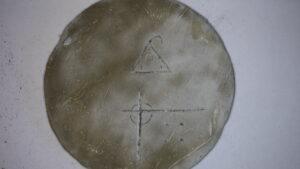
This Divinae Motum Orbis (denoted “la”) is believed to have been created around 1902 by Edith Van Dyne. According to her diaries, the Sensus Autem Huius Partis was added some 27 years later. The material for the Orbis was collected during a visit to her great uncle, Capt. Hugh Fitzgerald.
The reverse of the Orbis is notable in that the triangle is hooked, a detail on which Van Dyne declined to offer comment.
This is only a brief clip and is far from complete, so I am unable to comment on the outcome, but I thought it might be interesting to analyse the exchange a little.
Coach: “So Bex, given that we only have about 5 minutes to do this, is there some area that you feel you’d like to look at in terms of what you are feeling and what you are wanting?“
Client: “Umm… yeah, right now… umm… what is popping into my head is umm, my relationship with my mum at the moment.“
Client gives an example of the problem. Specifically, this is about the relationship with her mother. Within the realms of MoM we can expect the metaphor to take several possible forms. Classically, it may manifest as “The Hurts”, or if the relationship is about responsibilities, it may manifest as “The Burdens” and so on. At this stage, it is difficult to predict accurately. Being family related, there may well be “Containers” too. We simply don’t know yet.
The classic response to this statement might be, “What is this relationship with your mum like?” and to begin pushing for metaphor by shutting down The 4 Left Brain Responses of:
“How I feel about the relationship with my mum.”
“The consequences this relationship with my mum has upon my life.”
“Examples of this relationship.”
“My diagnosis of this relationship and the reason why it is the way that it is.”
Coach: “Perfect, trust that, trust that, so given your relationship with your mother, what are you feeling right now?”
This is an interesting response from the coach. He says to her that the information she has given him is “perfect” and that she should “trust that” information. This is interesting primarily because of what comes a few sentences later.
In MoM, we rarely ask for a feeling, unless we are seeking to ask for that feeling to be subsequently expressed in metaphor.
Client: “I feel that umm… she… umm… kind of works, work too hard, and she’s become negative and, you know, she is finding life really difficult at the moment, sort of working herself into an early grave.”
To use a bunch of words I don’t much like, the client is expressing a kinaesthetic that is a meta-report of the events. To put this simply, when it comes to bad stuff happening in our lives, there are several ways of feeling. To wit…
How we feel about the events that are happening (meta-position).
How the events happening make us feel (cause and effect).
How we feel at the time of the events (experiential).
How we remember feeling at the time of the events (recalled kinaesthetic).
Of course, there are more.
But my observation with therapists is that the vast majority never give this any consideration when working with clients, or even appear to have any awareness of these differences. For too many therapists, a feeling is just a feeling.
The question, “What are you feeling right now?” is quite ambiguous and has a huge assumption behind it. It reminds me of the question taught by some NLP schools when eliciting states. The client is asked, “Can you remember a time when you felt this feeling?” Before instructing the client to step into that time, feeling what they felt, seeing what they saw, and so on. When in reality, for some instances, “Can you remember a time when you felt this feeling?” The client may well answer yes, but have no kinaesthetic recall attached to it whatsoever.
“What are you feeling right now?”; feeling about what, specifically?
Coach: “Great, great, great, great, now notice when I asked you what is it that you are feeling you responded with what you are thinking, you shared thoughts, my mum is a worrier, etc, etc, etc. That is a very common thing that we do. We do not share what is really going on. We share what we are thinking. We stay in our heads. So just give yourself a moment to drop down, and see what is beneath the thoughts. In other words, what are you feeling when you have these thoughts running through your mind?”
Again, the coaches’ responses are interesting. Now obviously, he doesn’t think it is great, great, great, great that the client thinks her mum is going to an early death. He is congratulating her on giving him the responses that he wants. Worryingly, he is inadvertently coaching her on what responses to give him. The problem here is that previously he congratulated her on her “perfect” response, but now he is telling her that her responses and reported experiences were not actually valid. The indirect message here is that her trust was misplaced.
Now, there may be some validity here. After all, it is the daughter of the mum that is sat in front of the coach, not the mum herself. So the client can report as much of the behaviour of her mum as she likes, but the coach simply can’t do anything about that, so listing ever more of the mother’s behaviour would be pointless with regards to any change work.
But the client is asked to close her eyes and drop down to beneath the thoughts. So we are now in the analytical territory, the archaeological dig of the Freudians, who dig down deep into the subconscious to find what mysteries lurk deep within in order to bring them to the surface. A deeply faulted model of therapy that inevitably led to the excess of Recovered Memory Therapy, the Survivor Movement, and devastated lives and families worldwide. (As an aside, I note that in the past couple of years, there seems to have been a resurgence of this recovered memory nonsense, and the outcomes from this do not look at all good).
So, the feeling that the coach is seeking is quite specific. “… what are you feeling when you have these thoughts running through your mind?”
What he is asking for is number five to the above list:
5. How we notice ourselves feeling when we think about the events (a meta-meta kinaesthetic).
We can expect people to be able to report the most extreme states quite comfortably from this position. You’ve probably met phobics who can do this by talking about their phobic reactions in quite glorious funny terms, and they boast about how extreme they feel, and how people have to hold them down and so on. They can do this without showing the slightest hint of phobic response or fear.
Client: “I feel a lot of anxiety and worry.”
MoM trainees should be able to notice the use of “a lot” and now be aware of the emotional exchanges between her and her mother (hint: “The Fulfilments”).
Coach: “Great, great, great, now perfect, now when we connect to anxiety and worry, or when you just did, do you feel that is really the meat of the feeling is that… it? Or does it feel a bit flat?””
The connection metaphor is a common one with coaches and therapists. There is a sizeable amount of dissociation required to live this metaphor, and I have found it to be especially common in psychiatry. In simple terms, it looks like this.
A person exists as an independent entity.
A diagnosis or a bad feeling exists as an independent entity.
The person connects with this latter entity and now they “have it.”
The easiest example is that of “anorexia.” A person refuses food and does all that stuff that anorexics do. That person now “has” anorexia. The behavioural process is stripped out of the whole thing and the presenting problem now has the metaphoric structure of a non-contagious infectious disease (sic).
Many coaches and therapists of all disciplines learn to “distance themselves” from negative feelings as a coping strategy. From experience and observation, the long-term personal cost is high as the short-term gain is given higher priority at the cost of long-term well-being.
Additionally, he is also putting her into a simple bind between two alternatives. This should be immediately obvious to anyone familiar with Ericksonian hypnosis and NLP modelling thereof. Is it “flat”, or is it “meaty”?
The problem is that neither of the alternatives is particularly good or useful for the client. The client isn’t being asked about the quality of their experience, instead they are simply expected to shoehorn their experience into one of the two structures decided by the coach. But for what purpose? Let’s see…
Client: “It feels a bit flat.“
Coach: “Yeah, yeah, and the reason why is because often when we connect, the first thing that we feel is usually a cover emotion, things like boredom, impatience, confusion, doubt, worry, so if anxiety and worry really aren’t it. Close your eyes for a moment and drop, allow yourself to tune in and feel beneath the anxiety and worry. What’s actually there? Just give yourself a moment and see if you can feel… “
What we have here is simply inexcusable, and this is dangerous logic. To give an example that immediately springs to mind, back in the 80s and ’90s, lots of people were getting abducted by aliens all over the United States. What most of them had in common is that they had no idea that they had been abducted by aliens until they saw hypnotists or recovered memory therapists, and there were several high-profile hypnotists with best-selling books on alien abductions who, of course, were attractive to potential abductees.
Initially, “missing time” was an essential part of the abduction narrative. The hypnosis would then attempt to fill in the blanks and, hey presto, previously suppressed memories of aliens would emerge.
But not everyone reported missing time, so a new addition was required for the narrative.
“Screen memories” were added alongside “missing time”; the aliens would block the abduction memory by inserting innocuous memories of routine things or bunny rabbits in order to hide the abduction experience. Clever chaps, these aliens.
Along with the excesses that went with the recovered memory movement (alien abduction, satanic ritual abuse complete with the essential brood mares), more and more details were added to the narrative. “Screen emotions” became another, so did “multiple personality disorder” (MPD/DID), complete with “massive repression,” the spontaneous repression of traumatic memories and feelings. The trauma was so bad, that the brain blocked it. Aliens were thus rendered unnecessary to the process, and obscure and bogus psychological mechanisms took their place. Aliens were no longer sticking things up the bottoms of the abducted; Satanists were doing it instead. These days it’s those pesky Illuminati chaps that are doing it in the name of the New World Order.
So what’s happening in this session so far? Having been told that her responses were perfect and that she was to trust in that, coupled with a somewhat hypnotic sequence, she is now being told that her trust in her own feelings is misplaced. Her feelings are not her real feelings. The real feelings are yet to be discovered.
Remember, the presenting problem here is the concern the client has about the relationship with her mother (“mum “), who is basically working too hard and sounds like she might be a bit tired and irritable.
Client: crying “I feel a lot of guilt and a lot of fear…“
Now the client is emotional and feeling bad. In fact, she clearly is feeling a lot worse than she did right at the beginning. So, here is my question to the reader: without any intervention whatsoever, if the session ended right there and the coach simply got up and left, how long do you think this feeling would last for ? A minute or two? I doubt it would be for much longer.
How would she feel after these tears? A bit of relief, even if only temporary? I suspect so.
Coach: gesturing to self “I can feel that, yeah, that’s really powerful… now that feels a lot more meaty, right, you can feel that, I can see it.”
There’s empathy, there’s rapport, and then there is this. I’ll leave it to the reader to decide exactly what this is.
Again, he has made her initial experience invalid and reinforced his own “screen emotion” metaphor.
Client: “Yeah.”
Coach: “So you have identified it perfectly. Step one, complete. What is it that you want now in order to feel better?“
Any observations to add to this, or to my analysis? Please use the comments section below.
On The Correct Construction of Le Divinae Motum Orbis
The traveller is to construct a clay disc of between 10 to 25 cm in diameter (15 cm is best) and between 1 to 3 cm in thickness (1.5 cm is best).
The best clay is that which the traveller has dug himself and brought back from a foreign land (“ut quæ tibi domum“; literally: “That which we bring home”).
About the perimeter of the circle is inscribed: 666; hic manebimus optime; <triangle with a centre dot and a line with a side dot>; 777; Omne initium difficile; <square with centre dot and circle with centre dot>
The compass is to be situated off centre in the middle of the Orbis. The correct ratio of the Compass arms are:
Upward arm: 3
Downward arm: 2
Left and right arms: 1
About these arms are inscribed the letters: M M and A and Omega.
Outside of the Compass is to be an octagon. Outside each side of the octagon is to be inscribed the Sensus Autem Huius Partis(Literally, “The Sense of This Part”).
Outside, the lowest side is to be inscribed: 23 23/23.
The reverse of the Orbis is to be inscribed with an imperfect cross with the arms off centre, within which is an imperfect circle positioned off centre however the traveller chooses. Four points are to be inscribed within the realm of this cross, positioned however the traveller sees fit.
Above this cross is a triangle within which is an eye on its side and five dots, again placed according to the wishes of the traveller.
The clay is then to be sealed by heating with a mixture of one part olive oil and one part beeswax. The best olive oil is that which has been extracted by the traveller and the beeswax that is procured without harming a single bee.
Private instructions for consecration can then be given once the traveller has understood the meaning of this symbol.
I thought a quick analysis of this imagined exchange from a MoM perspective might be an interesting exercise:
Coach: “What would you like to have happen?
This is a nice ambiguous question and is something that can be either an outcome or a process.
Client: “I feel trapped.”
However, the client states a feeling that is expressed in metaphor/idiom, which is not a reply to the question. The client has answered the question, “What’s the problem?” but the referential index is missing. Trapped by the exchange with the therapist? Trapped by the soggy seat facing away from the door? And so on. But we can assume that the client is probably referring to their presenting problem, but this may not always be the case, of course.
Coach: “When you feel trapped, what would you like to have happen?”
Coach refers back to the outcome/process, incorporating the feeling of trapped.
Client: “I feel I’ve hit a brick wall, I want to get over the wall.”
Classically, the client experiences the wall as the presenting problem and not his coping behaviour. Getting over the wall is only one of many possibilities. MoM trainees will be aware of the other possibilities, including avoiding the wall, going through the wall, going around the wall, and so on.
We also know that the client’s current direction and momentum has led him to “hit” the wall. Thus, we have either “hit” as in he has punched it, or “hit” as in he has run into it. There are probably other less likely possibilities.
In the first scenario, he is punching it: we’d need to consider why exactly this man has violent tendencies to metaphoric walls (for example, he may have been taught to break down things that get in his way, or attended workshops that told him he was to be unstoppable). We also need to consider what this man hopes to achieve through this action.
In the second scenario, the man has been unstoppable… right up until something got in his way. He didn’t see it. This is someone who doesn’t pay much attention to where he is going and what is in front of him. This is someone who ignores outcomes, which is congruent with his responses to the first two questions.
Coach: “Is there anything else about getting over the wall?”
This reinforces the client’s failed solution to his situation, negates the problem of hitting walls and ignores the other possibilities that the client currently appears to be unaware of.
Client: “My friends are over the other side and I can’t get over the wall.”
There’s an obvious question here of how does he know they are the other side. Let’s assume they probably are both metaphorically and literally. This is his destination and the outcome is now defined. But we know from MoM that walls and related obstructions tend to reflect real-world obstacles, usually in the form of a primary negative injunctive (a rule that says “no”). The height of the obstruction, in this case, a wall, gives a clue as to the status level of that injunctive, and its location and orientation give an idea of its time frame (i.e., its place in time, i.e., behind: historical).
This is a wall in front. Presumably high enough that he can’t get over it. In order to get over this, he needs to raise/elevate himself (i.e., status increase), at least temporarily, in order to transcend this rule that currently gets in his way. We have to ask ourselves if this is a good thing or not.
At least he isn’t “breaking through” the wall, i.e. breaking the rule.
Coach: “What kind of wall?”
Symbolically, this is an important question, although I think that the import is lost in this instance. A solid wall of concrete is a single piece. Brick walls are made up of lots of small pieces. A clue: Think about how primary negative injunctives are formed…
Client: “Well, it’s got bricks and it is also surrounded by a small wall.”
There is a smaller, secondary injunctive.
Coach: “Is there anything else about the small wall?”
Client: “Well, it adds to the feeling of being trapped, but it’s made up of small bricks that I can break up and use, but that doesn’t help me though.”
At this point, it is worth mentioning the issue of “trapped” and “wall”. Go and stand behind a single wall, and see if you feel trapped. So we have a significant incongruency. In an MoM exchange, we’d have asked what was left, right, etc., and either this would have revealed itself, or would have presented as one of the 19 Boundary Violations.
The client’s strategy continues to fail, in that he thinks that he can change the metaphor by breaking up the smaller wall (presumably in the real world, he thinks that this injunctive can be broken down and used to his advantage). In the early levels of MoM, we leave the metaphor intact and don’t seek to change any aspect of it. We change the person’s coping behaviour, not the representation of their problem. In the higher levels, we begin to change the identity within the metaphor as well to something more congruent.
Coach: “When there are small bricks that you can break up and use, what happens to the big wall?”
The client’s flawed strategy for changing the metaphor is now reinforced by the coach.
Client: “Ah, there is an opening over there.”
Is the opening to the left or the right? This would be significant in terms of whether this is the right way forward or not. It might be something that is best left.
Coach: “When there is an opening over there, what happens next?”
Client: “I can see if I can use the bricks to get through.”
The client has switched strategy from trying to get over the wall to trying to go through the wall. Quite how they can do this by using smaller bricks isn’t revealed, but essentially not much has changed for this client. His strategy for dealing with rules that get in the way of his social life will remain as “The rules [primary negative injunctives] don’t apply to me.”
We can predict that such a client will leave the session feeling immediately empowered and with raised confidence. “I can do it!” will be his motto.
I shall leave it to the reader to ponder the implications of this.