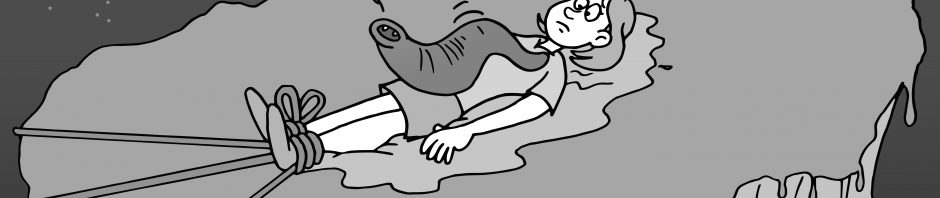

The Metaphor: “There is this fat leech on the centre of my chest and reaches the end of my torso, feels heavy and dense, and I can’t get rid of it. No matter what I do, it’s back.”
In front: “A vast empty dark sky.”
Behind: “Hard wet earth; my back is touching it; I am laying on it, but it’s floating as if in outer space.”
Left: “Empty space.”
Right: “Floating white misty thing.”
What about your hands and legs? “I can’t see my feet, but they seem tied by a rope; hands are by my side.”
The client ends her description with: “It seems like I’m banished from life.”
So, to begin with, some idioms:
- There’s something you might prefer to get off your chest.
- Something is sucking your lifeblood right out of you, and it is quite a burden.
- This thing has a life of its own, and it is taking yours.
- There is nothing left for you.
- There is nothing much right either.
- Nothing to look forward to.
- You are well grounded, but you are in the middle of nowhere.
- You cannot take any steps to change your position.
- You are not standing up for yourself or taking a stand in this situation.
- You are bound to stay where you are regarding this.
- You have not been able to let this go.
- Except for the parasite, you are all alone.
Metaphor taxonomies
Primarily, we have a burden metaphor (responsibilities) and an anthropomorphisation (the stereotype of a class of people).
The environmental metaphor is an interesting one. She is grounded in the immediate context but not in the greater context.
The “hard wet earth” she is on is not connected to the planet earth. The immediate context of the “hard wet earth” enables her to be disconnected from everyone else. This is actually the real issue, but of course, the client’s attention is likely to be preoccupied with the leech on her chest. I would suspect that she directs other people’s attention to this aspect of her experience too.
The rope around her legs is a partial container. Or is it? (Pro-tip: the rope isn’t actually there, it just seems like it.)
Time Predication
It has been my observation that the aspect of time in metaphor is the thing that is consistently overlooked by MoM trainees and yet is one of the most important things to consider. Consideration of time in metaphor will yield significant information about the client’s meta-strategies and time-oriented meta-programs.
It is clear from the metaphor that for the client in this context, time moves and she is still.
Ergo, she is passive to time. As such, she will be likely to display learned helplessness and hopelessness, passivity, and resistance to intervention. In working with such clients, the coach may begin to feel their own vital force and energy being sucked out of them. As I asked one such client recently, “Do other therapists find that working with you is about as rewarding as throwing gold coins into a black hole?”
Suggestions for change and attempts at getting the client to change what they are doing are likely to be defeated by the helplessness.
In this metaphor, the client cannot take any steps (feet tied with rope), cannot stand up for herself (leech on chest), and might even have trouble catching her breath (leech on chest). Trying to get her to handle this might be too difficult too. After all, who in their right mind wants to handle giant leeches?
It should be noted that her position on this floating patch of hard wet earth renders her to be a passive passenger in this situation. As such, she has no control over the outcome or where she, or the situation, is going.
The situation is, of course, the patch of hard dry earth, and the relationship is support between her and the leech. This situation is the background to this entire thing. (Behind: “Hard wet earth, my back is touching it, I am laying on it, but it’s floating as if in outer space.“)
Something to ponder: what else do we know about the background to the client’s problem?
Expecting her to take active control of this situation is unrealistic and, of course, would require her to change her orientation to time, which may not be something she is able to do. We would not be able to get her to switch to she moves, time is still. Think about the implications this would have on the situation.
People who are passive to time (they are still, time moves) will be waiting for “things” to change. As such, the coach will need to be the creator of change rather than attempt to empower the client in this situation.
Intervention
As per the reasons stated above, there is little to be gained in attempting to empower the client or getting her to change. Much can potentially be gained by utilising the natural orientations of the client. She is passive, so I’ll be taking charge. She is helpless, I don’t expect her help in resolving this.
Her support is currently very limited to the “hard wet earth”, and in turn, he is the full support (or even “life support”) for the people who leech off her. These people keep her down and prevent her from standing up for herself. She is simply not strong enough to do this, and any coach attempting to help her to do this might accidentally be arranging her very real murder.
When looking at a metaphor, it is important to ascertain the elements that are created by the client (feed-forward behaviours) and those which are responses to the real world (feedback behaviours). The environmental forces may be active (i.e., the sucking leech) or passive (i.e., the hard wet earth). These forces interact (pre-date (e.g., the hard wet earth) and pre-date (e.g., the leech)) with the client’s active/passive/reactive nature. The problem is that of predation. This is a genuine victim, not someone who merely thinks she is.
Based on her time orientation, we know she is passive. The active forces within the environment are predating on her. She is the victim of a blood-sucking predator, and it would be a grave mistake to underestimate the seriousness of this situation that the client is presenting. She has a blood-sucking predator in her life that is isolating her from the rest of the world, preventing her from standing up for herself, and it keeps her tied up and bound.
Now, imagine we are walking down a strange road, and we find this scene. It’s OK, we know exactly what to do, “Just grow up and stand up for yourself,” we tell her.” Does this sound like good advice?
Clearly, this is not a therapy problem.
So, real-world environmental intervention is required beyond that of the therapy office: support groups, refuge, lawyers, debt managers, mediators, men with baseball bats, that sort of thing.
This situation will not be resolved by asking her to stand up for herself or by using a humorous or provocative approach. Baseball bats first, then look at the humorous side. To do good therapy, it is important to get the sequence of things in the correct order.
In considering the status differential, I don’t perceive any elevation in the metaphor. This is more about being disconnected from the earth rather than elevated above it. So therefore, I’d treat her as a potential equal, but an equal that needs my help. I’d regard her as one of my tribe, and I’d be reintroducing her to my tribe. I know the right people, I know the sort of people who know how to deal with blood-sucking predatory leeches like the one/s in her life. These are the people in the real world that I’d be connecting her to.
Summary: this is not a therapy problem until the real-world situation has been resolved.